
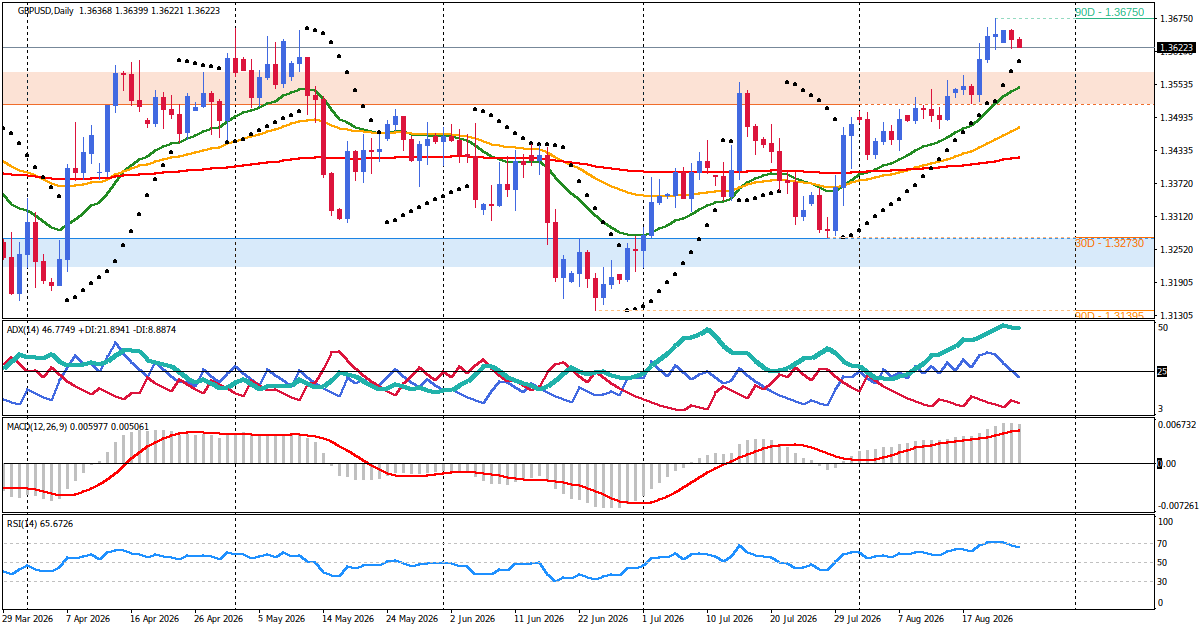
The GBP/USD pair maintains a bullish bias with medium confidence as the market navigates a complex transition between high-timeframe expansion and short-term exhaustion. While the daily and four-hour structures remain firmly aligned to the upside, the pair is currently grappling with intraday compression and signs of momentum divergence near multi-month peaks. The technical backdrop suggests a market in structural equilibrium, characterized by contracting volatility as participants look toward a heavy slate of North American economic catalysts to define the next directional leg. With the price hovering near overextended territory on daily oscillators, the immediate outlook is one of cautious consolidation with a heightened sensitivity to potential mean-reversion risks.
Technical Analysis
The technical market state is currently defined by a conflict between persistent long-term strength and immediate tactical fatigue. On the daily timeframe, the trend remains intensely bullish, supported by a multi-day advance that has pushed the pair toward the 1.3675 level. However, this move has left momentum indicators, such as the Relative Strength Index and Stochastic Oscillator, in deeply overbought territory. The price is currently hugging the upper Bollinger Band, a position that frequently precedes a corrective phase or a period of sideways "time-correction" to allow moving averages to catch up. The primary target for any mean reversion remains the 20-day Exponential Moving Average (EMA) near 1.3541.
On the four-hour (H4) timeframe, the trend intensity is more moderate. While the structure is still positive, the verticality of the recent rally has flattened. The pair is finding temporary support near the 1.3626 level, but the lack of follow-through toward new highs suggests a loss of immediate buying pressure. This cooling of momentum is even more evident on the hourly (H1) and thirty-minute (M30) timeframes, where the market has entered a state of structural compression. Volatility is contracting, and price action is characterized by narrow ranges and mixed candle signals. The M30 microstructure is currently testing lower Bollinger boundaries, signaling a reversal risk if buyers fail to defend the immediate intraday support zones.
Key Price Levels
The following technical zones are critical for determining the pair's near-term structural integrity:
- Resistance Zone 1 (1.3655 - 1.3675): This area represents the recent swing high and the daily Bollinger upper boundary. It serves as the primary ceiling for the current advance.
- Resistance Zone 2 (1.3637 - 1.3642): A localized cluster of the H4 Bollinger middle and H1 upper boundaries, acting as a pivot for intraday sentiment.
- Support Zone 1 (1.3620 - 1.3628): The most immediate defensive line for bulls, derived from recent intraday lows and the H1 Bollinger lower edge.
- Support Zone 2 (1.3577 - 1.3587): A more significant structural floor containing the Daily SAR and the H4 50-period EMA.
Fundamental Drivers
The fundamental backdrop for Cable is currently dominated by the relative policy outlooks of the Bank of England (BoE) and the Federal Reserve (Fed). While the British Pound has benefited from a resilient domestic growth narrative, the primary volatility drivers this week are centered on the US Dollar. Markets are closely monitoring the US inflation trajectory and labor market health to gauge the Fed's next steps.
Persistent drivers include the yield spread between UK Gilts and US Treasuries, which has recently favored the Pound, but this support is being challenged by a "wait-and-see" approach ahead of high-impact data. The macro narrative is currently in a state of partial support for the technical bullishness; while there is no immediate catalyst for a trend reversal, the lack of fresh UK-specific tailwinds makes the pair highly vulnerable to any resurgence in US Dollar demand should American economic data surprise to the upside.
Market Sentiment and Risk Environment
Broader market sentiment has been relatively supportive of risk-sensitive assets, as evidenced by recent highs in gold and elevated levels in digital assets. However, GBP/USD has entered a "quiet mode," reflecting a professional shift toward capital preservation ahead of potential volatility. Negative divergence in 14-day momentum and long upper shadows on recent daily candles indicate that the market's appetite for chasing the pair at current levels is diminishing. The risk environment is currently fragile; while safe-haven demand for the US Dollar is not dominant, any disappointment in the upcoming US data suite could quickly shift the mood from trend persistence to profit-taking and corrective liquidations.
Primary Scenario
The primary scenario anticipates a bullish rotation that aligns with the dominant high-timeframe trend. In this path, the pair successfully defends the 1.3620 support zone during the London or early New York sessions. A structural trigger would involve a clear rejection at this level, confirmed by a bullish engulfing or pin bar pattern on the M30 timeframe. If price acceptance is established above 1.3628, the market is likely to attempt a retest of the 1.3642 resistance and potentially the 1.3675 swing high. This scenario remains valid as long as there is no sustained hourly candle close below 1.3620, especially following the release of US consumer data.
Alternative Scenario
The alternative scenario considers a deeper corrective pullback if intraday support fails. A break and acceptance below the 1.3620 level would signal that the momentum loss on the H1 timeframe has transitioned into a broader structural failure. This would likely be catalyzed by stronger-than-expected US economic data, prompting an accelerated mean-reversion move. The target for this correction would be the Support Zone 2 near 1.3585, where the H4 50-period EMA resides. This scenario becomes the preferred interpretation if the market fails to recover quickly above 1.3630 following a support break.
Economic Calendar and Catalysts
The following events are expected to introduce significant volatility and may challenge the current technical structure (all times UTC):
- August 25, 14:00: US CB Consumer Confidence. Forecast: 90.3 (Previous: 90.8). This is the immediate catalyst for today's session and will likely dictate whether the 1.3620 support holds.
- August 26, 12:30: US Core PCE Price Index m/m. Forecast: 0.2% (Previous: 0.1%). As the Fed's preferred inflation gauge, this is a high-impact event for USD valuation.
- August 26, 12:30: US Prelim GDP q/q. Forecast: 1.5%. This will provide a critical update on the health of the US economy.
- August 28, 14:00: US Fed Chairman Warsh Speaks. This speech at the Jackson Hole symposium is the week's marquee event and could provide definitive signals on future interest rate paths.
Outlook
The outlook for GBP/USD is one of cautious consolidation within a broader bullish framework. While the primary trend remains intact, the combination of overbought technical conditions and a looming "wall" of US economic data suggests that the path of least resistance may involve a corrective dip or a sideways range before further gains can be realized. The balance of evidence currently favors range retention or a mild pullback rather than an immediate, aggressive breakout. Market participants should remain focused on the 1.3620 support level, as its preservation is essential for maintaining the current bullish integrity. Failure to hold this zone would shift the narrative toward a more significant structural reset as the market awaits the Federal Reserve's latest policy cues.
This is not personalized financial advice. The information is for educational purposes only and does not guarantee any future outcome.


