
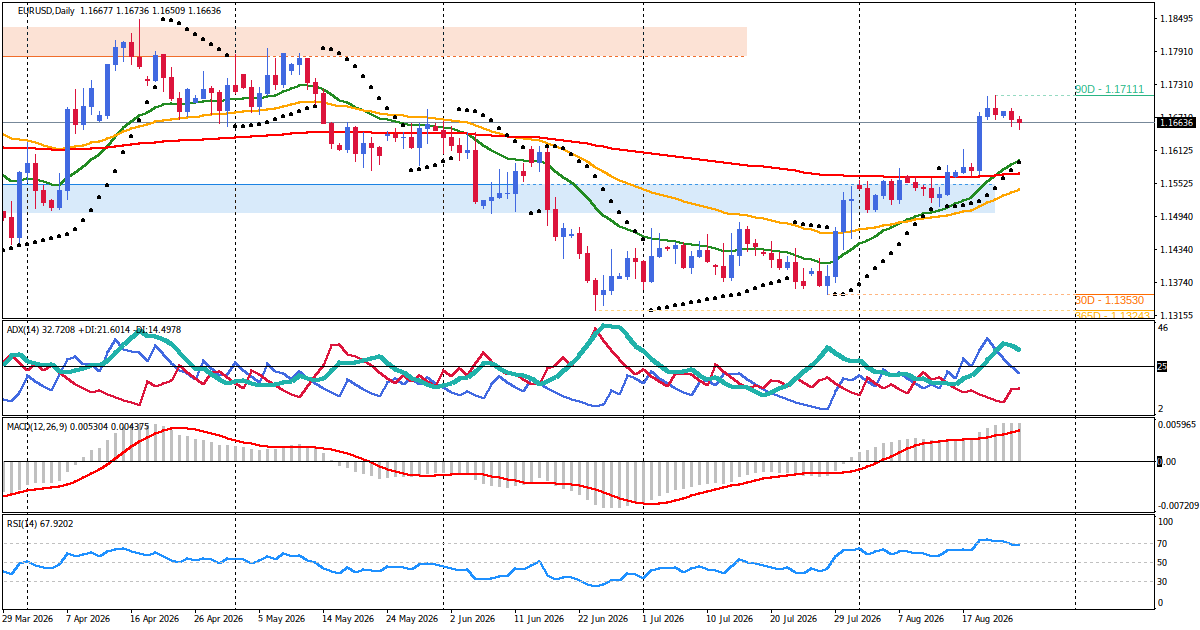
The EUR/USD pair currently exhibits a mixed technical bias with medium confidence, primarily driven by a structural conflict between higher and lower timeframes. While the daily (D1) chart shows a state of overbought exhaustion near multi-month highs, the four-hour (H4) framework suggests a potential reversal from oversold conditions. This technical tug-of-war is occurring against a backdrop of strengthening Eurozone economic sentiment, as evidenced by recent German IFO data, contrasted with a cautious market awaiting high-impact US inflation and growth figures. With volatility contracting on broader timeframes but remaining elevated on medium-term charts, the pair is locked in a period of compression, making it highly sensitive to the upcoming economic calendar.
Technical Analysis
The current technical market state for EUR/USD is characterized by range-bound consolidation and structural compression. On the daily timeframe, the pair maintains a dominant bullish trend but is showing signs of exhaustion. Momentum indicators such as the RSI are hovering near 69, while stochastic readings are stretched, suggesting that the move toward the 1.1687 resistance area may be reaching a temporary limit. Volatility on the D1 chart is contracting as price action settles into the upper half of the Bollinger Band range.
In contrast, the H4 framework reflects a recent corrective phase with high volatility, leaving the pair in an oversold state with stochastic readings below 15. This creates a "reversal risk" where the medium-term structure seeks to realign with the broader daily uptrend. Intraday price action on the H1 and M30 timeframes remains neutral, with the pair oscillating around the EMA200 at 1.1628 and the midline of its recent structure near 1.1661. Momentum is currently fragmented, lacking a clear directional driver as the market maintains a cautious posture within established boundaries.
Key Price Levels
The following technical zones represent the primary structural boundaries for current market participants:
- Resistance Zone 1 (1.1682 - 1.1687): This narrow 5-pip range is defined by the D1 high and opening price cluster, serving as the immediate ceiling for the current range.
- Resistance Zone 2 (1.1710 - 1.1711): A critical level representing the recent three-month swing high.
- Support Zone 1 (1.1651 - 1.1655): This zone aligns with recent H4 and D1 lows, acting as the primary floor for the intraday range.
- Support Zone 2 (1.1628 - 1.1630): A significant confluence area where the H1 EMA200 and the H4 EMA50 meet, providing a deeper structural anchor.
Fundamental Drivers
The fundamental backdrop for the Euro has improved following upbeat macroeconomic data from Germany. The IFO Business Climate Index rose to a one-year high of 88.8 in August, exceeding expectations and echoing recent improvements in PMI and ZEW surveys. Furthermore, the German GDP for the second quarter was revised upward to 0.3%, suggesting the Eurozone's largest economy is finding its footing. These factors have reinforced expectations for the European Central Bank (ECB) to resume rate hikes in September, a move currently priced in at approximately 95% by market participants.
Conversely, the US Dollar is facing a more complex policy environment. While US inflation remains above the Federal Reserve's 2% target, there are increasing risks of a dovish repricing. Market attention is fixed on the upcoming Jackson Hole Symposium and comments from Fed officials, which could shift expectations regarding the future path of US interest rates. A widening yield spread between the EU and US, fueled by the ECB’s hawkish lean and the Fed’s potential pause, remains a persistent underlying driver for the pair.
Market Sentiment and Risk Environment
Market sentiment is currently defined by an event-sensitive and cautious mood. While broader risk appetite has been supported by institutional demand in other asset classes, EUR/USD traders are largely sidelined ahead of the US Core PCE Price Index and the Jackson Hole summit. The pair is currently experiencing low volatility as it compresses within its technical range. However, the risk environment remains fragile due to external factors, including US Treasury liquidity support operations and energy price volatility, which could trigger sudden expansions in market volatility if economic data deviates significantly from forecasts.
Primary Scenario
The primary scenario anticipates continued horizontal oscillation within the established H1 range between 1.1655 and 1.1682. This path assumes that the conflict between D1 overbought signals and H4 oversold signals will prevent a sustained breakout in either direction until major US catalysts are released. For this scenario to remain valid, price action must continue to find rejection at the range edges (1.1682 resistance and 1.1655 support) without a sustained hourly close outside these boundaries. This scenario is most likely during the overlap of the London and New York sessions while the market awaits the US Consumer Confidence data.
Alternative Scenario
The alternative scenario involves a mean-reversion move developing on the H4 timeframe, driven by the current oversold momentum. In this path, the pair would achieve a bullish lean if it can secure an H1 close above the 1.1668 intraday pivot (EMA20). Such a move would signal a shift in short-term momentum, potentially leading the price toward the 1.1687 daily high. This scenario would likely gain traction if US economic data or Fed commentary triggers a dovish repricing of the US Dollar, allowing the Euro to capitalize on its recent positive economic surprises. An invalidation of this path would occur if the price breaks decisively below the 1.1651 support level.
Economic Calendar and Catalysts
The following high and medium-impact events are the primary catalysts for EUR/USD over the active calendar window:
- US CB Consumer Confidence (August 25): A key measure of consumer sentiment that could influence near-term US Dollar strength.
- US Core PCE Price Index & Prelim GDP (August 26): The Fed's preferred inflation gauge and revised growth data will be critical for shaping interest rate expectations.
- US Unemployment Claims (August 27): Provides a weekly snapshot of labor market health.
- US Fed Chairman Warsh Speaks (August 28): A high-impact event at the Jackson Hole Symposium that could clarify the Federal Reserve's policy stance.
- US Prelim Benchmark Payrolls Revision (August 28): Potential for significant volatility if there are major adjustments to historical labor data.
Outlook
The outlook for EUR/USD remains one of consolidation with unstable two-way risk in the immediate term. The balance of evidence suggests that while the broader trend favors the Euro due to supportive German data and ECB hike expectations, technical exhaustion on the daily timeframe and the looming US economic catalysts favor a "wait-and-see" approach. Confidence in any single directional move is limited by the current timeframe conflict and the potential for whipsaw action within the 1.1651–1.1687 compression zone. Traders should expect the pair to remain sensitive to the evolving US inflation narrative and central bank rhetoric throughout the remainder of the week.
This is not personalized financial advice. The information is for educational purposes only and does not guarantee any future outcome.


