
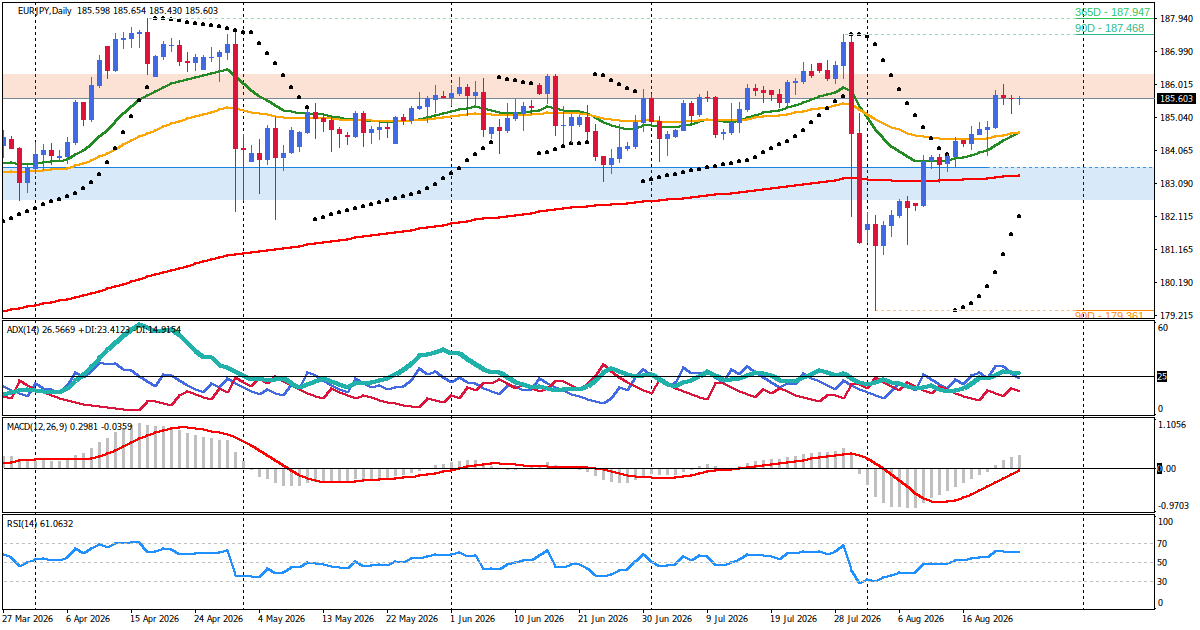
EUR/JPY enters the final week of August with a cautiously bullish technical bias but only medium confidence, and for good reason. The daily chart shows a late-stage uptrend that has stalled near 185.60 after pushing from a mid-August low near 183.92 to a swing high at 186.01, while the four-hour structure remains constructive and the short-term timeframes have compressed into a narrow range. At the same time, the fundamental backdrop has turned increasingly supportive for the yen: Japan's July inflation accelerated, market pricing now leans heavily toward a Bank of Japan rate hike in September, and the Germany-Japan yield spread has narrowed to a historically thin margin. The result is a two-way setup in which the technical path favors an eventual upside resolution, but the macro layer argues for caution and caps the bullish read until either the intraday compression resolves upward or a corrective break below 185.43/185.15 shifts the structure lower.
Technical Analysis
The dominant technical narrative is a high-level pause after a strong upward push. The daily structure is a late-stage uptrend with early signs of fatigue: price rallied from 183.92 to 186.01, but recent daily bars have settled around 185.60, producing a high-level stall. Trend direction is still bullish but flattening, trend strength is moderate, and the daily momentum profile is stretched after an extended run. The broader daily state is best described as reversal-risk within an uptrend.
The medium-term H4 framework is the most constructive layer. Price is holding above rising medium-term moving averages and successfully defended the 185.43 area after a dip. The four-hour trend remains up with positive momentum, and it aligns with the broader bullish bias, but it has not yet cleared the 185.65–185.79 supply zone that would confirm renewed directional intent. The short-term picture is altogether different: H1 is range-bound between roughly 185.46 and 185.65, M30 and M15 are compressing around 185.58–185.63, and the M5 microstructure is quiet near 185.60 with no breakout impulse. Volatility is high on D1 and H4 but contracting intraday, momentum is neutral on the shorter frames, and the market is essentially consolidating in the upper portion of its recent range rather than trending.
The weekly backdrop offers some support to the constructive read: the rally from 179.34 keeps initial bias toward 187.42, with a retest of 187.93 as the broader objective. Broader daily-chart commentary places the next significant upside marker near the Bollinger upper band at 187.35, while the 100-day SMA near 185.15 coincides with the lower demand shelf. The unresolved daily stall and flat H1 profile are the key technical caveats; the setup leaves room for both directions until price confirms a structural trigger.
Key Price Levels
The following zones are drawn from visible D1, H4 and H1 swing structure. Zone widths are approximate and follow the JPY pip convention of 0.010.
Resistance zones:
- Resistance 1: 185.63–185.66 — about 3 pips. Recent H4/H1 swing highs and supply zone.
- Resistance 2: 185.69–185.79 — about 10 pips. Prior H4 swing highs and intraday pivot cluster.
- Resistance 3: 185.83–186.02 — about 19 pips. Daily swing high and upper supply zone.
Support zones:
- Support 1: 185.43–185.46 — about 3 pips. Recent H4/H1 swing low and demand zone.
- Support 2: 185.15–185.19 — about 4 pips. Daily swing low and demand zone, reinforced by the 100-day SMA near 185.15.
- Support 3: 184.72–184.90 — about 18 pips. Prior daily support cluster.
Fundamental Drivers
The macro transmission mechanism for EUR/JPY is the narrowing Germany-Japan yield spread and the Bank of Japan's normalization path. The ECB held its deposit rate at 2.25% on July 23, while the BoJ held its policy rate at 1.0% on July 30, but the 10-year Bund-JGB spread has compressed to roughly 34 basis points. A spread that thin materially reduces the euro's carry advantage and makes the cross increasingly sensitive to incoming Japanese data and global risk sentiment rather than to nominal rate differentials alone.
Japan's July inflation data, released late last week, reinforced the normalization narrative: headline CPI rose to 1.9% year-on-year from 1.6%, while core CPI accelerated to 1.8% from 1.6%. Markets moved quickly, pricing roughly 82% odds of a September BoJ hike, up from about 23% before the BoJ's July meeting. A hawkish signal from BoJ Deputy Governor Ryozo Himino on Thursday, or a firm Tokyo inflation print on Friday, would intensify yen demand. The euro side is more balanced: Eurozone inflation is expected at 2.9% in July, keeping a September ECB hike on the table, and August flash PMIs showed a resilient economy with the composite at 52.1 and manufacturing output at its strongest in four and a half years. That resilience limits how far euro weakness can run, but the directional pressure this week is tilted toward the yen. Intervention risk also remains a background factor, with Japanese authorities sensitive to disorderly moves in the cross.
The fundamental layer therefore provides only partial support for the technically bullish read, and in some respects conflicts with it. The structural 1–6 month view is conditionally bearish to neutral for EUR/JPY as BoJ normalization compresses the carry differential, while the tactical macro view leans against upside continuation heading into the September BoJ meeting. This does not override the technical framework, but it caps confidence and raises the stakes for the upcoming JPY catalysts.
Market Sentiment and Risk Environment
Sentiment around EUR/JPY is increasingly fragile in a way that favors the yen. Safe-haven demand for JPY remains available if geopolitical tensions escalate; the Middle East situation continues to generate headline risk, and any risk-off impulse tends to accelerate yen repatriation flows. The carry dynamic has also shifted: with the Germany-Japan 10-year spread near historical lows, the pair no longer offers the structural carry bid that previously supported dips. That said, the euro remains supported by resilient Eurozone growth and sticky inflation, and softer USD conditions stemming from the US Treasury's buyback program have helped keep global risk appetite from deteriorating sharply. On balance, the environment complicates rather than reinforces the bullish technical setup; it does not preclude extension, but it makes the upside path more dependent on follow-through confirmation.
Primary Scenario
The primary scenario remains a bullish continuation once the intraday compression resolves upward. The trigger is a sustained move above 185.66 followed by acceptance through the 185.69–185.79 supply zone; confirmation would be follow-through above 185.83 and a hold above 185.58 on a retest. From there, the H4 structure would drive price toward the 185.83–186.02 daily supply zone, with the upper H4 band near 186.22 as the outer boundary. A London-session push after Asian compression would be the natural session context, and overlap liquidity may be needed to fuel the breakout. The scenario would remain valid as long as price holds above 185.43; a break below 185.15 would invalidate it. From a macro perspective, this path would be more credible if the BoJ's Thursday commentary sounds cautious about the pace of hikes, or if global risk appetite remains firm.
Alternative Scenario
The credible alternative is a corrective rejection from nearby supply that converts the intraday range into a distribution pattern. If price fails at the 185.65–185.79 zone and then loses 185.43, the daily reversal-risk label gains weight. A close below 185.15 would confirm the daily correction and open a deeper path toward the 184.72–184.90 demand cluster, with interim support at 185.15–185.19. This scenario aligns with the macro backdrop: a hawkish message from BoJ Deputy Governor Himino, a firm Tokyo CPI reading, or a risk-off shift in global sentiment could all trigger yen strength. A recovery and close above 185.79 would invalidate the corrective path. In effect, the alternative scenario is the macro-consistent path, while the primary scenario is the technically consistent path; the pair currently sits between them awaiting a trigger.
Economic Calendar and Catalysts
The direct EUR/JPY calendar is quiet this week, but two JPY-specific catalysts and several secondary USD events create a fragile event window. The pair is entering this stretch in a compressed state, which raises the sensitivity of the response.
- August 25, 14:00 UTC — US Consumer Confidence (Medium; forecast 90.3, previous 90.8). A secondary sentiment data point with modest spillover potential for global risk flows.
- August 26, 12:30 UTC — US Core PCE Price Index (High; forecast 0.2% month-on-month, previous 0.1%) and US Preliminary GDP (High; forecast 1.5%, previous 1.5%). Not direct EUR/JPY releases, but they can shift global yields and risk appetite at a moment when the pair is compressed.
- August 27, Thursday — BoJ Deputy Governor Ryozo Himino speech. A direct JPY event; hawkish remarks on the pace of rate hikes could support the yen and challenge the bullish technical setup.
- August 27, 23:30 UTC — Japan Tokyo Core CPI year-on-year (Medium; forecast 1.8%, previous 1.9%). The first regional inflation read ahead of the September BoJ meeting; a firm print would reinforce tightening bets.
- August 28, 14:00 UTC — US Preliminary Benchmark Payrolls Revision (High) and Fed Chairman Warsh speech (High). Broad risk catalysts late in the week that could trigger position adjustment.
Outlook
EUR/JPY is at a compression point that demands evidence, not anticipation. The technical structure favors a cautious bullish bias with medium confidence, but the daily stall, flat H1 profile, and high-level reversal risk mean the bullish read depends on a confirmed break of 185.66–185.79 with follow-through. The macro backdrop leans the other way: BoJ normalization, a narrowing yield spread, and heightened yen sensitivity make the corrective path the more macro-consistent route into the September BoJ meeting. The balance of evidence therefore points to an unstable two-way setup rather than a clean directional call in the near term. The dominant tension is continuation versus pullback: a decisive move above the supply zone restores the uptrend toward 186.02 and beyond, while loss of 185.43 opens a correction toward 184.72–184.90. Confidence is capped by the conflicted technical and policy signals, and the compressed intraday structure means the market's response to this week's JPY catalysts will likely set the tone into month-end.
Disclaimer: This is not personalized financial advice. The information is for educational purposes only and does not guarantee any future outcome.


