
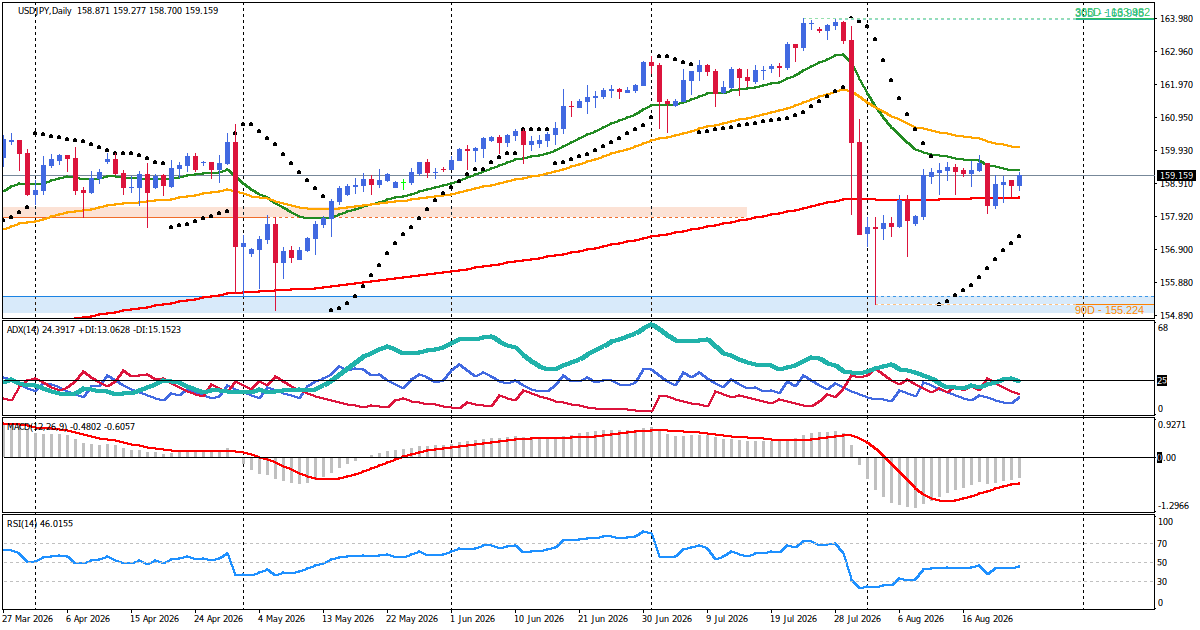
The USD/JPY pair is currently characterized by a neutral bias with medium confidence, reflecting a lack of structural alignment across major timeframes. The market is in a state of compression and range-bound movement, with volatility contracting on the daily, four-hour, and hourly horizons. While higher timeframe momentum remains lean-bearish, intraday price action is stable and lacks a clear directional driver as participants await high-impact US economic releases later this week. This technical standoff is occurring against a fundamental backdrop where the wide yield differential between the Federal Reserve and the Bank of Japan continues to support the Dollar, even as the memory of recent massive Japanese interventions and the psychological 160.00 level cap the upside.
Technical Analysis
The primary technical map for USD/JPY shows a market trapped in a structural compression phase. On the daily (D1) timeframe, the trend is mixed with moderate strength. Momentum remains bearish, as indicated by the MACD staying in negative territory, yet price action is currently hovering near the midline of the Bollinger Bands. A critical anchor for the current structure is the 200-day Exponential Moving Average (EMA) at 158.477, which has acted as a floor during the recent consolidation phase following heavy downside pressure in late July.
In the medium-term (H4) framework, the trend is flat with no established directional strength. Price action is compressed within the Bollinger Bands, and momentum is currently stretched into overbought territory, suggesting a risk of mean reversion toward the range's center. The lack of follow-through above the 159.20 level indicates that the market is struggling to maintain upward momentum. Short-term intraday charts (H1 and M30) further reinforce this compression state, with volatility contracting around the 159.092 midline. The current environment is dormant and characterized by low liquidity, making the pair sensitive to upcoming US economic catalysts.
Key Price Levels
- Resistance Zone 1: 159.210 to 159.280 — Based on recent H4 swing highs and Bollinger Band resistance.
- Resistance Zone 2: 159.410 to 159.550 — Defined by daily swing highs and the H4 upper Bollinger area.
- Support Zone 1: 158.890 to 158.990 — A cluster of H1/H4 Exponential Moving Averages and recent intraday lows.
- Support Zone 2: 158.470 to 158.550 — Aligning with the 200-day EMA and psychological support near the recent daily low.
Fundamental Drivers
The fundamental narrative is a tug-of-war between a persistent interest rate differential and the threat of Japanese government intervention. The Federal Reserve maintains a target range of 3.50% to 3.75%, while the Bank of Japan (BoJ) holds its policy rate at 1.00%. This yield gap of approximately 1.8 percentage points on the 10-year maturity remains a powerful magnet for carry trade flows, essentially rewarding investors for holding Dollars against the Yen. Recent data suggests that Japanese institutional investors have used the lower exchange rates following July's intervention as an entry point for foreign asset purchases, rather than a signal to exit.
However, the Bank of Japan is closely monitoring inflation risks, particularly those stemming from energy prices and Middle East tensions. While Tokyo Core CPI is forecast to ease slightly to 1.8% from 1.9%, any hawkish surprise could revive expectations for a September or October rate hike. Conversely, the US calendar is packed with "top-tier" data, including the Core PCE Price Index and Preliminary GDP, which will be instrumental in defining the Federal Reserve's interest rate trajectory for the remainder of the year.
Market Sentiment and Risk Environment
Market sentiment is currently influenced by a broad safe-haven bid for the US Dollar, driven by an escalation in geopolitical tensions and new sanctions regarding Iran. This environment typically complicates the Yen's traditional role as a safe haven, as the Dollar often benefits more directly from yield-seeking behavior during periods of global uncertainty. The technical state of "contracting volatility" suggests that the market is coiled, increasing the risk of a sharp breakout if economic data deviates significantly from forecasts. Furthermore, the proximity of the 160.00 level serves as a "red line" for many traders, as it is the zone where intervention risk is perceived to re-arm.
Primary Scenario: Range Rotation
In the primary scenario, the market is expected to maintain its current compression within the H4 and H1 boundaries. Price may rotate toward the upper resistance zones but is likely to fail in achieving sustained acceptance above 159.28. This would lead to a return toward the intraday midline as the market remains in a "wait-and-see" mode ahead of the US Core PCE release. This scenario remains valid as long as there is no decisive H4 candle closure above 159.35 and the US Consumer Confidence data does not trigger a massive shift in sentiment.
Alternative Scenario: Bearish Continuation
The alternative scenario involves a bearish breakout that aligns the intraday structure with the broader D1 bearish momentum. If USD/JPY fails to hold the immediate support cluster at 158.89, it would likely trigger a test of the major daily support floor near 158.47. A confirmation of this path would be a H1 break-and-retest of the 158.89 zone as resistance. This path would most likely be catalyzed by a downside surprise in US GDP or PCE data, or a hawkish shift in tone from Japanese policymakers regarding the inflation outlook.
Economic Calendar and Catalysts
- August 25, 14:00 UTC: US CB Consumer Confidence (Forecast: 90.3, Previous: 90.8) — Potential for intraday volatility shifts based on US consumer sentiment.
- August 26, 12:30 UTC: US Core PCE Price Index (Forecast: 0.2% MoM) and Prelim GDP (Forecast: 1.5%) — High-impact catalysts for interest rate expectations.
- August 27, 23:30 UTC: Japan Tokyo Core CPI (Forecast: 1.8%, Previous: 1.9%) — Critical for assessing the Bank of Japan's hike potential.
- August 28, 14:00 UTC: US Fed Chairman Speech — A major event for defining the medium-term outlook for the US Dollar.
Outlook
The outlook for USD/JPY remains neutral and consolidated in the near term. The balance of evidence suggests that while the carry trade provides a structural floor, the technical overhead resistance and the looming US data window prevent a clear bullish run. The market is currently characterized by low confluence quality as timeframes are not aligned in a single direction. Consequently, the most likely path is continued two-way risk within the identified 158.50 to 159.50 range. A decisive breach of the 200-day EMA or the 160.00 psychological level will be required to shift the market out of its current state of compression.
Disclaimer: This is not personalized financial advice. The information is for educational purposes only and does not guarantee any future outcome.


