
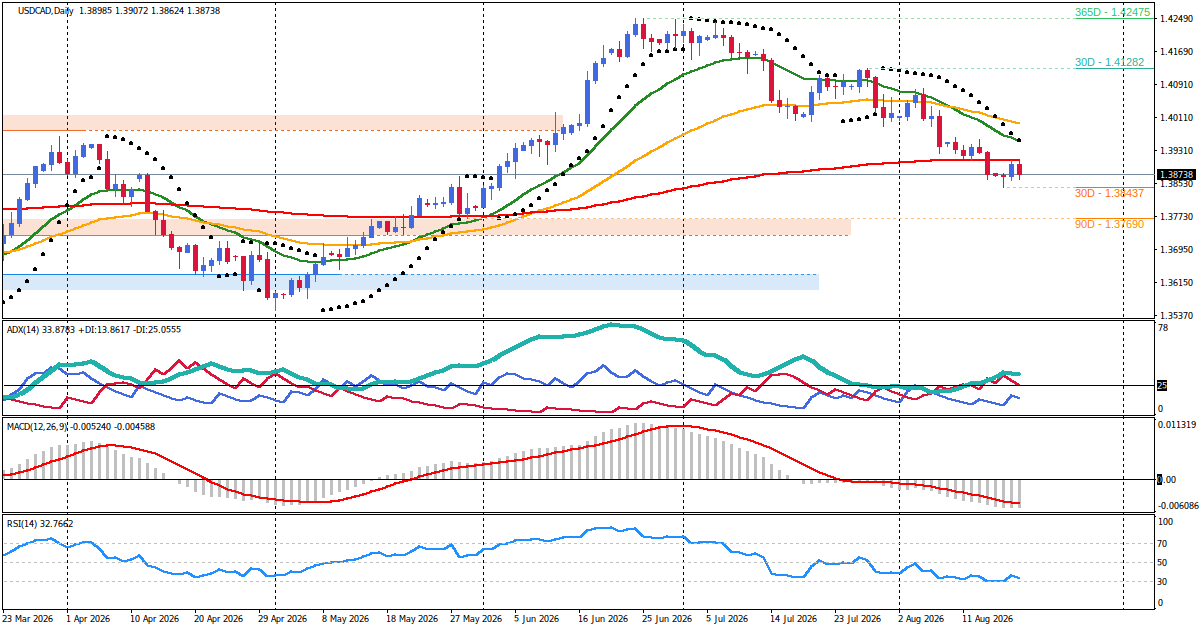
The USD/CAD pair is currently exhibiting a strong bearish bias with high confidence, driven by a rare alignment across the daily, four-hour, and hourly timeframes. The market structure is characterized by expanding volatility and a consistent series of lower highs and lower lows, indicating a transition from a broad multi-month range into a decisive downward expansion. While the technical framework is firmly negative, the fundamental backdrop provides a complex overlay; the Canadian Dollar has found temporary relief from a three-day pause in proposed U.S. tariffs, while the U.S. Dollar remains sensitive to "higher-for-longer" interest rate expectations ahead of the latest FOMC meeting minutes. Despite oversold intraday conditions, the path of least resistance remains lower as price action presses against critical support confluences near 1.3830.
Technical Analysis
The technical state of USD/CAD is defined by a high-conviction bearish expansion. On the daily (D1) chart, the pair has transitioned from a narrowing formation into a strong downward move, supported by a high ADX reading of 34.67, which signals a robust trend. Momentum is firmly bearish, with the Relative Strength Index (RSI) at 35.54, approaching but not yet fully exhausting its move into oversold territory. The pair continues to trade significantly below its 20-day and 50-day Exponential Moving Averages (EMAs), suggesting that any short-term rallies are currently viewed as corrective opportunities within a dominant bearish cycle.
In the medium-term (H4) framework, the trend is even more aggressive, capped by a descending EMA stack that confirms persistent supply pressure. Volatility is in an expanding regime, with price action currently hovering near the midline of its recent descent. On the intraday (H1 and M30) timeframes, the bearish momentum is reaching extreme levels, evidenced by a Stochastic reading of 15.35 on the H1 interval. This creates a state of technical "stretch," suggesting a risk of localized mean reversion or brief consolidation as the market builds energy for the next directional break. The current intraday pattern is one of "break-and-retest," where prior minor supports are being tested as new resistance levels.
Key Price Levels
The following technical zones are established based on recent swing structures and moving average clusters:
- Resistance Zone 1: 1.3883 - 1.3898 (H4 swing high and D1 prior close confluence).
- Resistance Zone 2: 1.3907 - 1.3918 (Recent H4 peak and H1 EMA200 area).
- Support Zone 1: 1.3860 - 1.3867 (Recent D1 low and H1 structural floor).
- Support Zone 2: 1.3829 - 1.3844 (D1 Bollinger Band lower limit and prior multi-day swing low).
Fundamental Drivers
The fundamental narrative for USD/CAD is currently a tug-of-war between central bank policy paths and shifting trade dynamics. In the United States, market participants are focused on the FOMC Meeting Minutes. Investors are looking for clarity on whether the Federal Reserve will prioritize cooling labor market momentum or persistent inflation risks. Current market pricing favors a "higher-for-longer" regime, with a significant probability that the benchmark rate will remain in the 3.50%–3.75% range through September.
In Canada, the Bank of Canada (BoC) faces a mixed inflationary environment. While headline CPI accelerated to 3.0% in July due to volatile energy costs, the preferred core metrics (CPI-Median and CPI-Trim) remained muted at approximately 1.9% to 2.0%. This suggests that underlying price pressures are contained, leading to expectations that the BoC will hold rates steady at 2.25% in its upcoming September meeting. Additionally, the Canadian Dollar received a sentiment boost after U.S. President Donald Trump announced a three-day pause on a planned 50% tariff on Canadian products. While this delay reduces immediate shock, the lack of a comprehensive trade reset keeps the long-term outlook for the Loonie cautious.
Market Sentiment and Risk Environment
Market sentiment is currently characterized by "deadline relief" regarding North American trade, though the muted reaction in the Canadian Dollar suggests that investors are reserving judgment until a formal agreement is signed. The broader risk environment is also influenced by commodity linkages; Brent crude oil prices near $87 and WTI near $81 provide underlying terms-of-trade support for the Canadian Dollar, complicating the USD's ability to reclaim higher ground. However, the market remains in a state of high event fragility. The upcoming FOMC minutes represent a major catalyst that could either accelerate the current bearish technical trend or trigger a sharp reversal if the Fed's tone is perceived as unexpectedly hawkish or concerned about labor weakness.
Primary Scenario
The primary scenario is a bearish continuation. Under this path, the pair maintains its structural alignment and breaks below the immediate support zone at 1.3860. Acceptance below this level, confirmed by an H1 candle close and sustained bearish momentum, would likely lead to a test of the deeper daily support levels near 1.3830. This scenario remains valid as long as the price stays below the 1.3885 resistance area. The session context for this move is expected to be the London/New York overlap, particularly as the market absorbs the volatility from the FOMC minutes.
Alternative Scenario
The alternative scenario involves a corrective mean reversion. Given the oversold state of intraday momentum indicators (RSI and Stochastic), a rejection at the 1.3860 floor could trigger a relief rally. Confirmation for this path would require an RSI rotation out of oversold territory on the H1 and M30 timeframes and a break above the M30 EMA20. This could lead to a corrective pullback toward the 1.3898 resistance area or the H4 EMA20. This scenario would likely be favored if U.S. economic commentary is perceived as neutral or if trade signatures are finalized earlier than expected.
Economic Calendar and Catalysts
The following high and medium-impact events are the primary catalysts for the active window:
- 19 August, 18:00 UTC: US FOMC Meeting Minutes (High Impact) – Crucial for determining the USD's yield advantage and policy trajectory.
- 19 August, 18:30 UTC: US Presidential Remarks (Medium Impact) – Potential for further updates on the U.S.-Canada trade and tariff situation.
- 20 August, 01:30 UTC: AU Employment Data (High Impact) – Relevant for broader global risk sentiment which often impacts USD/CAD volatility.
- 20 August, 12:30 UTC: US Philly Fed Manufacturing Index & Unemployment Claims (Medium Impact) – Key indicators for the health of the U.S. economy and labor market.
Outlook
The outlook for USD/CAD remains tilted to the downside, supported by a high degree of timeframe alignment and a strong bearish momentum regime. While the three-day tariff pause has removed an immediate tail risk for the Canadian Dollar, the market is now in a "wait-and-see" mode regarding the finality of trade agreements and the Fed's internal policy debate. The technical "stretch" on intraday charts suggests that while the primary trend is down, the journey toward the 1.3830 support zone may involve periods of consolidation or sharp, news-driven volatility. Traders should monitor the 1.3860 support level closely, as a decisive break there would likely signal the next leg of the bearish expansion.
Disclaimer: This is not personalized financial advice. The information is for educational purposes only and does not guarantee any future outcome.


