
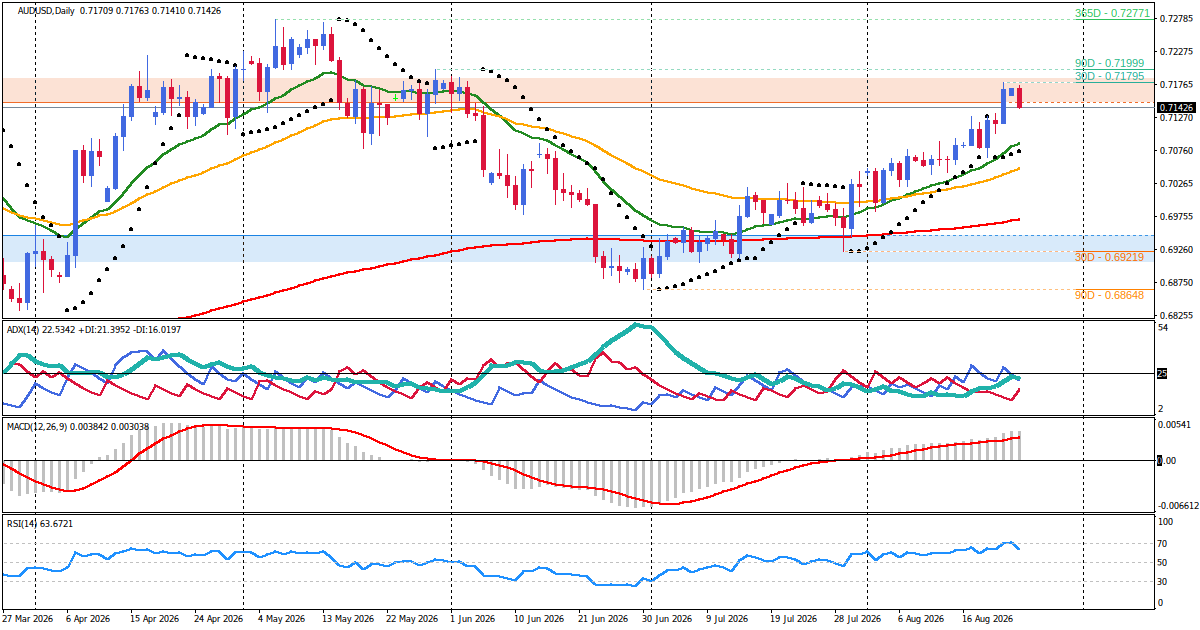
AUD/USD carries a bullish higher-timeframe bias with medium confidence entering the week of August 24-30, but the internal structure is messy: the daily and four-hour charts favor the upside, while the hourly frame is in a sharp corrective decline after a stretched daily advance, leaving cross-timeframe alignment weak. Intraday volatility is expanding, short-term momentum is oversold, and price is pressing just below the 0.7171-0.7180 supply zone that capped last week's rally into multi-month high territory. The macro backdrop is only a partial ally — the RBA-Fed yield differential and recovering Fed-cut pricing support the Australian dollar, while falling iron ore and a cooling Australian labor market cap conviction. The August 26 pairing of Australian CPI with US core PCE and preliminary GDP makes this an event-sensitive window in which the corrective pullback must prove itself.
Technical Analysis
The top-level bias is bullish with medium confidence, but the quality of the setup is constrained by weak near-term alignment. Daily and four-hour structures remain directional up, while the hourly chart is in a sharp corrective decline, leaving the evidence mixed near term. This is best described as a corrective pullback inside a broader uptrend rather than a confirmed reversal. The daily swing is stretched, the intraday move has expanded lower, and the high-impact calendar ahead of August 26 adds fragility to the tape.
On the daily chart, price recovered from the 0.7079 and 0.7066 lows, printed a strong bullish session toward 0.7180, and closed narrowly near 0.7171. Momentum is stretched: the advance has extended beyond the upper Bollinger band into overbought territory, a sign of extension rather than fresh impulse, and volatility is expanding. The daily swing is now testing the upper portion of a broader range, with the 0.7171-0.7180 zone as the key overhead supply and the primary barrier to further upside progress.
The four-hour picture confirms the uptrend with moderate strength but signals a corrective pause. The latest completed four-hour bar is a bearish pullback from 0.7167 to near 0.7150; momentum remains bullish yet cooling, volatility is contracting, and price still holds above the 0.7143 moving-average cluster. The intraday leader is the hourly chart, which closed near 0.71423, below the lower band, with deeply oversold momentum — a stretched down-move rather than an established downtrend. Lower timeframes show early stabilization: the 30-minute chart tagged 0.71398 and recovered to 0.71497, the 15-minute chart is consolidating in a 0.7146-0.7150 range, and the five-minute microstructure is quiet near 0.7147, consistent with base-building. The short-term corrective decline weakens the broader bullish bias but does not overturn it.
Risk assessment is mixed: confluence quality is medium, momentum quality is weak, and volatility is expanding intraday while contracting on H4 and stretched on D1. With headline risk from the week's data, execution conditions are fragile and the structure demands confirmation rather than presumption.
Key Price Levels
Zones are derived from daily, four-hour and hourly swing structure; widths are approximate on a 0.0001 pip scale.
Resistance zones:
- Resistance 1: 0.7150 - 0.7157, about 7 pips, prior swing and EMA area; the hourly shelf that must be reclaimed to restore bullish continuation.
- Resistance 2: 0.7162 - 0.7168, about 6 pips, prior swing highs with Bollinger context.
- Resistance 3: 0.7171 - 0.7180, about 9 pips, daily and four-hour supply zone; the key overhead barrier at the upper portion of the broader range.
Support zones:
- Support 1: 0.7139 - 0.7143, about 4 pips, recent low and the immediate demand zone.
- Support 2: 0.7122 - 0.7135, about 13 pips, daily swing and moving-average confluence.
- Support 3: 0.7066 - 0.7081, about 15 pips, August lows and deeper demand.
Fundamental Drivers
The dominant macro force remains the RBA-Fed policy differential. The Reserve Bank of Australia left the cash rate at 4.35% in August, a unanimous hold with a clearly hawkish tone; Governor Bullock described policy as restrictive and tight and stated that the board did not discuss a rate cut, with only a hike or hold considered. Australian ten-year yields near 4.99% remain above US ten-year yields near 4.70%, providing a structural yield advantage and positive carry for the Australian dollar. The Federal Reserve, by contrast, held its target range at 3.50%-3.75% in July, and despite hawkish meeting minutes, markets have re-priced a higher probability of a September cut back into the 60%-70% range as US data cooled.
That rate support is offset by two forces. First, the commodity cycle is deteriorating: iron ore has fallen to roughly $95 per tonne on subdued Chinese demand, reducing Australia's export income and terms of trade. Second, the Australian labor market is cooling — July employment declined by 15,800 and the unemployment rate rose to 4.5%, the highest since late 2021. Sticky inflation, with June headline at 3.8% and core measures near 3.6%, keeps the RBA confined to a higher-for-longer stance, but softer labor data limits the case for additional tightening.
The macro backdrop therefore only partially reinforces the technical structure. The rate differential and recovering Fed-cut pricing support the higher-timeframe bullish bias, but the commodity drag and cooling labor market cap conviction. The mid-August fundamental framework anticipated a 0.7000-0.7150 trading band; price has already pressed to the upper edge of that band and is now probing 0.7171-0.7180, meaning a sustainable breakout would likely require the commodity headwind to fade. The constructive macro case would be invalidated by an aggressive iron ore breakdown toward the $85-$90 area, a US inflation re-acceleration forcing a hawkish Fed hold, or a sharp deterioration in Australian domestic data that forces an RBA pivot.
Market Sentiment and Risk Environment
The broader risk environment is a partial tailwind. The US dollar entered the week still down roughly 2.6% over one month, and Monday's rebound reads more as consolidation after an extended selloff than as evidence of a trend reversal. Markets have been looking past the hawkish July FOMC minutes toward cooler inflation and labor data, which supports the risk-sensitive Australian dollar and its positive carry. The complication is the AUD's high sensitivity to commodities and China-linked growth expectations: weak iron ore and subdued Chinese demand drag on the commodity leg of the AUD story even as the yield spread supports it.
Geopolitical risk adds another layer. The US Treasury's Iran sanctions announcement on August 24 keeps oil and broader risk tone sensitive, and a broad risk-off move would likely revive USD safe-haven demand and cap AUD upside. Into the August 26 data cluster, the technical backdrop of stretched daily momentum, oversold hourly oscillators, and quiet low-timeframe base-building suggests cautious positioning rather than aggressive conviction, leaving the pair vulnerable to two-way headline swings.
Primary Scenario
The primary path treats the current decline as a corrective pullback within the broader uptrend, conditional on buyers defending the low zone and reclaiming the hourly shelf.
- Structural trigger: defense of the 0.7139-0.7143 demand zone and a reclaim of the 0.7150-0.7157 shelf.
- Confirmation: an hourly close above 0.7150 with 30-minute momentum turning up.
- Structure path: a higher low near 0.7139-0.7143, followed by a push through 0.7162-0.7168 toward a retest of the 0.7171-0.7180 supply zone.
- Context: cautious positioning into August 26 data; a firm Australian CPI would reinforce the RBA's hawkish-hold narrative, while a cool US core PCE reading would support Fed-cut pricing and the AUD upside bias.
- Invalidation: a sustained hourly close below 0.7139.
Alternative Scenario
The alternative path is a deeper correction, activated if the stretched daily condition allows a larger retracement and the hourly shelf fails.
- Structural trigger: failure at the 0.7150-0.7157 resistance area followed by an hourly close below 0.7139.
- Confirmation: a decisive break of 0.7139 with a 30-minute close below it.
- Structure path: extension toward 0.7122-0.7135, then 0.7118, with deeper demand at 0.7066-0.7081.
- Favored by: a hot US core PCE reading, an upside US GDP surprise, hawkish late-week Fed commentary, an iron ore breakdown below $90, or an RBA minutes release that reveals a comfortable hold rather than a near-miss hike, fading some of the hawkish premium.
- Invalidation: reclaim of 0.7162.
Economic Calendar and Catalysts
The week's highest-impact catalysts are concentrated in a dense 36-hour window, and the market enters it with weak cross-timeframe alignment and a stretched daily structure, so two-way volatility risk is elevated.
- Asian session, August 25: RBA August meeting minutes. Market commentary expects the account to show how close the unanimous hold at 4.35% came to a hike; a near-miss narrative would support AUD and Australian yields, while a more comfortable hold would soften the hawkish premium.
- August 25, 14:00 UTC: US Conference Board consumer confidence (medium), forecast 90.3 versus 90.8 — a consumption pulse ahead of the core PCE print.
- August 26, 01:30 UTC: Australian CPI monthly (high), forecast 0.9% versus -0.1%; Australian CPI yearly (high), forecast 3.3% versus 3.8%; Australian trimmed mean CPI monthly (high), forecast 0.3% versus 0.3% — the first official July inflation read and a direct input to the RBA narrative.
- August 26, 12:30 UTC: US core PCE price index month-over-month (high), forecast 0.2% versus 0.1%; US preliminary GDP quarter-over-quarter (high), forecast 1.5% versus 1.5%; US preliminary GDP price index (medium), forecast 6.2% versus 6.2% — the Fed's preferred inflation gauge plus a growth snapshot that will shape September policy expectations and USD direction.
- August 27, 12:30 UTC: US initial unemployment claims (medium), forecast 208K versus 206K — a labor-market pulse in the post-data window.
- August 28, 14:00 UTC: Federal Reserve Chairman Warsh speaks (high impact), with the preliminary benchmark payrolls revision (high, previous -911K) and revised University of Michigan sentiment and inflation expectations (medium) also due — late-week policy and labor-market risk that can extend or reverse the week's AUD/USD move.
Recent context also matters: the US Treasury Secretary's August 24 appearance at 18:00 UTC framed the Iran sanctions risk that keeps oil and broader risk tone sensitive for the rest of the week.
Outlook
The balance of evidence favors a corrective pause within a broader uptrend rather than a confirmed reversal, but the setup is not clean. Daily and four-hour structure remain constructive, and the RBA-Fed divergence plus recovering Fed-cut pricing argue for dip support near 0.7139-0.7143. However, the daily swing is stretched, hourly momentum is oversold, commodity prices are dragging, and the August 26 data pairing can quickly shift the narrative. Confidence is therefore capped at medium, with the dominant tension being continuation versus deeper correction. Reclaiming the 0.7150-0.7157 shelf would reopen the path toward 0.7171-0.7180, while a sustained break below 0.7139 would expose 0.7122-0.7135 and eventually the 0.7066-0.7081 August demand zone. The most credible near-term resolution is elevated two-way volatility around the data, with the technical evidence favoring higher-timeframe continuation if the low zone holds.
Disclaimer: This is not personalized financial advice. The information is for educational purposes only and does not guarantee any future outcome.


