
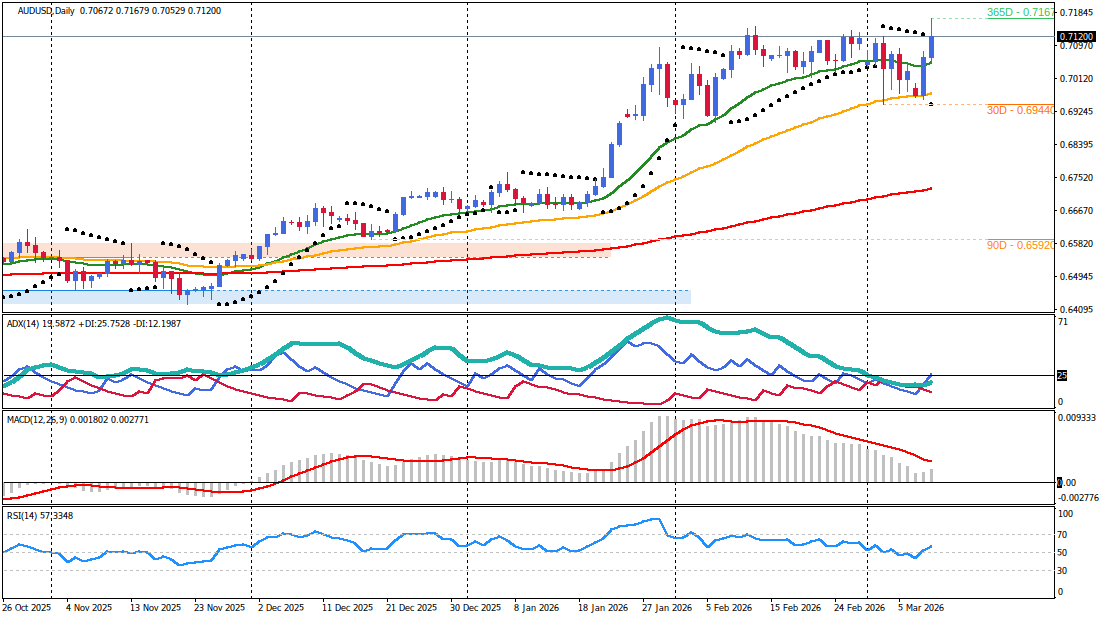
The AUD/USD currency pair maintains a dominant bullish structural profile across higher timeframes, recently reaching a three-year peak of 0.7168. This technical breakout aligns with a shifting fundamental backdrop characterized by increasing speculation regarding a Reserve Bank of Australia (RBA) interest rate hike at the upcoming March meeting. While the primary trend remains positive, price action is currently undergoing a corrective phase as market participants digest the impact of rising oil prices and geopolitical tensions in the Middle East. Technical structure combined with hawkish rhetoric from RBA Deputy Governor Andrew Hauser supports the case for trend persistence, though immediate headwinds from a strengthening US Dollar ahead of critical inflation data necessitate a cautious approach to entry levels. The current market view favors buying structural dips as long as the pair remains above the 0.7100 psychological threshold.
Technical Analysis
Multi-Timeframe Market Structure
The primary trend on the Daily (D1) timeframe is decisively bullish, defined by a consistent series of higher highs and higher lows. Price remains positioned comfortably above the 20-day, 50-day, and 200-day Exponential Moving Averages (EMAs), confirming long-term upward pressure. Although the Average Directional Index (ADX) indicates the trend is still in a developing stage, the MACD remains in positive territory, suggesting that the broader upward trajectory is intact. Fundamental drivers, specifically the "Petrodollar" trade and commodity demand, provide the necessary tailwinds for this long-term structure.
On the four-hour (H4) framework, medium-term momentum is robust, highlighted by an ADX reading above 34. However, a sharp reversal from the 0.7168 peak indicates a temporary exhaustion of buyers and a shift into a corrective pullback phase. The Stochastic oscillator is retreating from overbought territory, signaling that the pair requires a period of mean reversion toward key supports before attempting another leg higher. This technical cooling-off period aligns with market uncertainty ahead of top-tier US economic releases.
The intraday perspective (H1/M30) shows a bearish shift in immediate momentum as price breaks below recent consolidation lows. However, with the M30 Stochastic reaching deeply oversold levels below 11, the immediate selling pressure appears overextended. A period of stabilization near 0.7110 is expected during the Asian session, providing a potential floor for the next bullish rotation.
Critical Price Levels & Momentum Assessment
The technical landscape is defined by the following key levels which serve as primary markers for trend continuation or reversal:
- Resistance 0.7168: The recent three-year high and current H4 rejection point. A daily close above this level is required to open the path toward 0.7200.
- Resistance 0.7200: A major psychological barrier and structural target.
- Resistance 0.7245: Static resistance derived from historical price action in mid-2022.
- Support 0.7110: Immediate intraday support coinciding with the H1 EMA20.
- Support 0.7070: A high-confluence zone featuring the H4 EMA20 and EMA50.
- Support 0.7053: The primary structural floor and March 10 low, aligned with the D1 EMA20.
Fundamental Market Drivers
Central Bank Policy & Economic Outlook
The Reserve Bank of Australia is currently the primary driver of Aussie strength. Recent signals from RBA Deputy Governor Andrew Hauser indicate a "genuine debate" is likely at the March policy meeting. This hawkish shift is fueled by concerns that inflation remains too high, with headline figures projected to reach 4.2% by June. The recent surge in global oil prices, linked to Middle East conflicts, adds significant upside risk to these inflation forecasts. If oil prices persist near the USD 100 level, the RBA may be forced into a more aggressive tightening cycle than previously anticipated.
This policy outlook creates a clear divergence with other major central banks. While the market monitors the Federal Reserve's response to US inflation, the RBA’s potential for a "hawkish surprise" provides a fundamental floor for AUD/USD. Australia's status as a resource-rich nation further enhances this outlook; as a major exporter of iron ore, the Australian economy benefits from higher commodity prices and a positive trade balance. The health of the Chinese economy remains a critical variable, as increased demand for raw materials from Australia’s largest trading partner directly boosts the value of the AUD.
Market Sentiment & Risk Environment
The current risk environment is dominated by the US-Iran-Israel conflict, which has introduced extreme volatility into energy markets. Traditionally, the AUD is viewed as a "risk-on" currency that thrives when global sentiment is positive. However, the current "Petrodollar" dynamic—where firms require more USD to purchase high-priced oil—has created a complex environment where the USD and AUD can occasionally move in tandem against other currencies.
Risk-off sentiment generally triggers safe-haven flows into the US Dollar, which can weigh on AUD/USD in the short term. However, the underlying strength in commodity prices acts as a buffer for the Aussie. Technical consolidation currently reflects this tug-of-war between geopolitical risk and domestic hawkishness. Traders are closely monitoring whether the safe-haven demand for the Greenback will overshadow the RBA’s tightening narrative as the US inflation data approaches.
Integrated Trading Execution
Primary Trading Scenario
- Bias: Bullish trend persistence following a corrective pullback.
- Trigger/Entry: Long entries are favored on a successful test of the 0.7110 support zone, confirmed by price stabilization on the M30 timeframe.
- Stop-Loss: 0.7085, placed below immediate intraday liquidity to protect against volatility spikes.
- Profit Targets:
- Target 1: 0.7160 - Re-test of the recent swing high and H4 rejection zone.
- Target 2: 0.7190 - Proximity to the 0.7200 psychological resistance level.
- Session Context: This setup is most viable during the London session open, provided price action stabilizes during the preceding Asian session.
Alternative Market Scenario
- Invalidation: A decisive H1 close below the 0.7110 level, suggesting a failure of immediate buyers.
- Bias: Bearish intraday correction toward deeper structural support.
- Trigger/Entry: Short positions may be considered on a break of the 0.7100 handle.
- Stop-Loss: 0.7125, above the failed support-turned-resistance.
- Profit Targets:
- Target 1: 0.7070 - Alignment with the H4 EMA20 and EMA50 confluence.
- Target 2: 0.7053 - The primary structural floor at the D1 EMA20.
- Session Context: This scenario is more likely if US Dollar strength intensifies due to safe-haven flows or pre-CPI positioning.
Risk Management & Catalyst Analysis
Trade Risk Assessment
The primary risk to the bullish thesis is the heavy cluster of US economic data scheduled for the remainder of the week. High-impact news can override technical structures, leading to rapid stop-hunting or trend reversals. Position sizing should be managed carefully using the H1 Average True Range (ATR) of approximately 20 pips. A stop-loss protocol of 1.25x ATR is recommended to navigate the current volatility. Furthermore, it is prudent to reduce exposure by 50% ahead of the US CPI release to mitigate the risk of slippage and extreme price gaps.
Economic Calendar & Event Impact
- US CPI and Core CPI m/m (Tomorrow, 12:30 UTC): Forecast 0.3% and 0.2% respectively - This is the most critical catalyst for USD direction and will heavily impact AUD/USD technical validity.
- US Unemployment Claims (March 12, 12:30 UTC): Forecast 214K, Previous 213K - Key labor market indicator that will influence Fed policy expectations.
- US Core PCE Price Index m/m (March 13, 12:30 UTC): Forecast 0.4%, Previous 0.4% - The Fed's preferred inflation gauge; a higher-than-expected reading could trigger a sharp AUD/USD sell-off.
- US Prelim GDP q/q (March 13, 12:30 UTC): Forecast 1.5%, Previous 1.4% - Broad measure of economic health impacting overall USD sentiment.
- US JOLTS Job Openings (March 13, 14:00 UTC): Forecast 6.79M, Previous 6.54M - Provides insight into labor demand and potential wage inflation.
Synthesized Market Outlook
The AUD/USD pair remains in a strong technical uptrend, but it has reached a junction where fundamental catalysts will dictate the next major move. The confluence of RBA rate hike speculation and high commodity prices aligns with the bullish technical framework to favor a "buy the dip" strategy at the 0.7110 and 0.7070 levels. However, the impending US inflation data represents a significant hurdle. A hotter-than-expected CPI print would likely strengthen the USD, potentially forcing a deeper correction toward the 0.7053 structural floor. Conversely, any signs of cooling US inflation combined with continued hawkishness from the RBA would likely propel the pair beyond 0.7168 toward the 0.7250 target. Traders should monitor the 0.7100 level as a pivotal filter for near-term direction; staying above this level maintains the immediate bullish bias, while a break below shifts the focus to broader consolidation.


