
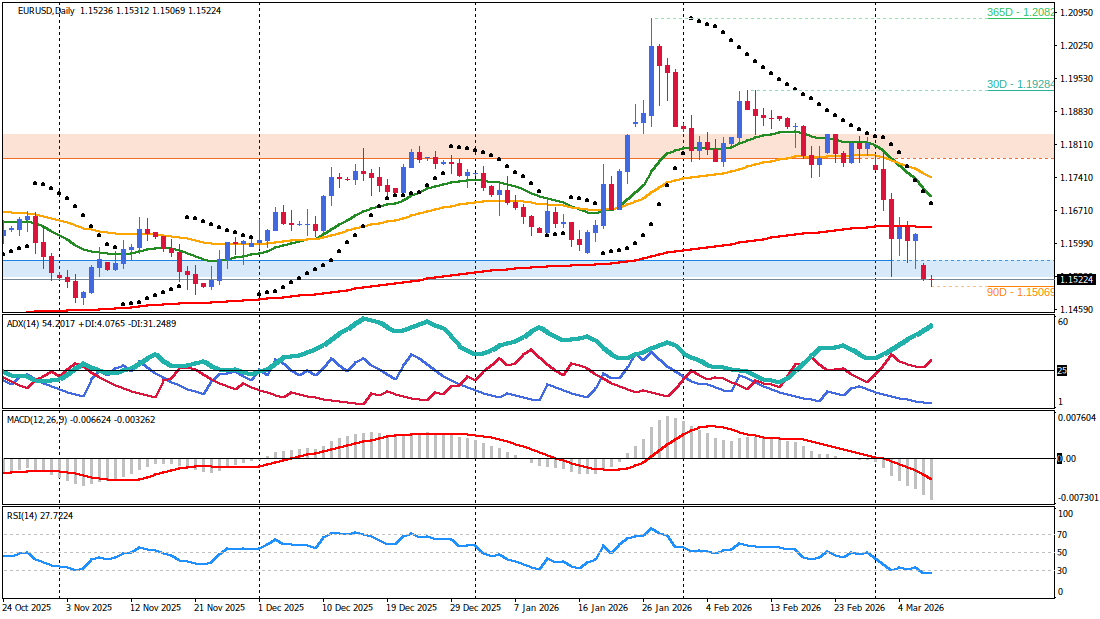
The EUR/USD pair remains locked in a decisive bearish trend as of March 9, 2026, driven by a potent combination of technical breakdown and a deteriorating fundamental backdrop. While the pair is attempting a modest intraday corrective bounce toward 1.1550 during the London session, the broader market structure is firmly controlled by sellers. This technical weakness is fundamentally reinforced by escalating hostilities in the Middle East, specifically the Iran conflict, which has propelled crude oil prices above $115 per barrel. These geopolitical tensions have triggered a broad "risk-off" sentiment, favoring the US Dollar as a premier safe-haven asset while simultaneously pressuring the Euro due to the Eurozone's sensitivity to energy price shocks. Technical structure combined with the current risk-averse environment supports a "sell the rallies" approach, with market participants closely monitoring the upcoming US Consumer Price Index (CPI) data as the next major catalyst for directional conviction.
Technical Analysis
Multi-Timeframe Market Structure
The primary market structure on the daily (D1) timeframe is aggressively bearish. Price action remains confined within a well-defined descending channel, trading significantly below its 9-day, 20-day, 50-day, and 200-day Exponential Moving Averages (EMAs). The 14-day Relative Strength Index (RSI) has slipped below the 30 threshold, indicating oversold conditions; however, the lack of a bullish divergence suggests that the trend has not yet reached an exhaustion phase. The Average Directional Index (ADX) reading above 50 confirms an exceptionally strong trend, suggesting that any upward moves are corrective rather than structural reversals.
On the four-hour (H4) chart, the medium-term framework exhibits a persistent series of lower highs and lower lows. The H4 EMA20, currently situated at 1.1595, serves as a critical dynamic resistance level. Until this level is reclaimed on a closing basis, the path of least resistance remains skewed to the downside. The intraday H1 and M30 timeframes show a period of stabilization between 1.1550 and 1.1570, but this bounce lacks significant volume conviction, characterizing it as a technical reset of oversold oscillators rather than a genuine shift in sentiment.
Critical Price Levels & Momentum Assessment
The technical landscape identifies several pivotal levels that will dictate near-term price action. Fundamental headwinds from the energy sector increase the significance of support levels as targets for the ongoing bearish cycle.
- Resistance 1: 1.1580 – This level aligns with the H1 EMA50 and the recent consolidation ceiling, representing the first hurdle for any relief rally.
- Resistance 2: 1.1595 - 1.1615 – A major confluence zone featuring the H4 EMA20 and the M30 EMA200. A failure to break this zone would reinforce the bearish bias.
- Resistance 3: 1.1633 – The D1 EMA200, which serves as a major structural pivot and a long-term trend indicator.
- Support 1: 1.1521 – The previous daily low and a psychological support level where buyers have recently attempted to stall the decline.
- Support 2: 1.1468 – The seven-month low and a critical structural support that, if broken, could accelerate selling toward 1.1430.
- Support 3: 1.1353 – The 38.2% Fibonacci retracement of the 1.0176 to 1.2081 move, serving as a primary medium-term downside target.
Fundamental Market Drivers
Central Bank Policy & Economic Outlook
The fundamental divergence between the Federal Reserve and the European Central Bank (ECB) remains a primary driver of EUR/USD weakness. While the market awaits fresh US inflation data, the overall resilience of the US economy compared to the Eurozone’s energy-vulnerable industrial base continues to support the US Dollar. The ECB faces a challenging environment where persistent geopolitical risks and high energy costs complicate the inflation outlook, potentially limiting the central bank's room for hawkish maneuvers if growth continues to stagnate.
The economic outlook for the Eurozone is currently dampened by the rapid escalation of the Middle East conflict. With crude oil prices surging, fears of "stagflation" are resurfacing, as higher energy costs act as a tax on consumers and businesses alike. This fundamental backdrop aligns with the technical bearish structure, as the Euro struggles to find buyers in an environment of increasing economic uncertainty and rising import costs.
Market Sentiment & Risk Environment
Risk sentiment is currently dominated by the "war premium" in commodities and the flight to safety. The Iran conflict has transformed the market landscape, making the US Dollar the preferred destination for capital seeking protection. This risk-off environment is visible in the poor performance of risk-correlated assets and the Euro's inability to sustain recoveries despite being technically oversold.
Market positioning reflects this caution, with traders reducing exposure to the Euro ahead of the heavy US data calendar. The sentiment is further weighed down by the Eurozone Sentix Investor Confidence data, which remains at levels suggesting tepid optimism. As long as the geopolitical situation remains volatile, the technical scenarios favoring the downside carry a higher probability of success due to the fundamental alignment of safe-haven demand.
Integrated Trading Execution
Primary Trading Scenario
- Bias: Bearish, favoring trend continuation on corrective rallies.
- Trigger/Entry: Short positions are preferred on a corrective rally into the 1.1580 to 1.1600 zone, seeking bearish confirmation on the M30 timeframe.
- Stop-Loss: 1.1635, placed above the D1 EMA200 to protect against a structural shift.
- Profit Targets:
- Target 1: 1.1525 – Near the recent daily low and psychological support.
- Target 2: 1.1505 – Aiming for a test of the psychological 1.1500 handle and recent swing lows.
- Session Context: Execution is best suited for the London session or the London/New York overlap to utilize peak daily liquidity.
Alternative Market Scenario
- Invalidation: A sustained break and H4 close above the 1.1615 resistance zone.
- Bias: Neutral to Bullish correction, suggesting a deeper relief rally.
- Trigger/Entry: Long positions on a confirmed M30 close above 1.1615 with momentum support.
- Stop-Loss: 1.1585, below the broken resistance-turned-support.
- Profit Targets:
- Target 1: 1.1650 – Aligning with the nine-day EMA.
- Target 2: 1.1680 – A prior structural consolidation level.
- Session Context: This scenario would likely require a significant de-escalation in geopolitical tensions or a major miss in US economic data.
Risk Management & Catalyst Analysis
Trade Risk Assessment
The primary risk to the bearish thesis is the oversold nature of the pair, as indicated by the RSI. A "short squeeze" could occur if geopolitical tensions ease unexpectedly or if US inflation data comes in significantly lower than forecast. Additionally, the transition between trading sessions often produces volatility spikes or "stop hunts" near the 1.1570 level. Traders should utilize the H1 ATR of 24 pips to calibrate position sizing, applying a 1.5x ATR buffer for stop-loss placement to mitigate noise.
Economic Calendar & Event Impact
The upcoming economic calendar is heavily weighted toward US data, which will serve as the final arbiter for the USD's strength this week.
- US CPI m/m, y/y (March 11, 12:30 UTC): Forecast 2.5% y/y, Previous 2.4% - The most critical event of the week; higher-than-expected inflation will likely cement the bearish EUR/USD trend.
- US Unemployment Claims (March 12, 12:30 UTC): Forecast 216K, Previous 213K - A key measure of labor market resilience; a low number supports the USD.
- US Core PCE Price Index m/m (March 13, 12:30 UTC): Forecast 0.4%, Previous 0.4% - The Fed's preferred inflation gauge; will drive end-of-week volatility.
- US Prelim GDP q/q (March 13, 12:30 UTC): Forecast 1.4%, Previous 1.4% - Essential for assessing the overall health of the US economy relative to the Eurozone.
- US JOLTS Job Openings (March 13, 14:00 UTC): Forecast 6.84M, Previous 6.54M - Provides insight into labor demand and potential wage pressure.
Synthesized Market Outlook
The EUR/USD outlook remains predominantly bearish as the pair grapples with a formidable combination of technical resistance and fundamental headwinds. The technical breakdown below 1.1600 aligns with the fundamental narrative of US Dollar dominance, fueled by safe-haven flows and a widening economic disparity between the US and the Eurozone. While intraday oversold conditions may spark brief periods of consolidation or minor bounces, these should be viewed as opportunities for trend-aligned entries rather than signs of a reversal. Monitoring the 1.1580-1.1600 resistance zone is essential for technical confirmation, while the March 11 US CPI release stands as the ultimate fundamental hurdle that will determine if the pair reaches its medium-term target of 1.1353.


