
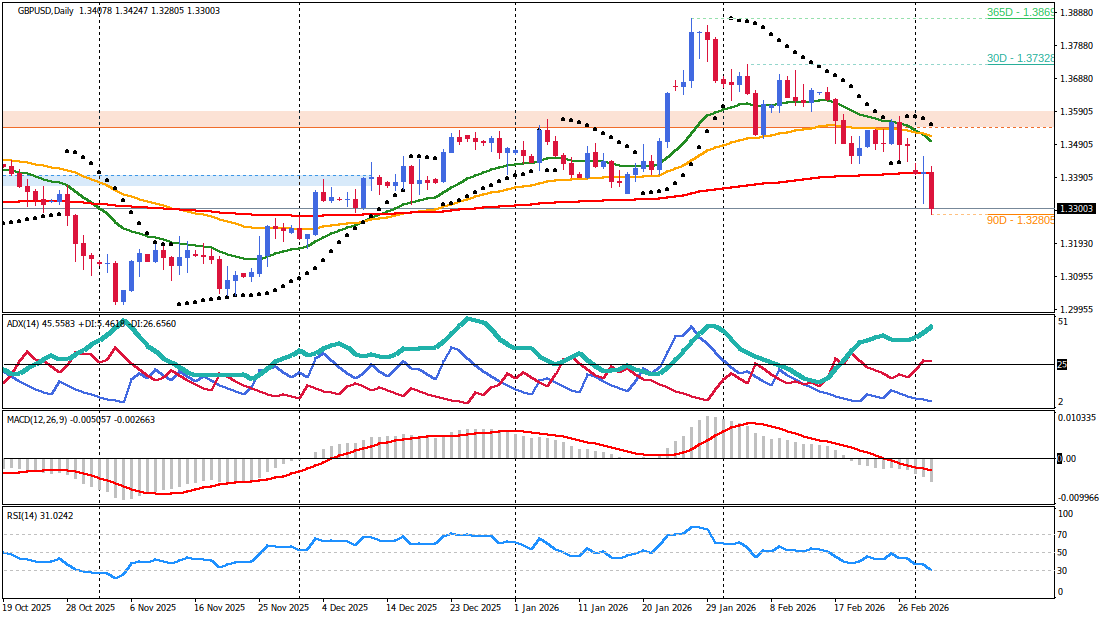
The GBP/USD pair exhibits a decisively bearish technical structure following a clean break below the critical 1.3400 psychological handle and the 200-day exponential moving average. This technical deterioration aligns with a worsening fundamental backdrop in the United Kingdom, where the economy faces acute stagflation risks. Surging energy prices, driven by geopolitical instability in the Middle East and disruptions to the global oil supply chain, are fueling inflationary pressures that threaten to keep the Bank of England (BoE) on a hawkish path despite stagnant economic growth. While technical indicators suggest the pair is currently oversold, the combination of a resilient US labor market and deteriorating UK macroeconomic conditions supports a "sell the rally" environment. Investors have significantly pared back expectations for a March interest rate cut from the BoE, with market pricing shifting toward a pause as headline inflation remains stubbornly above the 2% target. The path of least resistance remains lower as the market prepares for a cluster of high-impact US employment data that could further bolster the US Dollar's dominance.
Technical Analysis
Multi-Timeframe Market Structure
The primary technical trend on the daily (D1) timeframe is firmly bearish. The decisive close below the 200-day EMA at 1.3402 has fundamentally altered the long-term structure, shifting the pair from a corrective phase into a primary bearish trend. This move is validated by an ADX reading of 45.72, which confirms high trend intensity. Although the RSI has dipped to 30.36, signaling oversold conditions, the fundamental pressure of stagflation risks suggests that technical oversold readings may persist as the market seeks a new structural floor.
On the H4 framework, the pair continues to trade well below the H4 EMA20 (1.3408), which now acts as a formidable dynamic resistance. The significant gap between the current price and the EMA50 at 1.3465 illustrates the velocity of the recent sell-off. While a minor mean-reversion move toward 1.3345 is technically possible, the H4 stochastic levels at 11.40 reflect extreme bearish pressure that likely limits the scope of any recovery. The intraday H1 and M30 timeframes show a consistent pattern of lower highs and lower lows, with an ADX of 54.16 on the M30 chart highlighting extreme trend strength during the recent descent toward 1.3285.
Critical Price Levels & Momentum Assessment
The technical structure identifies several key levels that will dictate near-term price action. The transition of the 1.3400-1.3410 zone from support to major structural resistance is the most significant development, as this area now aligns with the D1 EMA200 and H4 EMA20. Momentum quality is currently rated as strong, with moving averages across multiple timeframes aligned in a descending "fan" formation, a classic signal of high-conviction bearish momentum.
- Resistance Levels:
- 1.3345: H1 EMA20 and primary intraday pivot zone.
- 1.3405: Confluence of D1 EMA200 and H4 EMA20; the "line in the sand" for the bearish thesis.
- 1.3465: H4 EMA50 and previous swing high.
- Support Levels:
- 1.3262: Recent session low and immediate downside target.
- 1.3200: Major psychological level and 38.2% Fibonacci retracement of the 1.2099 to 1.3867 rise.
- 1.3150: Structural support from previous price action cycles.
Fundamental Market Drivers
Central Bank Policy & Economic Outlook
The fundamental narrative for the Pound Sterling has shifted toward a "stagflation" scenario, where accelerating inflation meets stagnant growth and employment. The ongoing war in the Middle East has caused energy prices to surge, particularly as threats to the Strait of Hormuz disrupt oil supplies. Since the UK is a significant net importer of energy, these wholesale price spikes directly threaten the Bank of England's price stability mandate. UK headline inflation, which stood at 3% in January, could potentially peak at 3.5% or even 5% if energy costs remain elevated into the second quarter. This inflationary threat has forced markets to re-evaluate the BoE's interest rate path.
Market expectations for a March rate cut have plummeted from 80% to just 20%. The Bank of England has historically shown high sensitivity to supply-side inflation shocks, and Chief Economist Huw Pill has previously indicated that CPI levels in the 3.5-4% range are statistically likely to lead to persistent price pressures. Consequently, while the UK labor market is weakening—with vacancies falling and unemployment rising—the BoE is likely to prioritize inflation control over growth support in the immediate term. This policy dilemma creates a "hawkish pause" that fails to support the currency, as the underlying economic weakness weighs on investor sentiment.
Market Sentiment & Risk Environment
The broader market sentiment is currently dominated by geopolitical risk and US economic outperformance. The denial of negotiation talks by Tehran and threats of a prolonged conflict have driven a "risk-off" environment that benefits the US Dollar. Furthermore, US private sector employment data (ADP) recently surprised to the upside, showing 63K new jobs against a 50K forecast. This divergence in economic health between the US and the UK reinforces the bearish technical structure of GBP/USD. While the US economy shows resilience, the UK's fiscal constraints and energy dependence make it particularly vulnerable to the current global environment. This sentiment is reflected in the technical breakdown, as investors favor the Greenback's safe-haven status and superior yield outlook.
Integrated Trading Execution
Primary Trading Scenario
- Bias: Bearish - Technical structure combined with UK stagflation risks favors continued depreciation toward psychological support.
- Trigger/Entry: Sell limit orders in the 1.3340 - 1.3350 zone (H1 EMA20 retest) or a sustained break below 1.3260.
- Stop-Loss: 1.3385 - Placed above the recent H1 consolidation and 1.25x ATR to protect against intraday volatility.
- Profit Targets:
- Target 1: 1.3265 - Recent session lows where initial profit taking is expected.
- Target 2: 1.3210 - Alignment with the 1.3200 psychological level and Fibonacci retracement targets.
- Session Context: Best executed during the London/New York overlap to capture maximum liquidity and volatility.
Alternative Market Scenario
- Invalidation: A confirmed M30 candle close above 1.3350 and a reversal of the current geopolitical rhetoric regarding energy supplies.
- Bias: Bullish (Counter-trend) - A mean-reversion move driven by extreme oversold conditions and potential de-escalation news.
- Trigger/Entry: Long entry on a confirmed M30 close above 1.3350, targeting a retest of the broken 200-day EMA.
- Stop-Loss: 1.3280 - Below current session lows.
- Profit Targets:
- Target 1: 1.3400 - Psychological resistance and D1 EMA200.
- Target 2: 1.3440 - Secondary structural resistance.
- Session Context: Requires a significant fundamental catalyst, such as a cooling US inflation print or a de-escalation in Middle Eastern tensions.
Risk Management & Catalyst Analysis
Trade Risk Assessment
The primary risk to the bearish scenario is a "short squeeze" resulting from the heavily oversold technical state of the pair. Both RSI and Stochastic oscillators are at levels that typically precede a corrective bounce. Additionally, the high-impact US data cluster starting today introduces significant "event risk." If US labor data misses expectations, it could trigger a sharp USD sell-off, forcing GBP/USD back toward the 1.3400 level. Traders should consider reducing position sizes by 50% ahead of the Non-Farm Payrolls report to mitigate the risk of slippage and wider spreads.
Economic Calendar & Event Impact
- US Unemployment Claims (Today, 13:30 UTC): Forecast 215K, Previous 212K - A higher-than-expected reading could trigger a temporary corrective bounce in GBP/USD.
- US Average Hourly Earnings m/m (Tomorrow, 13:30 UTC): Forecast 0.3%, Previous 0.4% - Critical for assessing wage-push inflation and Fed interest rate expectations.
- US Non-Farm Employment Change (Tomorrow, 13:30 UTC): Forecast 58K, Previous 130K - The primary volatility driver; a strong beat would likely accelerate the GBP/USD descent toward 1.3200.
- US Retail Sales m/m (Tomorrow, 13:30 UTC): Forecast -0.3%, Previous 0.0% - A measure of US consumer resilience that will impact broad USD sentiment.
- US Unemployment Rate (Tomorrow, 13:30 UTC): Forecast 4.3%, Previous 4.3% - Key indicator for the health of the US labor market and the Fed's dual mandate.
Synthesized Market Outlook
The outlook for GBP/USD remains heavily tilted to the downside. Technical price action aligns perfectly with the fundamental backdrop of UK stagflation and US economic resilience. The breach of the 200-day EMA at 1.3402 is a "sea change" event for the pair, suggesting that previous support levels will now serve as major resistance for any recovery attempts. While the BoE may remain hawkish due to energy-driven inflation, this is increasingly viewed by the market as a negative for the currency, as it compounds the risk of a deeper economic contraction. Traders should monitor the 1.3345 level as an immediate intraday pivot; as long as price remains below this zone, the bearish momentum is expected to persist. A break of 1.3252 will open the door for a move toward the 1.3200 psychological level and potentially the 1.3008 support zone in the medium term. Conversely, any sustained move back above 1.3400 would require a significant fundamental shift, such as a rapid de-escalation in geopolitical tensions or a major dovish turn in US economic data.


