
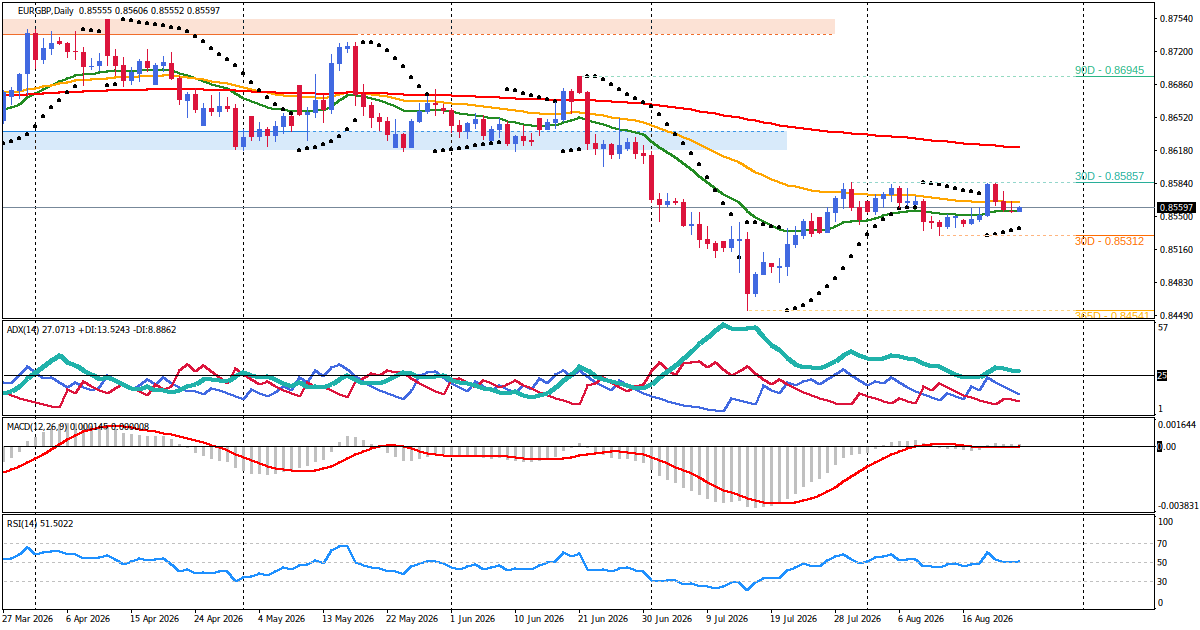
EUR/GBP enters the week of August 24 with a bearish top-level bias and medium confidence, but the market is not offering a clean continuation signal. The daily structure remains anchored in a downtrend defined by lower highs, while the H4 has turned oversold after a corrective bounce and the H1 is compressed inside a narrow range. That weak cross-timeframe alignment, together with a macro backdrop split between a persistent Bank of England yield advantage and a narrowing inflation differential, leaves the pair in a fragile, event-sensitive state. The central tension is whether the broader bearish posture resumes from current resistance or the compressed intraday range resolves with a corrective recovery toward the mid-range.
Technical Analysis
The dominant market map is bearish on the daily timeframe with moderate trend strength. Price has formed a sequence of lower daily highs since the August 19 swing top at 0.85840, and the latest daily bar closed near its low, signaling persistent selling pressure in the broader swing. Momentum at the daily level, however, is neutral, and corrective bounces have so far failed to reclaim the upper part of the daily range.
The medium-term H4 picture complicates that view. The cross fell from 0.85758 to 0.85552 before bouncing, with momentum turning mildly positive and the RSI moving into oversold territory. This reads as a fragile recovery attempt inside a larger downtrend, and it weakens the daily bearish signal rather than confirming it cleanly. Descriptively, the H4 state is best classified as reversal risk within a broader down move.
The intraday structure is where the compression is most visible. H1 direction is mixed, with price trapped in a narrow range and momentum neutral; volatility is contracting. The M30 timeframe shows a bounce from the low that has pushed momentum into overbought territory while volatility stays low, implying short-term mean-reversion pullback risk within the range. Lower timeframes are ranging without directional commitment, so the intraday structure does not strongly support the daily bearish bias. The broader conclusion is a compressed pause within a bearish posture rather than an active breakdown, with daily volatility elevated but intraday ranges contracting. That configuration can produce a sharp range expansion if the current band resolves.
Key Price Levels
The following zones are based on visible swing structure on the daily, H4, and H1 timeframes, with H1 and H4 exponential moving averages used for confluence:
- Resistance Zone 1: 0.85609 – 0.85624. A narrow cluster based on recent intraday highs and the H1 EMA20/H4 EMA20 area. The first test for sellers seeking to defend the downtrend.
- Resistance Zone 2: 0.85659 – 0.85667. Built from the recent daily swing high and H4 mid-range/EMA confluence. A rejection here would mark a shallower bearish continuation path.
- Resistance Zone 3: 0.85758 – 0.85781. The H4 swing high and SAR level; a recovery through this area would signal a meaningful challenge to the daily structure.
- Support Zone 1: 0.85579 – 0.85593. Recent M30/M15 lows with the H1 EMA200 nearby; the first downside pivot for any continuation push.
- Support Zone 2: 0.85546 – 0.85560. The recent daily low, latest H4 reaction low, and daily EMA20 area. A sustained break here is the key bearish trigger.
- Support Zone 3: 0.85456 – 0.85470. Prior daily swing low and the demand zone originating from the August 18 session; the deeper target if downside momentum expands.
Fundamental Drivers
The macro backdrop for EUR/GBP is genuinely two-sided. The most immediate force is the Bank of England's 150 basis point policy rate advantage over the European Central Bank, with Bank Rate at 3.75% versus the ECB's 2.25%. That gap structurally anchors sterling yield appeal and is the main tactical argument for continued euro softness, which partially supports the technical bearish bias.
Against that, the inflation differential is narrowing in favor of the euro. Euro area headline inflation accelerated to 2.9% in July, moving further above the ECB's target, while UK CPI cooled to 2.6% in June, approaching the BoE's 2.0% goal. Both economies posted resilient and identical 0.4% quarter-on-quarter GDP growth in Q2 2026, removing any immediate growth-shock catalyst. UK regular pay growth remains sticky at 3.4% for the three months to June, however, versus softer Euro area negotiated wage growth of 2.46% in Q1, which preserves the negative carry penalty for holding euros.
Recent Eurozone survey data adds further nuance: the August composite PMI remained firm at 52.1, with manufacturing output at its strongest in four and a half years and services holding at 51.7, while businesses reported softening input cost and selling price growth. That suggests ongoing resilience in the euro area's growth picture into Q3, which trims the risk of a near-term euro-negative growth shock.
The next real policy validation points are the September meetings: a potential ECB decision on September 10 and the BoE meeting on September 17. Until those deliver explicit forward guidance, the tactical carry reality favors sterling and keeps EUR/GBP contained, while the inflation trend argues for a gradual narrowing of the policy gap. In short, the macro backdrop provides only partial support to the technical bearish structure; it does not resolve the conflict between carry and inflation.
Market Sentiment and Risk Environment
Neither the euro nor sterling is a classic safe-haven currency, so EUR/GBP is driven primarily by relative Eurozone-UK rate expectations, inflation dynamics, and regional growth sentiment rather than by broad risk-off flows. The broader sentiment environment is best described as calm but fragile: the pair itself is moving in a narrow band, and the short-term technical picture is quiet and dormant, with price unable to extend meaningfully in either direction.
The Eurozone macro tone is cautiously constructive, with the economy described as stubbornly resilient despite geopolitical unrest and oil prices above $90 per barrel. That resilience is a mild EUR-supportive factor, but it has not so far been enough to challenge the sterling yield advantage. From a cross-asset perspective, the main sensitivity this week is to the US dollar: high-impact US releases dominate the calendar during UTC hours, and broad dollar flows can spill into both the euro and sterling legs of the cross, creating indirect volatility that the compressed EUR/GBP structure is not positioned to absorb cleanly.
Primary Scenario
The primary scenario is bearish continuation, consistent with the daily sequence of lower highs and the tactical carry backdrop. The structure requires a rejection near the 0.85609 – 0.85624 resistance cluster, or alternatively a sustained break below the 0.85546 – 0.85560 support cluster. Confirmation would come from a clear intraday rejection candle at resistance or a break-and-retest below support, with H1 momentum turning down from neutral.
The descriptive path is a lower-high formation near resistance followed by an intraday expansion toward the 0.85546 – 0.85560 cluster, then the deeper demand zone at 0.85456 – 0.85470. This scenario remains valid while price holds below the resistance structure. It would be invalidated by acceptance above 0.85624 with a sustained H1 close above the zone.
Alternative Scenario
The alternative scenario is a corrective recovery toward the mid-range. The structural trigger would be acceptance above the 0.85609 – 0.85624 resistance zone after a bounce from the 0.85579 – 0.85593 support cluster, with confirmation in the form of a decisive H1 close above resistance and a broadening intraday range.
The path would target the 0.85659 – 0.85667 zone, with the oversold H4 condition supporting a deeper pullback inside the overall downtrend. A softer US data backdrop could provide the broader sentiment tailwind for this corrective path, but event outcomes are inherently unpredictable. This scenario would be invalidated by failure back below 0.85579 after an attempted breakout. Importantly, even in this path, the daily structure remains bearish until the higher resistance zones are reclaimed.
Economic Calendar and Catalysts
No high-impact euro or pound release is scheduled inside the active window, so the direct pair-specific calendar is quiet. The catalysts that matter are external, mainly US dollar events that can shift the market-wide FX tone and indirectly move the euro and sterling legs:
- August 25, 14:00 UTC — US Consumer Confidence (Medium, consensus 90.3). An early-week sentiment data point for the dollar complex.
- August 26, 01:30 UTC — Australian CPI and trimmed mean inflation prints (High). Secondary cross-market context for broad FX volatility.
- August 26, 12:30 UTC — US Core PCE Price Index month-on-month (High, consensus 0.2%) and Preliminary GDP quarter-on-quarter (High, consensus 1.5%). The key external volatility event of the week.
- August 27, 12:30 UTC — US Unemployment Claims (Medium, consensus 208K). Routine labor-market input.
- August 28, 14:00 UTC — US Fed Chairman speech and Preliminary Benchmark Payrolls Revision (High), accompanied by revised University of Michigan sentiment and inflation expectations (Medium). A late-week external risk event.
The compressed state of EUR/GBP, with contracting intraday ranges and elevated daily volatility, raises sensitivity to any surprise in these releases. The true pair-specific catalysts, however, remain the September 10 ECB meeting and the September 17 BoE meeting, which will validate whether carry or inflation trends dominate the medium-term path. Until then, the event overlay is external rather than pair-specific, and the market is fragile rather than firmly directional.
Outlook
The balance of evidence favors continuation of the broader bearish posture, but with an important qualifier: the market is compressed, not actively breaking down. Daily volatility is elevated while intraday ranges are contracting, momentum is weak across timeframes, and the H4 oversold condition creates genuine reversal risk inside the downtrend. The macro picture offers only partial confirmation: the BoE yield advantage aligns with the bearish tactical view, while the narrowing inflation differential and resilient Eurozone growth threaten it over a longer horizon.
The dominant tension is therefore trend persistence versus corrective pullback risk. A resolution of the compressed range around the key support and resistance clusters will likely determine whether the next leg is a continuation toward 0.85456 – 0.85470 or a recovery toward 0.85659 – 0.85667. Confidence in this interpretation remains medium, limited mainly by the weak cross-timeframe alignment and the two-sided fundamental backdrop. Into the August 26–28 US data window, the structure is sensitive to external volatility and could expand sharply in either direction.
Disclaimer: This is not personalized financial advice. The information is for educational purposes only and does not guarantee any future outcome.


