
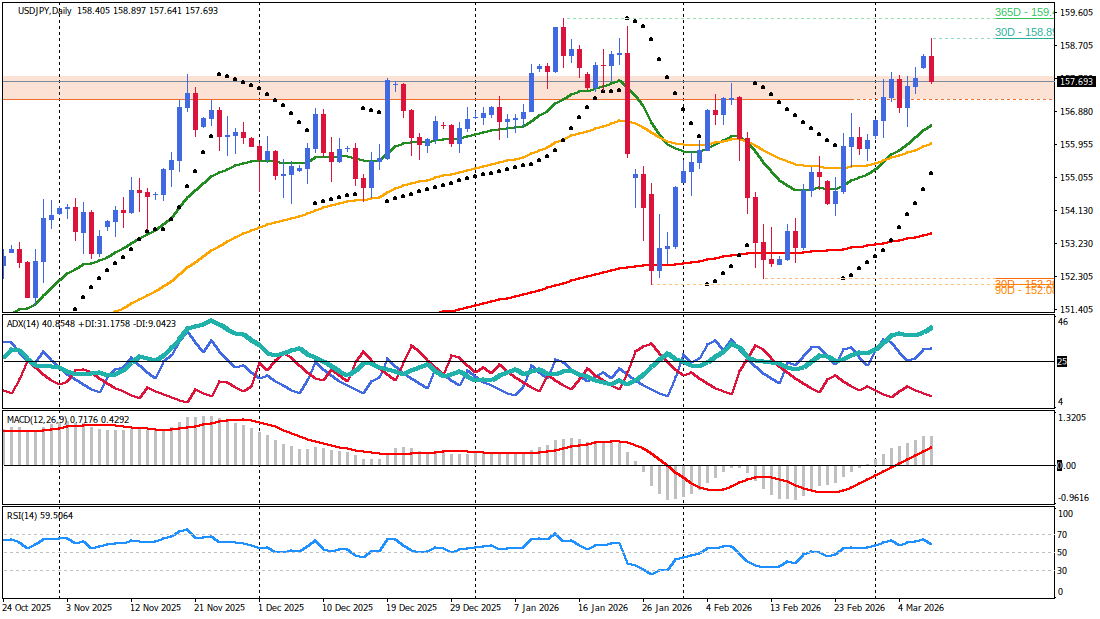
The USD/JPY exchange rate maintains a dominant long-term bullish bias as it navigates a complex environment of divergent monetary policies and escalating geopolitical tensions. Technical structure combined with the fundamental backdrop of surging global oil prices supports a continuation of the primary uptrend, despite the current short-term corrective pressure. While the pair recently retreated from multi-week highs near 158.90, the underlying momentum remains robust, fueled by the safe-haven appeal of the US Dollar and a deteriorating trade outlook for Japan. Critical focus now shifts to the 159.00–160.00 psychological barrier, a zone historically associated with Japanese Ministry of Finance intervention. The market is currently balancing a robust daily uptrend against intraday exhaustion, with upcoming US inflation data serving as the primary catalyst for the next directional leg. Volatility remains elevated as traders weigh the Bank of Japan’s cautious policy stance against the inflationary implications of the Middle East conflict.
Technical Analysis
Multi-Timeframe Market Structure
The dominant structure on the daily (D1) timeframe is decisively bullish, characterized by a perfect alignment of the 20, 50, and 200-period Exponential Moving Averages (EMAs). A strong Average Directional Index (ADX) reading of 40.85 confirms a high-intensity trend environment. However, the technical narrative is currently defined by a "buy the dip" regime, as the Stochastic oscillator is heavily overbought at 89.00 and price action shows a rejection of higher levels near 158.46. This daily overextension aligns with fundamental fears of currency intervention as price nears the 159.00 handle.
On the H4 framework, the medium-term momentum is transitioning toward a neutral stance. Price has breached the Parabolic SAR and is testing the EMA 20 at 157.83. While the EMA 50 and 200 remain well below current price action, providing a structural safety net, the Relative Strength Index (RSI) has retreated to 51.23. This suggests a loss of immediate bullish impulse, making the 157.64 level a critical pivot for the week’s direction. Short-term intraday bias remains bearish as price creates a series of lower highs on the H1 timeframe, though deeply oversold conditions on the H1 Stochastic (11.10) suggest that the current pullback is nearing exhaustion.
Critical Price Levels & Momentum Assessment
The technical framework identifies several key levels that align with fundamental pressure points:
- Resistance 158.46: Recent swing high and structural peak; a breach here signals a retest of the intervention zone.
- Resistance 158.87: H4 Parabolic SAR and psychological resistance where profit-taking is likely to intensify.
- Support 157.64: Immediate intraday floor; a sustained break below this level would signal a deeper corrective phase.
- Support 157.17: Confluence of the H1 EMA 200 and H4 EMA 50, representing major structural support.
- Support 156.50: D1 EMA 20; the ultimate trend-definition level for the medium term.
Momentum indicator synthesis reveals a fragmentation between timeframes. While the daily trend remains powerful, the H1 MACD histogram is negative, reflecting persistent selling pressure from traders booking profits ahead of the 159.00 intervention threshold. This divergence favors range-bound price action between 157.60 and 158.50 until a fundamental catalyst breaks the deadlock.
Fundamental Market Drivers
Central Bank Policy & Economic Outlook
The policy divergence between the Federal Reserve and the Bank of Japan (BoJ) remains the primary engine for USD/JPY strength. While the Fed is expected to maintain a "higher for longer" interest rate stance due to persistent US inflation, the BoJ continues to exercise extreme caution. BoJ Governor Kazuo Ueda recently reiterated that while the central bank will continue raising rates if economic trends align with projections, policymakers must closely monitor the impact of Middle East developments. This cautious rhetoric, combined with the BoJ's history of ultra-loose policy, continues to favor the US Dollar in the carry trade environment.
Fundamental pressure on the Yen is exacerbated by Japan’s status as a major energy importer. The recent surge in West Texas Intermediate (WTI) oil prices to approximately $101.00, following geopolitical strikes, represents a negative terms-of-trade shock for the Japanese economy. Prime Minister Sanae Takaichi has expressed concern over rising gasoline prices, suggesting that the government may need to tap emergency reserves. Historically, higher energy costs weigh heavily on the Yen, as they widen Japan's trade deficit and complicate the BoJ's path toward normalization. This fundamental headwind reinforces the technical bullish structure despite overbought oscillators.
Market Sentiment & Risk Environment
Market sentiment is currently dominated by risk-off flows stemming from the conflict involving the US, Israel, and Iran. While the Yen often serves as a safe-haven asset, its performance in this cycle has been hampered by the energy shock. Instead, the US Dollar has emerged as the preferred haven, underpinned by rising Treasury yields and safe-haven demand. MUFG strategists have noted that while the Yen has not yet benefited from the latest volatility spike, a squeeze on accumulated JPY-funded carry trades remains a significant tail risk if volatility intensifies further. This possibility creates a "volatility ceiling" for USD/JPY, where technical breakouts may be met with sharp, sentiment-driven reversals.
Integrated Trading Execution
Primary Trading Scenario
- Bias: Neutral/Bullish - Technical structure combined with the fundamental energy shock to Japan supports buying on weakness.
- Trigger/Entry: Long positions are favored on a confirmed bounce from the 157.65-157.75 support zone, confirmed by a bullish reversal pattern on the M30 timeframe.
- Stop-Loss: 157.35 - Placed below the H4 support cluster and the H1 EMA 200.
- Profit Targets:
- Target 1: 158.10 - Structural resistance and H1 EMA 20.
- Target 2: 158.40 - Test of the recent daily swing high.
- Session Context: Best executed during the London or New York sessions to capitalize on increased liquidity and reaction to energy market moves.
Alternative Market Scenario
- Invalidation: A sustained H1 candle close below 157.60, indicating a failure of the immediate support floor.
- Bias: Short-term Bearish/Corrective - Driven by potential JPY carry trade unwinding or intervention rhetoric.
- Trigger/Entry: Sell on a break below 157.60 targeting deeper structural supports.
- Stop-Loss: 157.95 - Above the intraday pivot and EMA resistance.
- Profit Targets:
- Target 1: 157.20 - Confluence of H4 EMA 50.
- Target 2: 156.80 - Structural swing low.
- Session Context: High probability if US inflation data (CPI) prints significantly below forecasts tomorrow.
Risk Management & Catalyst Analysis
Trade Risk Assessment
The primary risk to the bullish outlook is "headline risk" regarding Japanese currency intervention. With price action recently touching 158.90, the proximity to the 159.00–160.00 "danger zone" increases the likelihood of sudden, sharp liquidity-driven moves. Additionally, the conflict in the Middle East introduces extreme volatility in the energy sector; any further spike in oil could paradoxically weaken the Yen further while simultaneously increasing the risk of a carry trade squeeze. Traders should utilize an ATR-based stop-loss protocol (1.25x ATR on H1) to manage intraday noise and reduce position sizing ahead of tomorrow's high-impact US CPI release.
Economic Calendar & Event Impact
The following events are critical for USD/JPY price discovery over the coming days:
- US Core CPI m/m (Tomorrow, 12:30 UTC): Forecast 0.2%, Previous 0.3% - A higher-than-expected print will likely drive USD/JPY toward the 159.00 intervention zone.
- US CPI m/m (Tomorrow, 12:30 UTC): Forecast 0.3%, Previous 0.2% - Key indicator for Federal Reserve interest rate trajectory.
- US CPI y/y (Tomorrow, 12:30 UTC): Forecast 2.5%, Previous 2.4% - Broad measure of inflationary pressure impacting USD demand.
- US Unemployment Claims (March 12, 12:30 UTC): Forecast 216K, Previous 213K - Important for assessing labor market cooling and Fed policy shifts.
- US Core PCE Price Index m/m (March 13, 12:30 UTC): Forecast 0.4%, Previous 0.4% - The Fed's preferred inflation gauge; critical for long-term USD trend.
- US Prelim GDP q/q (March 13, 12:30 UTC): Forecast 1.4%, Previous 1.4% - Growth data will influence the "soft landing" vs. "stagflation" narrative.
- US JOLTS Job Openings (March 13, 14:00 UTC): Forecast 6.84M, Previous 6.54M - Significant for assessing labor demand and wage pressure.
Synthesized Market Outlook
The path of least resistance for USD/JPY remains upward, as price action aligns with the fundamental backdrop of a widening trade deficit for Japan and a cautious Bank of Japan. However, the pair is entering a high-stakes technical and political zone. The technical structure suggests that the current correction is a healthy consolidation within a larger bull market, but the proximity to 159.00 makes the "intervention ceiling" a tangible threat. Traders should monitor the 157.64 support level closely; as long as this holds, the primary bullish scenario remains valid. A break above 158.46 will likely trigger a rapid move toward 159.00, where the risk of Japanese authority intervention will peak. Conversely, tomorrow's US CPI data serves as the ultimate fundamental filter; a soft inflation print could provide the necessary excuse for a deeper technical correction toward 156.50, effectively resetting the overbought daily oscillators.


