
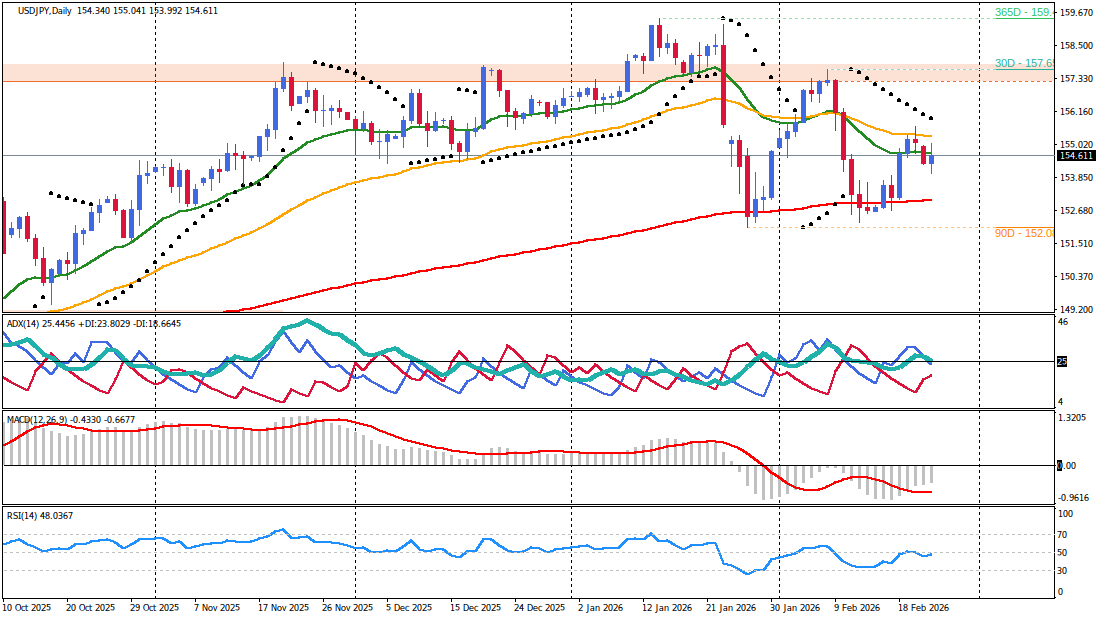
The USD/JPY exchange rate is currently navigating a complex consolidation phase, characterized by a neutral technical bias and a high-stakes fundamental backdrop. Technical structure combined with the emerging "Sell America" narrative supports a period of range-bound price action as markets digest the latest escalation in U.S. trade policy and rare central bank maneuvers. While the pair remains pinned between key moving average clusters, the fundamental environment has shifted following the U.S. Supreme Court's decision to block specific tariffs, followed immediately by President Trump's defiance and proposal of a 15% blanket tariff. Furthermore, the Federal Reserve's admission of a "rate check" conducted at the White House's request introduces a significant psychological cap on the pair, signaling a mutual intent between Washington and Tokyo to prevent a sustained breach of the 160.00 level. Critical volatility is expected to remain suppressed until the scheduled speech by President Trump and the release of high-impact U.S. inflation data later this week.
Technical Analysis
Multi-Timeframe Market Structure
The primary trend on the daily (D1) timeframe remains corrective and bearish in the immediate term, as price action continues to trade below the 20-day and 50-day Exponential Moving Averages (EMAs). Sellers maintain control of the medium-term narrative following multiple failures to reclaim the 154.70 structural level. However, the broader long-term bullish bias is preserved so long as the pair holds above the 200-day EMA, currently situated near 153.04. This technical floor aligns with fundamental support for the Yen as safe-haven flows increase due to U.S. equity weakness and trade policy uncertainty.
On the H4 secondary framework, momentum is notably flat. Price is pivoting around the 20-period EMA, while a convergence of the 20 and 50 EMAs signals trend exhaustion and range contraction. The Relative Strength Index (RSI) is oscillating near the 50 midpoint, confirming the absence of a directional advantage. On the lower timeframes (H1/M30), the Average Directional Index (ADX) remains below 20, indicating a low-volatility environment where mean-reversion behavior dominates the Asian and early European sessions.
Critical Price Levels & Momentum Assessment
Technical levels are currently acting as firm barriers, though they remain vulnerable to fundamental overrides from upcoming catalysts. The significance of these levels is enhanced by the recent "rate check" revelations, which suggest institutional defense of specific zones.
- Resistance Levels:
- 154.71: Primary resistance at the D1 20-day EMA and H1 50-period EMA confluence. This level has recently capped intraday recoveries.
- 155.04: Secondary resistance identified by the H4 Parabolic SAR and recent daily highs.
- 155.28: Major structural resistance at the D1 50-day EMA, representing a significant hurdle for any bullish reversal.
- Support Levels:
- 154.43: Immediate intraday support at the H4 50-period EMA.
- 154.31: Primary support floor and recent session low.
- 153.04: Major long-term support at the D1 200-day EMA, which serves as the ultimate line of defense for the long-term uptrend.
Fundamental Market Drivers
Central Bank Policy & Economic Outlook
The fundamental landscape for USD/JPY is dominated by an "extremely rare" interventionist signal from the Federal Reserve. The Fed recently acknowledged performing a "rate check" on the dollar-yen exchange rate for the U.S. Treasury, a move intended to signal dissatisfaction with Yen weakness and to prevent the pair from maintaining a move through 160.00. This proactive stance by the White House in foreign exchange matters aligns with a desire for a weaker dollar to support U.S. exports, creating a fundamental headwind for USD/JPY bulls despite the hawkish rhetoric from Fed Governor Christopher Waller. Waller has noted that while he favors easing, a solid labor market could keep interest rates steady, providing a floor for the Greenback.
In Japan, the Bank of Japan (BoJ) policy outlook remains sensitive to domestic inflation. The upcoming Tokyo Core CPI data is a critical barometer for national trends. A forecast of 1.7% suggests a slight cooling from the previous 2.0%, which may temper immediate expectations for aggressive BoJ tightening. However, the Yen continues to find support from risk-off flows as global investors react to the breakdown of the U.S. legal framework for tariffs and the subsequent proposal of alternative trade restrictions.
Market Sentiment & Risk Environment
Risk sentiment has soured following the Supreme Court's ruling against IEEPA tariffs and President Trump's subsequent vow to impose a 15% reciprocal tariff under Section 122 of the 1974 Trade Act. This legal and policy uncertainty has revived the "Sell America" narrative, evidenced by a weakening U.S. Dollar Index (DXY) and a decline in U.S. equity futures. As safe-haven assets, the Japanese Yen and Gold have seen increased demand. The Japanese Yen has emerged as a top performer against several major currencies this month, particularly the British Pound, as traders rotate out of riskier assets and into the Yen amid global trade uncertainty.
Integrated Trading Execution
Primary Trading Scenario
- Bias: Neutral/Range-Bound. Price action aligns with the fundamental backdrop of uncertainty to favor mean-reversion between established levels.
- Trigger/Entry: Look for short entries near 154.70 or long entries near 154.40. For a breakout, a sustained H1 candle close above 154.75 is required to confirm an intraday bullish move.
- Stop-Loss: 154.95 or a 1.25x ATR buffer (approx. 25 pips) from entry, placed beyond the H4 EMA cluster to avoid market noise.
- Profit Targets:
- Target 1: 155.20 - Structural resistance and D1 50-day EMA zone.
- Target 2: 154.00 - Psychological level and area of recent support.
- Session Context: This scenario is most valid during the London and early New York sessions when liquidity is highest, preceding the major high-impact events scheduled for February 25th.
Alternative Market Scenario
- Invalidation: A recovery and sustained trade above 155.10 or a breakdown triggered by a significant shift in U.S. trade headlines.
- Bias: Bearish Continuation. Technical breakdown below structural support coincides with deteriorating risk sentiment.
- Trigger/Entry: A bearish break and retest of the 154.30 level.
- Stop-Loss: 154.80 - Above the recent consolidation range.
- Profit Targets:
- Target 1: 153.50 - Mid-point toward major daily support.
- Target 2: 153.04 - D1 200-day EMA and major long-term structural floor.
- Session Context: Likely to be triggered by dovish U.S. data or an escalation in "Sell America" sentiment following President Trump's speech.
Risk Management & Catalyst Analysis
Trade Risk Assessment
The primary risk to the current outlook is the high concentration of event risk toward the end of the week. Technical levels are highly susceptible to fundamental overrides, particularly given the White House's active interest in the exchange rate. Traders should adjust position sizing to account for contracting ATR (Average True Range) and the potential for sharp volatility spikes during session transitions. Confidence in technical signals should be reduced within four hours of the high-impact events listed below.
Economic Calendar & Event Impact
- US CB Consumer Confidence (Today, 15:00 UTC): Forecast 87.4, Previous 84.5 - High-impact data that will influence short-term Dollar sentiment and consumer spending outlook.
- US Richmond Manufacturing Index (Today, 15:00 UTC): Forecast -8, Previous -6 - Provides insight into industrial health; a significant miss could weigh on the USD.
- US President Trump Speaks (Tomorrow, 02:00 UTC): High Impact - Major catalyst for trade policy and tariff clarity; likely to drive substantial volatility in the "Sell America" narrative.
- US Unemployment Claims (February 26, 13:30 UTC): Forecast 217K, Previous 206K - Critical for labor market assessment and Fed policy expectations.
- JN Tokyo Core CPI y/y (February 26, 23:30 UTC): Forecast 1.7%, Previous 2.0% - Key indicator for BoJ policy direction and Yen strength.
- US Core PPI m/m (February 27, 13:30 UTC): Forecast 0.3%, Previous 0.7% - Essential inflation data that will dictate the Fed's next steps regarding interest rate adjustments.
Synthesized Market Outlook
The USD/JPY pair is currently caught in a tug-of-war between technical consolidation and aggressive fundamental shifts. While the technical structure hints at a bearish corrective phase on the daily chart, the pair is fundamentally anchored by the Federal Reserve's rare "rate check" intervention, which has effectively established a ceiling for the Dollar. The "Sell America" sentiment, fueled by tariff uncertainty and legal challenges to U.S. trade policy, provides the Japanese Yen with a competitive edge as a safe haven. Traders should monitor the 154.71 resistance and 154.31 support levels closely. A break below 154.30, supported by weak U.S. data or hawkish BoJ signals, would likely accelerate a move toward the 153.04 long-term support. Conversely, a sustained break above 155.00 would require a significant cooling of trade tensions or a surprisingly hawkish shift in U.S. economic data.


