
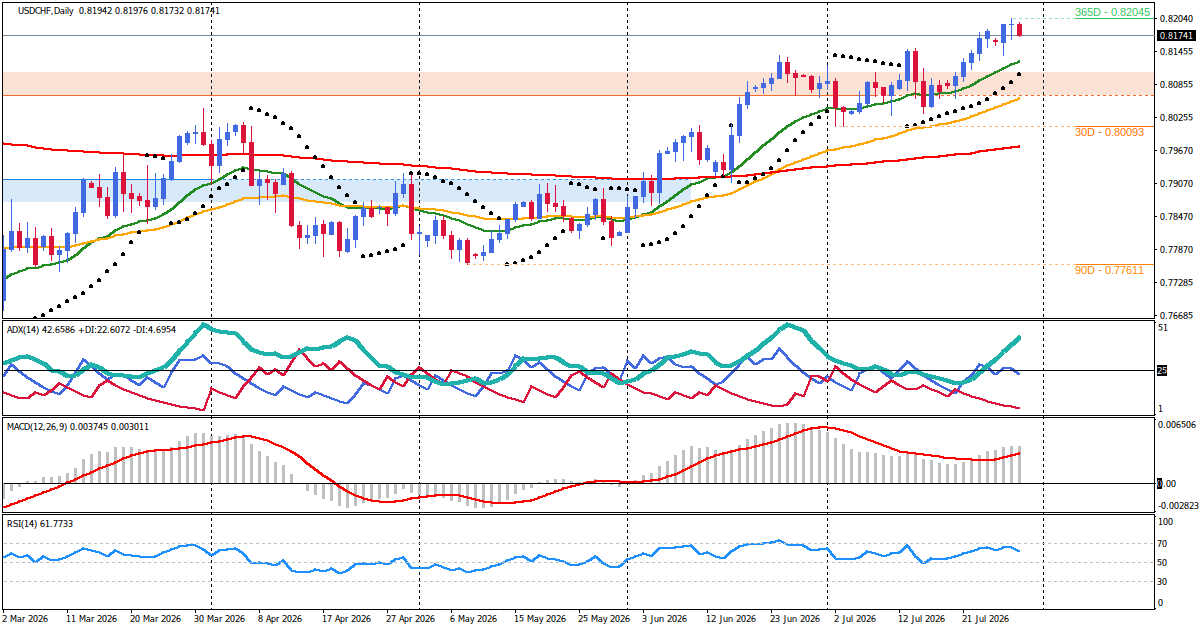
The USD/CHF pair maintains a bullish broader bias with medium confidence, supported by a strong primary trend on the daily timeframe that reflects persistent US Dollar strength against the Swiss Franc. However, the market is currently navigating a period of intraday conflict, as the hourly timeframe exhibits a corrective range with bearish momentum ahead of today’s high-impact Federal Reserve policy decision. While the fundamental backdrop remains supportive due to widening interest rate differentials and rumors of a prolonged low-rate environment in Switzerland, the technical structure shows signs of temporary exhaustion. This creates a volatile, event-driven environment where the FOMC statement at 18:00 UTC will likely serve as the critical catalyst for either a structural resolution to the upside or a deeper corrective phase.
Technical Analysis
The technical market map for USD/CHF reveals a clear divergence between long-term strength and short-term hesitation. On the daily (D1) timeframe, the primary trend is firmly bullish with strong intensity. Price action has recently tested the upper limits of its expansion, leaving momentum in an overbought state with an RSI of 66.30. This proximity to the upper Bollinger band suggests a state of exhaustion, raising the probability of a consolidation phase or a shallow mean-reversion move toward the 20-day EMA near 0.8122.
The medium-term (H4) framework confirms this upward bias but with moderate strength. While the market remains in an expansion state, momentum has neutralized following a recent peak, with the pair currently oscillating near the 20-period EMA at 0.8175. On the intraday horizon (H1 and M30), the situation is more complex. The H1 timeframe is currently range-bound with bearish momentum (RSI 38.50), while the M30 timeframe shows oversold conditions with an RSI of 32.41 and a Money Flow Index (MFI) at 3.49. This suggests that while selling pressure is currently dominant in the short term, it may be reaching a point of temporary depletion. A shift back to bullish alignment would require the pair to reclaim the 0.8180 intraday pivot.
Key Price Levels
Technical levels are clustered around recent swing points and moving average benchmarks, providing a framework for the current volatility regime:
- Resistance Zone 1: 0.8194 to 0.8205. This area aligns with the recent daily swing high and the H4 peak, representing the primary barrier to further expansion.
- Resistance Zone 2: 0.8186 to 0.8190. A critical intraday pivot area defined by the H1 20-period EMA.
- Support Zone 1: 0.8167 to 0.8172. This zone is the immediate floor, where recent H1 swing lows and daily low confluence meet.
- Support Zone 2: 0.8146 to 0.8150. A deeper support area identified by the H4 lower Bollinger band and the 50-period EMA cluster.
Fundamental Drivers
The fundamental narrative for USD/CHF is dominated by the policy divergence between the Federal Reserve and the Swiss National Bank (SNB). In the United States, markets are positioning for a potentially hawkish FOMC meeting, with some speculation even leaning toward a surprise rate hike to bolster inflation-fighting credentials. This keeps the US Dollar bid as investors seek the higher yields offered by the greenback.
Conversely, the Swiss Franc is facing downward pressure following reports that the SNB may maintain its policy rate at 0.00% until the end of 2027. This potential for long-term forward guidance makes the Franc an increasingly attractive funding currency for carry trades, especially as global interest rates remain elevated. The resulting positive swap differential significantly favors the US Dollar, encouraging traders to hold long positions to collect daily interest. This macro backdrop reinforces the technical bullish bias, provided the Fed does not deliver a dovish surprise.
Market Sentiment and Risk Environment
The broader risk environment is currently characterized by a mix of "risk-off" sentiment and interest rate sensitivity. Geopolitical tensions in the Middle East have historically supported both the USD and CHF as safe havens; however, the current yield advantage of the Dollar is currently winning the battle for capital flows. Sentiment is also influenced by a sell-off in technology and chip stocks, which occasionally drives a flight to quality. Despite these cross-currents, the USD/CHF pair remains a popular vehicle for expressing a pro-Dollar view. Market conditions are currently event-sensitive and compressed, indicating that liquidity may remain uneven until the FOMC provides a clear directional signal.
Primary Scenario
The primary scenario assumes the broader bullish trend will prevail once the current intraday correction finds a structural floor. In this path, the pair is expected to test and reject the support zone between 0.8167 and 0.8172. Validation for this move would come from a shift in M30 momentum to the upside and a successful break back above the 0.8180 intraday pivot. Following a successful defense of this support, the pair would likely rotate back toward the recent swing highs at 0.8194 and potentially target the 0.8213 retracement level. This scenario remains valid as long as the market does not sustain a close below 0.8165 on the H1 timeframe.
Alternative Scenario
The alternative scenario considers a deeper structural correction if the US Dollar faces a "sell the fact" reaction following the FOMC or if US economic data underperforms. If the pair finds acceptance below the 0.8167 support level, confirmed by an H1 candle close with expanding volatility, the technical structure would shift toward a bearish correction. This would likely lead to a break-and-retest sequence, targeting the secondary support zone near 0.8148, which aligns with the H4 50-period EMA. A hawkish surprise that fails to lift the Dollar or a negative revision to US GDP outlooks could trigger this deeper pullback.
Economic Calendar and Catalysts
The remainder of the week is packed with high-impact catalysts that will define the USD/CHF trajectory:
- US Federal Funds Rate and FOMC Statement (Today, 18:00 UTC): The most significant event for the pair, likely to trigger immediate volatility and determine the medium-term trend.
- US FOMC Press Conference (Today, 18:30 UTC): Vital for understanding the Fed's forward guidance and the likelihood of future tightening.
- US Advance GDP q/q (Tomorrow, 12:30 UTC): Critical for assessing the resilience of the US economy and the sustainability of the Dollar's strength.
- US Core PCE Price Index (Tomorrow, 12:30 UTC): As the Fed's preferred inflation gauge, this will influence long-term rate expectations.
Outlook
The outlook for USD/CHF is one of cautious optimism for the bulls, but the immediate path is clouded by the upcoming central bank volatility. While the daily and four-hour structures remain firmly aligned to the upside, the overbought conditions on the daily chart and the bearish intraday momentum suggest the pair is in a fragile state. The balance of evidence favors a continuation of the uptrend, provided the support at 0.8167 holds through the FOMC window. Traders should expect choppy, two-way price action in the short term, with a decisive move likely only after the Federal Reserve clarifies its policy path. The persistence of the positive swap and the SNB's dovish backdrop suggest that pullbacks are likely to be viewed as consolidation rather than a trend reversal at this stage.


