
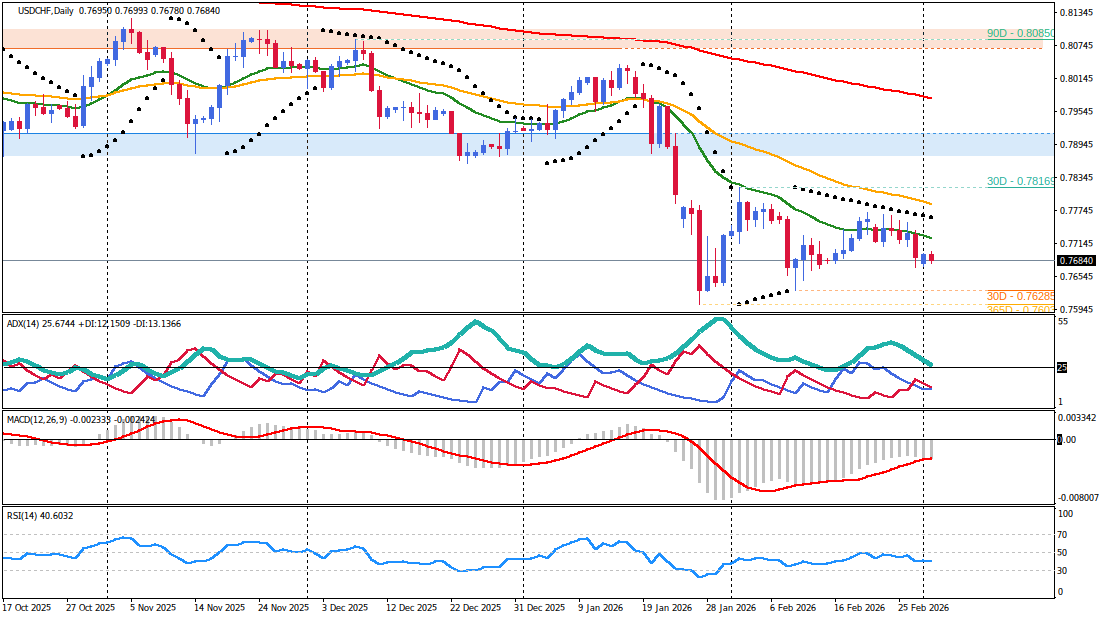
The USD/CHF pair is currently navigating a complex intersection of technical corrective momentum and a high-impact geopolitical "black swan" event. While the pair exhibits a Neutral/Bullish intraday bias as it attempts to recover from recent lows, the broader structural trend remains decisively bearish. This technical recovery is being fueled by a firmer US Dollar, which has gained traction following hotter-than-expected US Producer Price Index (PPI) data, reinforcing expectations that the Federal Reserve will maintain steady interest rates through the first half of 2026. However, the Swiss Franc is simultaneously attracting significant safe-haven flows following reports of US-Israeli strikes in Iran and the death of Supreme Leader Ayatollah Ali Khamenei. Technical structure combined with this heightened geopolitical risk supports a cautious outlook, as the market awaits the US ISM Manufacturing PMI for directional confirmation. The current price action aligns with a fundamental backdrop that favors safe-haven assets, potentially capping the USD's recovery near critical structural resistance zones.
Technical Analysis
Multi-Timeframe Market Structure
The dominant structure on the Daily (D1) timeframe remains firmly bearish, characterized by price action trading well below the EMA20, EMA50, and EMA200. These moving averages are aligned in a classic bearish sequence, suggesting that the long-term path of least resistance is still to the downside. Although a base was established near 0.7673, the lack of a higher high on the daily chart indicates that the current move is merely a corrective bounce within a larger downtrend. The fundamental deterioration of European security sentiment, driven by the collapse of the Geneva negotiations and the subsequent Middle East escalation, provides a backdrop that supports the sustainability of this long-term bearish structure for USD/CHF.
On the H4 timeframe, the market is attempting to stabilize, testing the EMA20 which has consistently acted as dynamic resistance. A sustained close above this level is required to shift the framework toward a neutral stance. Conversely, the H1 and M30 timeframes show active bullish momentum, with price holding above the H1 EMA20 and forming a series of higher lows. Technical signals require event confirmation from today's US manufacturing data before a sustained reversal can be validated against the primary bearish trend.
Critical Price Levels & Momentum Assessment
The pair is currently testing several high-confluence resistance and support zones that will determine the short-term trajectory:
- 0.7715 (Resistance): This level represents the intraday high and the M15 EMA200 confluence zone. It serves as the primary gateway for further bullish extension.
- 0.7727 (Resistance): The D1 EMA20 level acts as the most significant structural barrier. Rejection here would align with the primary bearish trend.
- 0.7695 (Support): A critical 15-pip support zone defined by the M30 EMA20 and the daily open. This level must hold to maintain the intraday recovery narrative.
- 0.7673 (Support): The previous session low and major structural support. A break below this level would signal the end of the corrective bounce and a resumption of the primary downtrend.
Momentum quality is currently moderate. While intraday oscillators like the RSI on the M30 are reaching overbought levels near 70, the daily RSI remains in neutral-bearish territory. This divergence suggests that the intraday rally may be overextended and vulnerable to a fundamental catalyst, such as a safe-haven surge or a weak US PMI print.
Fundamental Market Drivers
Central Bank Policy & Economic Outlook
The fundamental narrative for USD/CHF is a tug-of-war between US economic resilience and the Swiss National Bank's (SNB) policy stability. The US Dollar is currently bolstered by the January PPI report, which showed headline inflation rising 0.5% MoM, significantly exceeding the 0.3% market consensus. This data reinforces the "higher for longer" stance of the Federal Reserve, as US President Donald Trump’s calls for lower rates are countered by persistent inflationary pressures. The upcoming US ISM Manufacturing PMI, forecast at 51.7, will be a critical barometer for whether the US economy can sustain this momentum.
In contrast, the Swiss National Bank maintains a quarterly meeting cycle focused on keeping inflation below 2%. While the SNB has historically intervened to prevent excessive Franc appreciation, the current geopolitical environment limits their ability to suppress CHF strength. Higher interest rates in the US provide a yield advantage for the Greenback, but the Swiss Franc’s role as a premier safe-haven asset is currently the more dominant fundamental driver. Price action aligns with the fundamental backdrop to favor the Franc during periods of extreme market stress, such as the current "regime uncertainty" following the strikes in Iran.
Market Sentiment & Risk Environment
Market sentiment has shifted from "negotiation risk" to "open conflict" following the collapse of diplomatic efforts in Geneva. The killing of Ayatollah Ali Khamenei has created an existential power vacuum in Iran, elevating geopolitical risk to unprecedented levels. This "panic bid" for safe havens is clearly visible in the EUR/CHF cross, which has broken to multi-year lows, and is now spilling over into USD/CHF.
The risk environment is characterized by:
- Geopolitical Rupture: Direct kinetic engagement in the Middle East has moved safe-haven flows from theoretical scenarios to live reality.
- Energy Market Volatility: With 20% of global oil passing through the Strait of Hormuz, any instability in Iran’s command structure threatens global energy security, which historically strengthens the CHF against most majors.
- Equity De-risking: The "fire drill" atmosphere in global futures markets, with the S&P and Nasdaq showing significant pre-market weakness, supports the Swiss Franc's defensive appeal.
Integrated Trading Execution
Primary Trading Scenario
- Bias: Bullish continuation (Intraday) based on US economic outperformance.
- Trigger/Entry: Buy stop at 0.7718. This entry requires a breakout above the intraday high and a stronger-than-expected US ISM Manufacturing PMI (above 51.7).
- Stop-Loss: 0.7702. This level is placed below the M30 EMA20 to protect against minor volatility spikes.
- Profit Targets:
- Target 1: 0.7735 - Alignment with the H4 Parabolic SAR and psychological resistance.
- Target 2: 0.7750 - Major structural resistance and the D1 EMA20 zone.
- Session Context: Best executed during the US session overlap when liquidity and volatility are at their peak following the PMI release.
Alternative Market Scenario
- Invalidation: Failure to clear the 0.7720-0.7727 resistance zone or a significant "miss" in US PMI data.
- Bias: Bearish rejection at structural resistance, driven by intensified safe-haven demand.
- Trigger/Entry: Sell on an H1 bearish engulfing candle near 0.7715, particularly if geopolitical headlines escalate.
- Stop-Loss: 0.7732. Placed above the D1 EMA20 to allow for volatility while maintaining a clear invalidation point.
- Profit Targets:
- Target 1: 0.7695 - Retest of the daily open and M30 support.
- Target 2: 0.7675 - Target near the previous session low and major structural support.
- Session Context: Post-event volatility play or a reaction to breaking news regarding the Middle East conflict.
Risk Management & Catalyst Analysis
Trade Risk Assessment
The primary risk for any USD/CHF position today is the extreme sensitivity to geopolitical headlines. While technical levels remain the primary framework for execution, fundamental catalysts can override technical signals instantly. The death of a world leader and the potential for Iranian retaliation create a high-probability environment for "gap" moves and slippage. Traders should consider reducing position sizes by half to account for this elevated ATR and the potential for liquidity to thin out immediately surrounding the 15:00 UTC news release.
Economic Calendar & Event Impact
- US ISM Manufacturing PMI (Today, 15:00 UTC): Forecast 51.7, Previous 52.6 - This is the primary catalyst for USD strength or weakness today. A reading above 52.0 likely validates the bullish intraday scenario.
- US ISM Manufacturing Prices (Today, 15:00 UTC): Forecast 60.6, Previous 59.0 - Critical for assessing the inflationary backdrop that dictates Federal Reserve policy.
- US ADP Non-Farm Employment Change (March 4, 13:15 UTC): Forecast 49K, Previous 22K - Early indicator of labor market health ahead of Friday's NFP.
- US ISM Services PMI (March 4, 15:00 UTC): Forecast 53.5, Previous 53.8 - Key for assessing the larger portion of the US economy.
- US Unemployment Claims (March 5, 13:30 UTC): Forecast 215K, Previous 212K - Weekly gauge of labor market resilience.
- US Non-Farm Employment Change (March 6, 13:30 UTC): Forecast 58K, Previous 130K - The most significant data point of the week for USD direction.
- US Retail Sales m/m (March 6, 13:30 UTC): Forecast -0.3%, Previous 0.0% - Critical for assessing consumer health and recessionary risks.
Synthesized Market Outlook
The outlook for USD/CHF is a battle between US economic exceptionalism and the absolute safety of the Swiss Franc. Technical structure combined with the geopolitical rupture in Iran supports a view that any USD-led rallies will likely face heavy selling pressure at the 0.7727 structural resistance level. While a strong US ISM print today could provide the momentum needed for a temporary breakout toward 0.7750, the underlying "panic bid" for CHF remains the dominant macro theme. Traders should monitor the 0.7715 level closely; a failure to hold above this mark following the US session open would confirm that safe-haven flows are overwhelming the USD's yield advantage. Conversely, if the US data is exceptionally strong and geopolitical tensions enter a "wait-and-see" phase, a corrective rally toward 0.7824 (55 D EMA) cannot be ruled out. Risk management must remain paramount, with strict adherence to stop-losses given the possibility of sudden, news-driven reversals.


