
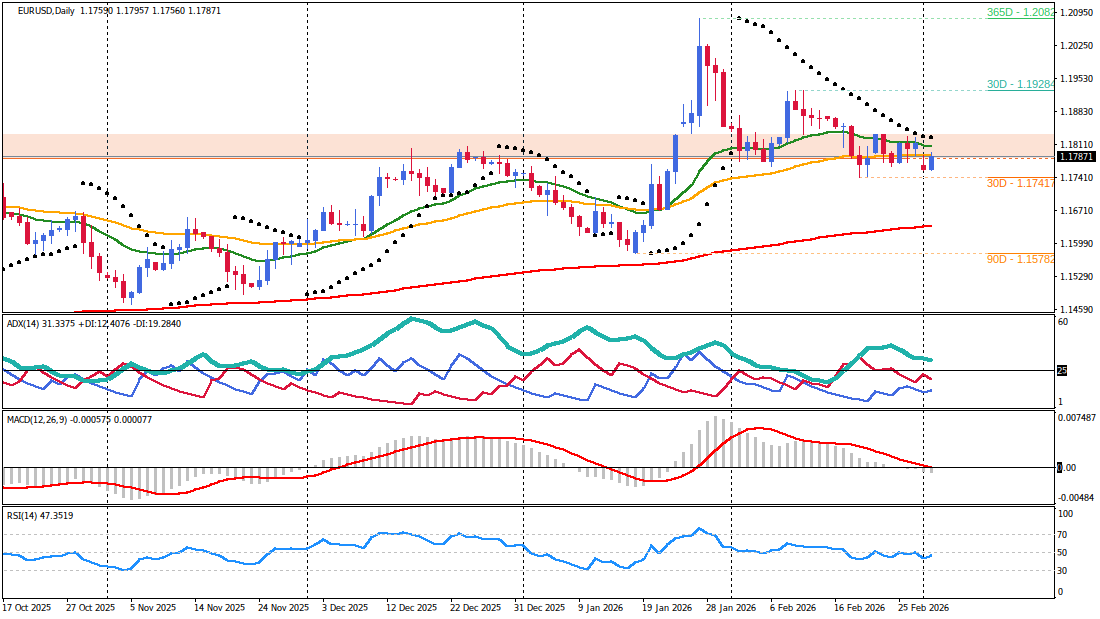
The EUR/USD pair enters the first trading week of March under significant selling pressure, as a volatile combination of geopolitical conflict and deteriorating macroeconomic fundamentals weighs heavily on the Euro. The technical breakdown below the 1.1800 psychological handle aligns with a massive flight to safety following the outbreak of hostilities between the United States, Israel, and Iran over the weekend. Technical structure combined with the sharp spike in energy prices supports a sustained bearish outlook for the pair. While intraday oscillators signal oversold conditions, the broader daily trend remains firmly in the hands of the bears, with market participants focusing on the European Central Bank’s upcoming policy guidance and a series of high-impact US labor market data releases. The immediate market view favors selling into corrective bounces as the Eurozone faces renewed energy security risks and a strengthening US Dollar.
Technical Analysis
Multi-Timeframe Market Structure
The dominant structure on the daily (D1) timeframe reveals increasing bearish strength as price action remains pinned below the 20-day Exponential Moving Average (EMA). The Average Directional Index (ADX) reading above 30 confirms a strong trending environment, suggesting that the current move is not merely a retracement but a concerted push toward lower structural levels. The lack of immediate horizontal support until the 1.1700 psychological level provides a clear runway for further downside, provided the 1.1800 handle continues to act as firm resistance.
On the H4 framework, the pair is transitioning from a prior ranging phase into a confirmed bearish path. Price is currently struggling to maintain its position near the 200-period EMA, and the shift below 1.1750 serves as a technical confirmation of the medium-term bearish bias. On the intraday timeframes (H1/M30), aggressive selling pressure is evident, though the Relative Strength Index (RSI) dipping below 30 and Stochastic readings near 10 indicate that momentum is temporarily stretched. This technical setup suggests that while the primary direction is down, the most favorable trade entries will likely occur following a brief period of consolidation or a mean-reversion move toward the H1 EMA20.
Critical Price Levels & Momentum Assessment
Current price action identifies several layers of resistance that will likely cap any attempted recoveries. The confluence of the H1 EMA20 and a previous consolidation zone at 1.1787 represents the first major hurdle for bulls. Above this, the 1.1803 level, which aligns with the H1 EMA200 and the 1.1800 psychological barrier, stands as the primary invalidation zone for the intraday bearish thesis. On the support side, the intraday low at 1.1731 provides immediate relief, but the primary target for bears remains the 1.1700 structural floor. A break below this level would expose the long-term D1 EMA200 at 1.1637.
Fundamental Market Drivers
Central Bank Policy & Economic Outlook
The fundamental backdrop for the Euro has deteriorated sharply due to the escalation of conflict in the Middle East. The killing of Iran’s Supreme Leader and the subsequent attacks on oil tankers near the Strait of Hormuz have sent oil prices surging by approximately 9% to 13%. This development is particularly detrimental to the Eurozone economy, which relies heavily on energy imports. Rising energy expenditure acts as a de facto tax on Eurozone consumers and businesses, threatening to stifle growth and complicate the European Central Bank’s (ECB) path toward normalization. The technical bearish structure on EUR/USD is reinforced by the divergence in economic resilience between the Eurozone and the United States.
Central bank policy expectations are also in flux. While the Eurozone Core CPI Flash Estimate is forecasted to remain steady at 2.2%, lower-than-expected German inflation data (2.0% vs 2.1% previous) suggests that price pressures may be cooling faster than anticipated in the bloc's largest economy. This may provide the ECB with room to adopt a more cautious or even dovish stance if the geopolitical situation continues to dampen economic activity. ECB President Lagarde’s scheduled appearances today are critical; any signals of a policy shift in response to the Middle East crisis will likely dictate the Euro's medium-term trajectory.
Market Sentiment & Risk Environment
Risk sentiment is currently the primary driver of currency markets. The "fire drill" market open on Monday reflects a global flight to safety, benefiting the US Dollar and the Swiss Franc at the expense of pro-cyclical currencies like the Euro. The closure of the Strait of Hormuz and the risk of a protracted four-week military campaign, as suggested by US leadership, maintain a high-risk premium in the market. This risk-off sentiment aligns with the bearish technical scenarios, as investors favor the liquidity and safety of the Greenback. Furthermore, the US Dollar Index (DXY) continues to trade higher despite surrendering some early gains, indicating that the fundamental bid for the USD remains robust.
Integrated Trading Execution
Primary Trading Scenario
- Bias: Bearish continuation following a corrective bounce, supported by safe-haven USD demand and Eurozone energy concerns.
- Trigger/Entry: Sell limit at 1.1765-1.1770, targeting a retracement to the M30 EMA20 where technical resistance meets intraday exhaustion.
- Stop-Loss: 1.1795, placed above the H1 EMA50 to protect against volatility spikes during the US session.
- Profit Targets:
- Target 1: 1.1730 - Previous intraday low and immediate liquidity zone.
- Target 2: 1.1705 - Major psychological level and H4 structural target.
- Session Context: Ideal execution window occurs during the New York open, specifically surrounding the US ISM Manufacturing PMI release.
Alternative Market Scenario
- Invalidation: A confirmed H1 candle close above 1.1805, suggesting a failure of the bearish trend line and a shift in sentiment.
- Bias: Mean reversion bounce driven by potential US Dollar weakness or profit-taking.
- Trigger/Entry: Buy on a confirmed M30 close above 1.1755 following a failed test of the 1.1730 support level.
- Stop-Loss: 1.1725, below the recent swing low.
- Profit Targets:
- Target 1: 1.1785 - Retest of the H1 EMA20.
- Target 2: 1.1800 - Psychological resistance and mean reversion target.
- Session Context: This scenario requires a significant miss in the US ISM Manufacturing data or a de-escalation in geopolitical rhetoric.
Risk Management & Catalyst Analysis
Trade Risk Assessment
The primary risk to the bearish thesis is the extreme oversold condition observed on intraday timeframes. RSI and Stochastic indicators suggest that a corrective bounce is overdue, which could trigger stop-losses for traders chasing the move at current levels. Additionally, the high-impact nature of the US ISM Manufacturing PMI and the upcoming Eurozone CPI data introduces the risk of two-way volatility. Traders should utilize reduced position sizing ahead of these releases and consider widening stop-losses to 2x ATR to account for news-driven slippage. The fundamental risk of a sudden de-escalation in the Middle East could also spark a sharp "relief rally" in EUR/USD, invalidating current technical setups.
Economic Calendar & Event Impact
The following events are critical for EUR/USD price discovery this week:
- EZ ECB President Lagarde Speaks (Today, 14:00 UTC): Medium Impact - Market will scan for shifts in policy guidance due to energy price spikes.
- US ISM Manufacturing PMI (Today, 15:00 UTC): Forecast 51.7, Previous 52.6 - High Impact - A strong print will likely accelerate EUR/USD downside toward 1.1700.
- EZ CPI Flash Estimate y/y (Tomorrow, 10:00 UTC): Forecast 1.7%, Previous 1.7% - Medium Impact - Key for ECB interest rate expectations.
- US ADP Non-Farm Employment Change (March 4, 13:15 UTC): Forecast 49K, Previous 22K - High Impact - Leading indicator for Friday's NFP.
- US Unemployment Claims (March 5, 13:30 UTC): Forecast 215K, Previous 212K - High Impact - Crucial for assessing US labor market resilience.
- US Non-Farm Employment Change (March 6, 13:30 UTC): Forecast 58K, Previous 130K - High Impact - The primary volatility catalyst for the week's end.
Synthesized Market Outlook
Price action aligns with the fundamental backdrop to favor a continuation of the EUR/USD downtrend. The technical rejection at the 1.1800-1.1840 resistance zone, combined with the emergence of a key bearish trend line, suggests that the path of least resistance remains lower. Fundamentally, the Eurozone's vulnerability to energy price shocks and the global flight to the US Dollar provide the "why" behind the technical breakdown. While short-term oversold conditions may lead to a temporary bounce toward 1.1770, the broader market structure points toward a test of the 1.1700 psychological level and potentially 1.1650 if US data remains robust. Traders should monitor the 1.1730 support level for signs of a break and the 1.1800 resistance level for signs of a trend shift. The combination of high-impact US manufacturing data and ECB rhetoric today will be the deciding factor for the pair's immediate direction.


