
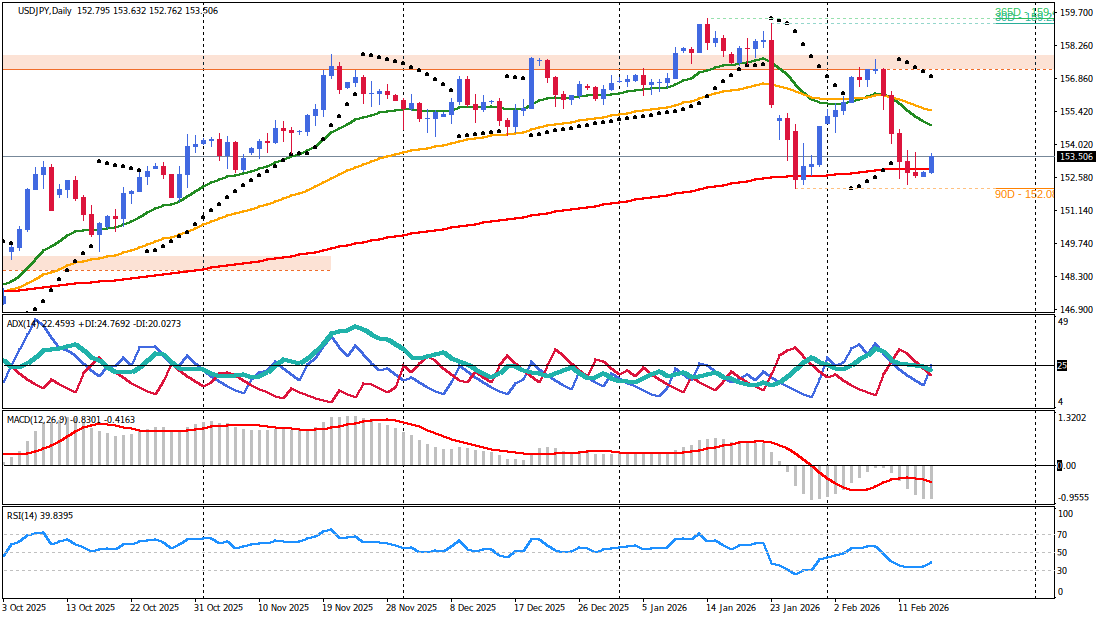
The USD/JPY currency pair enters a critical transitional phase as the technical bearish momentum encounters a significant structural floor at the 200-day exponential moving average (EMA). Technical structure combined with underwhelming Japanese economic growth data supports a short-term corrective recovery, even as the broader daily trend remains heavy. While the pair recently experienced a sharp 3% weekly decline—its largest since late 2024—the inability of bears to force a decisive close below the 152.95 level has invited intraday buying interest. Fundamentally, the market is navigating a complex backdrop: Japan’s fourth-quarter GDP missed expectations significantly, printing at 0.1% against a 0.4% forecast, which has temporarily dampened the urgency for Bank of Japan (BoJ) policy normalization. However, political developments, including Governor Kazuo Ueda’s meeting with Prime Minister Sanae Takaichi, keep the prospect of a March or April rate hike on the table. Price action aligns with this fundamental backdrop to favor a period of consolidation and intraday bullish retracement toward 154.20, pending high-impact catalysts from the United States later this week, specifically the FOMC Meeting Minutes and Core PCE inflation data.
Technical Analysis
Multi-Timeframe Market Structure
The primary trend on the daily (D1) timeframe is decidedly bearish. Price action remains positioned below the 20-day and 50-day EMAs, while the MACD indicator resides in negative territory, confirming that medium-term selling pressure is not yet exhausted. Despite this, the 200-day EMA at 152.95 is serving as a formidable structural floor. The failure to breach this level on a closing basis suggests that the market is entering a consolidation or corrective phase rather than an immediate trend extension. This technical pause is fundamentally reinforced by the lack of follow-through in Yen strength following the disappointing GDP figures, which suggests that the "Yen-carry" unwind may have reached a temporary exhaustion point.
On the H4 timeframe, momentum is shifting toward a neutral stance. The reclamation of the 20-period EMA indicates that the immediate aggressive selling has abated. While the Average Directional Index (ADX) remains high—reflecting the strength of the previous move—stochastic oscillators are approaching overbought territory. This suggests that the current corrective bounce may face significant headwinds as it approaches the 50-period EMA near 154.15. Technical structure combined with the recent GDP miss suggests that while the downside is protected at 152.95, the upside remains capped by structural resistance.
Critical Price Levels & Momentum Assessment
The intraday technical outlook (H1/M30) is currently bullish. Price has established a series of higher lows above the 153.40 zone, supported by a convergence of the H1 EMA20 and EMA50. While RSI and Stochastic readings on the M30 timeframe are reaching overbought levels, the absence of bearish divergence indicates that the current momentum has sufficient strength to test the H1 200-period EMA at 154.20. The significance of these levels is amplified by the fundamental environment; a break above 154.20 would suggest that the market is pricing in a more hawkish Federal Reserve ahead of tomorrow's FOMC minutes.
- Resistance 1: 154.20 - This level represents a confluence of the H1 EMA200 and H4 EMA50, acting as a primary target for the current corrective bounce.
- Resistance 2: 154.85 - The D1 EMA20 serves as the primary trend trigger; a break above this would invalidate the immediate bearish bias.
- Support 1: 153.30-153.40 - An intraday support zone defined by the H1 EMA cluster.
- Support 2: 152.95 - The 200-Day EMA structural floor, which remains the most critical level for long-term trend determination.
Fundamental Market Drivers
Central Bank Policy & Economic Outlook
The fundamental narrative for the Japanese Yen is currently caught between disappointing growth data and persistent expectations for monetary tightening. Japan’s preliminary Q4 GDP grew by only 0.1% quarterly, missing the 0.4% market expectation. On an annualized basis, the 0.2% growth was a fraction of the 1.6% forecast. This data highlights the fragility of Japan's domestic recovery, particularly as private consumption remains stagnant due to the high cost of living. The technical failure of USD/JPY to break below 152.95 is a direct reflection of this fundamental weakness, as traders reconsider the BoJ's ability to hike rates aggressively in a low-growth environment.
However, the policy outlook remains a source of volatility. BoJ Governor Kazuo Ueda’s recent meeting with Prime Minister Sanae Takaichi is a key development. Although Ueda described the talks as a "general exchange of views," the absence of public friction suggests that the BoJ may still have the political cover to raise interest rates as early as March or April if inflation remains sticky. The GDP Deflator, a broad measure of inflation, eased only slightly to 3.4%, indicating that price pressures are still present. Technical structure combined with these policy expectations suggests that while the Yen is under pressure today, its long-term trajectory is still tied to the BoJ’s normalization path.
Market Sentiment & Risk Environment
Global risk sentiment is currently characterized by a "wait-and-see" approach, exacerbated by recent holidays in major markets including the US, China, and South Korea. The US Dollar has remained relatively steady as investors process cooling inflation data, which supports the narrative of potential Federal Reserve rate cuts later in the year. However, the upcoming FOMC Meeting Minutes are expected to provide a crucial reality check. If the minutes reveal a more hawkish-than-expected stance, the USD/JPY pair is likely to see a technical breakout above 154.20. Conversely, a dovish tone would likely see the pair retest the 152.95 structural floor.
Furthermore, geopolitical risks, particularly tensions involving Iran and the US, are providing a subtle underlying bid for haven assets. While this hasn't translated into a massive Yen surge today, it remains a "tail risk" that could trigger a sudden technical breakdown if risk-off sentiment intensifies. Currently, market positioning suggests that the 3% drop last week was a significant liquidation event, and the current price action reflects a period of "bears taking a breather" before the next major fundamental catalyst.
Integrated Trading Execution
Primary Trading Scenario
- Bias: Bullish intraday continuation within a broader bearish structure.
- Trigger/Entry: Long positions are favored on a retest of the 153.30-153.40 support zone. Entry should be targeted within a 3-pip tolerance of 153.41, following a successful hold of the H1 EMA cluster.
- Stop-Loss: 153.20, placed below the recent H1 swing low to protect against volatility noise.
- Profit Targets:
- Target 1: 154.15 - Alignment with the H4 EMA50 and initial structural resistance.
- Target 2: 154.40 - Proximity to the H1 200-period EMA.
- Session Context: This scenario is most viable during the Asian and early London sessions, taking advantage of the current momentum shift before major US data releases.
Alternative Market Scenario
- Invalidation: A decisive H1 candle close below 152.95 (200-Day EMA) or a failure to reach 154.20 before the New York open tomorrow.
- Bias: Bearish reversal from resistance.
- Trigger/Entry: Short entry is triggered if price fails to clear 154.20 and prints a bearish engulfing pattern on the M30 timeframe. This scenario gains significant weight if US manufacturing data underperforms.
- Stop-Loss: 154.45, positioned above the H1 EMA200 resistance.
- Profit Targets:
- Target 1: 153.40 - Retest of the intraday EMA support.
- Target 2: 153.00 - Psychological support just above the 200-Day EMA.
- Session Context: This scenario is likely to play out during the New York session or following the FOMC Minutes if the US Dollar faces renewed pressure.
Risk Management & Catalyst Analysis
Trade Risk Assessment
The primary risk to the bullish intraday setup is the conflict with the dominant daily bearish trend. Counter-trend trades inherently carry higher risk, as structural resistance levels like 154.20 often attract heavy selling volume. Additionally, the transition between the Asian and London sessions frequently produces "stop hunts" around the 153.30 level. Traders should utilize a 1.25x ATR stop-loss protocol (approximately 15-20 pips on the H1 timeframe) to avoid noise-induced liquidations. Position sizing should be conservative given the high-impact events scheduled for the remainder of the week.
Economic Calendar & Event Impact
- US Empire State Manufacturing Index (Today, 13:30 UTC): Forecast 6.4, Previous 7.7 - A lower-than-expected reading could dampen the USD recovery and trigger the alternative bearish scenario.
- US Core Durable Goods Orders m/m (Tomorrow, 13:30 UTC): Forecast 0.3%, Previous 0.5% - Indicator of business investment and US economic resilience.
- US FOMC Meeting Minutes (Tomorrow, 19:00 UTC): High Impact - The primary catalyst for USD/JPY. Hawkish sentiment regarding interest rate holds will drive the pair toward 154.85.
- US Unemployment Claims (February 19, 13:30 UTC): Forecast 229K, Previous 227K - Key labor market data that will influence Fed policy expectations.
- US Advance GDP q/q (February 20, 13:30 UTC): Forecast 2.8%, Previous 3.0% - Critical for assessing the "soft landing" narrative in the US.
- US Core PCE Price Index m/m (February 20, 13:30 UTC): Forecast 0.3%, Previous 0.2% - The Federal Reserve's preferred inflation gauge; higher readings will likely support a USD/JPY breakout.
Synthesized Market Outlook
The USD/JPY pair is currently caught in a tug-of-war between long-term structural support at 152.95 and medium-term bearish momentum. The fundamental backdrop of a disappointing Japanese GDP print provides the catalyst for a technical relief rally, as it reduces the immediate pressure on the Bank of Japan to hike rates. However, the broader trend remains bearish until price can decisively reclaim the 154.85 level. For the current session, the technical structure combined with the fundamental data supports a bullish corrective bias toward the 154.20 resistance zone. Traders should monitor the 152.95 support level with extreme vigilance; a sustained break below this floor would signal a shift in the larger trend toward 150.00. Conversely, the high-impact US data cluster arriving later this week will determine if the current bounce is a genuine reversal or merely a "dead cat bounce" before a deeper structural breakdown.


