
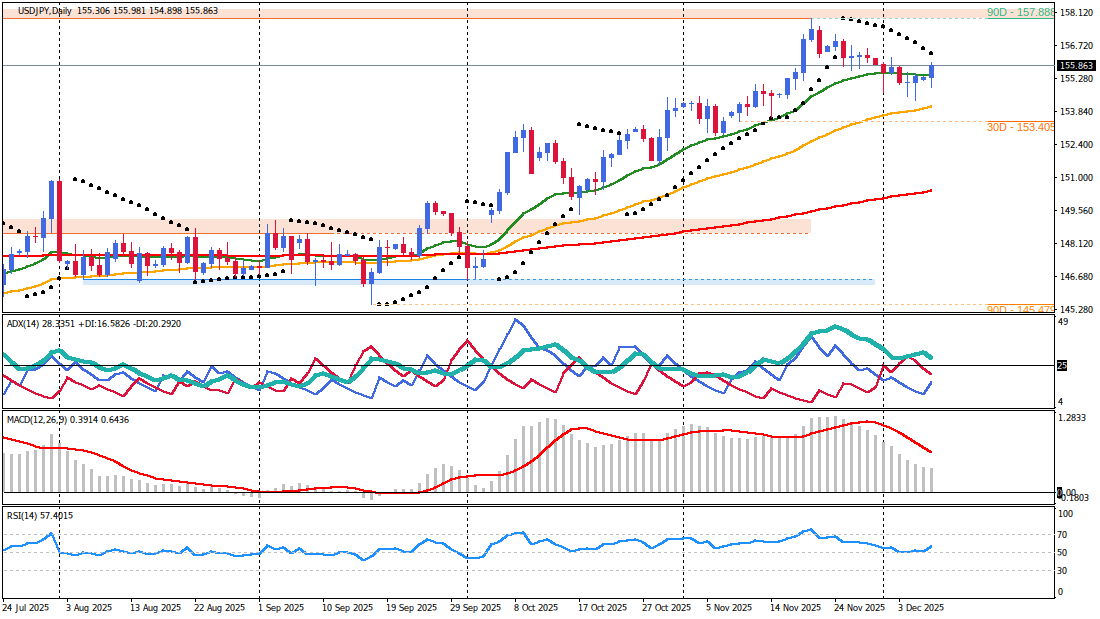
USD/JPY is in a neutral consolidation phase, balancing underlying medium-term bullish momentum with immediate profit-taking pressures. The Japanese Yen faces significant headwinds from the recent 7.6-magnitude earthquake, which weighs on sentiment and introduces uncertainty regarding the Bank of Japan's policy normalization timeline, despite strong market expectations for a December rate hike. Conversely, the US Dollar experiences pre-FOMC repositioning, with markets broadly anticipating a 25 basis point rate cut from the Federal Reserve tomorrow. This divergence in central bank outlook, coupled with critical US employment and inflation data, creates a highly event-driven environment for the pair. Technical levels indicate a likely bullish pullback before further upside, but extreme event risk from the upcoming FOMC decision could override immediate technical signals. The yen carry trade unwinding risk remains a significant background factor.
Technical Analysis
Multi-Timeframe Market Structure
The broader market structure for USD/JPY maintains a bullish bias on the daily (D1) timeframe, with price action trading above the EMA50 and EMA200. This long-term uptrend is fundamentally supported by the persistent interest rate differential favoring the US Dollar, even with impending Fed rate cuts, against a backdrop of the BoJ's ultra-loose monetary policy gradually unwinding. However, the most recent D1 candle closed below the EMA20, indicating a temporary pause or correction within this larger uptrend. The Demarker indicator at 0.29 suggests potential for further downside correction, aligning with pre-event caution. On the H4 chart, strong bullish momentum is evident, with price firmly above all key EMAs (EMA20, EMA50, EMA200). This H4 bullishness reflects the US Dollar's recent recovery driven by repositioning ahead of the FOMC and the immediate weakness in the JPY following the Japan earthquake. Overbought Stochastic readings at 93.22 on H4, however, signal an extended move and suggest a consolidation or pullback is likely before further advances. The short-term intraday H1 chart also shows strong bullish momentum, with price above all EMAs and a high ADX at 42.63 confirming a strong trend. However, the M30 timeframe reveals a slight deceleration from the H1 peak, with RSI at 56.71 and Stochastic at 74.13, indicating a minor loss of immediate upward thrust. This short-term cooling is a direct response to the market anticipating high-impact US economic data and the critical FOMC decision.Critical Price Levels & Momentum Assessment
Current price action indicates a battle around key technical levels, with momentum indicators suggesting a potential for consolidation before a decisive move.- Resistance:
- 156.00: This psychological level aligns with recent H1/M30 highs. A break above 156.00 indicates renewed bullish intent, potentially driven by stronger-than-expected US labor data or a "hawkish cut" from the Fed.
- 156.35: The D1 SAR level. A decisive breach above this point would signal strong bullish continuation, likely fueled by a significant divergence in central bank policy expectations or a sustained weakening of the JPY due to earthquake-related economic concerns.
- Support:
- 155.80: A strong intraday level, representing a confluence of the H1 SAR and M30 EMA20. Holding this level indicates resilience in the bullish bias, especially if early US data provides no negative surprises.
- 155.65: The H1 EMA20. A break below this level would invalidate the immediate intraday bullish bias, suggesting deeper profit-taking or a reaction to weaker US data. This level is critical for the primary bullish pullback scenario.
- 155.45: A critical structural support level, formed by the confluence of the D1 EMA20 and H4 EMA20. A sustained break below 155.45, particularly on an H1 close, would signal a significant shift in short-term sentiment, potentially triggered by a more dovish-than-expected Fed or strong JPY buying on BoJ hawkishness.
Fundamental Market Drivers
Central Bank Policy & Economic Outlook
The primary fundamental drivers for USD/JPY revolve around significant policy divergence and economic expectations from the Bank of Japan and the Federal Reserve. The Bank of Japan is widely anticipated to execute an imminent rate hike in December, with overnight index swaps (OIS) pricing in nearly a 90% chance of a 25 basis points increase to 0.75%. This hawkish expectation is underpinned by recent strong wage growth data in Japan, which reaffirms market bets for a policy normalization. The gradual unwinding of the BoJ's ultra-loose monetary policy has provided some support to the Japanese Yen. However, recent economic data from Japan also raises concerns, with the third-quarter Gross Domestic Product (GDP) revised down to an annualized contraction of 2.3%, the sharpest since 2023. This economic fragility, combined with the impact of the recent earthquake, could complicate the BoJ's normalization timeline or temper the pace of future tightening.In contrast, the US Federal Reserve is expected to cut its policy rate by 25 basis points at tomorrow's meeting, with Fed funds futures traders pricing in nearly a 90% chance of a reduction. This expectation stems from recent softer and moderating inflation reports. However, there is a strong possibility of a "hawkish cut," where Chair Jerome Powell's communication emphasizes risks of persistent inflation, and the Federal Open Market Committee (FOMC) may exhibit an unusual number of dissenters, which would reduce visibility on the policy path into 2026. This potential for a divided committee or a cautiously hawkish tone during a rate cut could provide some underlying support for the US Dollar, preventing a sharper decline against the JPY. US labor market data, including ADP Weekly Employment Change and JOLTS Job Openings, are critical today, as they will refine the assessment of the labor-market slowdown ahead of next week's Nonfarm Payrolls. Friday’s Personal Consumption Expenditures (PCE) data confirmed a slower-than-hoped disinflation trend, with Core PCE at 2.8% YoY, reinforcing the Fed's cautious stance on future easing.
The differential between Japanese and US bond yields remains a critical factor. While the BoJ's shift away from ultra-loose policy has narrowed this differential, the current recovery in US Treasury yields ahead of the FOMC decision provides buying pressure for the US Dollar, counteracting some of the JPY's strength from BoJ hike expectations.
Market Sentiment & Risk Environment
Market sentiment is currently overshadowed by the significant 7.6-magnitude earthquake that struck northeastern Japan. This event has triggered tsunami warnings and evacuation orders for approximately 90,000 residents, introducing immediate selling pressure on the Japanese Yen. Investors are assessing the potential economic impact of the earthquake, and the risk that the Bank of Japan may postpone its anticipated rate hike due to the need for economic stability and reconstruction efforts. While the Japanese Yen is traditionally viewed as a safe-haven asset, the immediate domestic crisis has temporarily weighed on its value.Beyond the immediate earthquake impact, a critical underlying theme is the potential unwinding of the yen carry trade. For nearly a decade, investors borrowed yen cheaply and invested in higher-yielding assets globally, particularly US Treasurys and tech stocks, profiting from the vast interest rate differential. With the BoJ now moving towards rate hikes, borrowing yen becomes more expensive, and the yen strengthens, triggering an unwinding of these carry positions. This unwinding could lead to significant selling in US tech stocks, Treasurys, and commodities, potentially sparking a "giant global margin call" if it occurs too rapidly. A rise in the US 10-year yield above 4.5% is identified as a potential catalyst for a larger-scale unwinding, creating broad pressure on the S&P 500 and Nasdaq QQQ. This global risk factor adds a layer of complexity to USD/JPY dynamics, as a stronger yen could be a symptom of broader market stress.
Integrated Trading Execution
Primary Trading Scenario
- Bias: Bullish Pullback (Medium Probability) - The underlying bullish structure on higher timeframes, combined with the US Dollar's pre-FOMC strength and the JPY's immediate weakness due to the earthquake, suggests a pullback for optimal long entries. This scenario is highly sensitive to upcoming US economic data and the Fed's communication.
- Trigger/Entry: Buy Limit at 155.65 (±3 pips). This entry targets the confluence of the H1 EMA20 and H4 EMA20, offering a structural support level for a bounce. This entry is optimal during the London session if early US data is not excessively volatile.
- Stop-Loss: 155.45 (Below D1 EMA20) - This stop-loss is placed below a critical structural support level, offering protection against a deeper correction or an invalidation of the short-term bullish bias.
- Profit Targets:
- Target 1: 156.00 (Psychological resistance) - This level represents a quick profit target at a key psychological and recent resistance point, aligning with the initial rebound from the pullback.
- Target 2: 156.30 (Near D1 SAR) - This target is near a daily resistance level, indicating a strong continuation of the underlying bullish trend, potentially driven by a "hawkish cut" from the Fed or sustained JPY weakness.
- Session Context: This scenario is highly sensitive to today's US ADP and JOLTS data, and will likely be invalidated by any strong bearish surprises. It should be considered pre-FOMC. Reduce position size by at least 50% when trading within 4 hours of today's US high-impact events due to elevated risk.
Alternative Market Scenario
- Invalidation: A sustained close below 155.60 on the H1 timeframe. This would indicate a failure to hold critical technical support, potentially triggered by significantly disappointing US economic data, an unexpectedly dovish Fed, or a rapid unwinding of yen carry trades.
- Bias: Bearish Breakout (Low Probability) - A bearish breakout would emerge if fundamental catalysts strongly shift sentiment against the USD or in favor of the JPY, overriding the underlying bullish trend.
- Trigger/Entry: Sell on a break and H1 close below 155.60. This entry capitalizes on a confirmed breakdown of immediate support.
- Stop-Loss: 155.85 (Above H1 EMA20) - This stop-loss is placed above the H1 EMA20, providing protection against a false breakdown and re-entry into the previous range.
- Profit Targets:
- Target 1: 155.45 (D1/H4 EMA20 confluence) - This initial target aims for the next major structural support level.
- Target 2: 155.20 (Previous H4 low) - This target represents a deeper retracement, indicating a more significant shift in short-term market dynamics.
- Session Context: This scenario is more event-driven and carries higher risk due to the underlying bullish trend. It is most viable during the immediate aftermath of negative US data releases during the London/NY overlap session.
Risk Management & Catalyst Analysis
Trade Risk Assessment
The current market environment for USD/JPY presents a medium confluence quality, with higher timeframes showing a clear bullish bias, but immediate intraday action indicating a corrective phase. Strong overbought signals on H1/H4 suggest caution. The imminent high-impact US economic events, particularly the FOMC decision, introduce significant uncertainty and could override existing technical structures. Intraday signals lack recent confirmation due to the Asian session's reduced volatility. The potential for a "hawkish cut" from the Fed, a divided FOMC, and the economic fallout from the Japan earthquake all contribute to elevated event risk. The risk of an accelerated unwinding of the yen carry trade, triggered by BoJ policy shifts, also poses a systemic risk to global markets, which could rapidly impact USD/JPY through broad risk aversion or US asset selling. Position sizing should be conservative, with a 1.25x ATR stop for intraday setups, adjusted to 1.5x ATR if volatility increases around event releases. Any bullish setups are highly time-sensitive and should be considered pre-FOMC, as the entire technical and fundamental landscape may shift dramatically post-FOMC.Economic Calendar & Event Impact
The upcoming economic calendar features several high-impact events that will significantly influence USD/JPY:- JN BOJ Gov Ueda Speaks (Today, 09:00 UTC): High-impact event for JPY direction - Any commentary on the earthquake's economic impact or the BoJ's rate hike timeline will drive significant volatility in the Japanese Yen.
- US ADP Weekly Employment Change (Today, 13:20 UTC): Previous: -13.5K - Critical for assessing the US labor market's health; a stronger-than-expected reading could support USD, while a weaker reading could reinforce Fed dovishness.
- US JOLTS Job Openings (Today, 15:00 UTC): Forecast: 7.14M, Previous: 7.23M - Another key labor market indicator. A lower-than-forecast reading would signal labor market cooling, potentially reinforcing Fed rate cut expectations and weighing on USD.
- US Employment Cost Index q/q (Tomorrow, 13:30 UTC): Forecast: 0.9%, Previous: 0.9% - High-impact inflation indicator; a higher reading could challenge Fed dovishness, while a lower reading supports rate cut expectations.
- US Federal Funds Rate (Tomorrow, 19:00 UTC): Forecast: 3.75%, Previous: 4.00% - The primary high-impact event for USD. A 25bps cut is widely expected; any deviation or surprise will cause extreme market volatility.
- US FOMC Economic Projections (Tomorrow, 19:00 UTC): High-impact event - These projections will provide insight into the Fed's future rate path and economic outlook, influencing long-term USD direction.
- US FOMC Statement (Tomorrow, 19:00 UTC): High-impact event - The statement's language on inflation, growth, and future policy will be scrutinized for clues on the Fed's forward guidance.
- US FOMC Press Conference (Tomorrow, 19:30 UTC): High-impact event - Fed Chair Powell's commentary will be crucial for interpreting the FOMC's decision and projections, driving substantial USD volatility.
- US Unemployment Claims (December 11, 13:30 UTC): Forecast: 220K, Previous: 191K - Key labor market indicator with significant market impact potential, contributing to the overall assessment of US economic health.


