
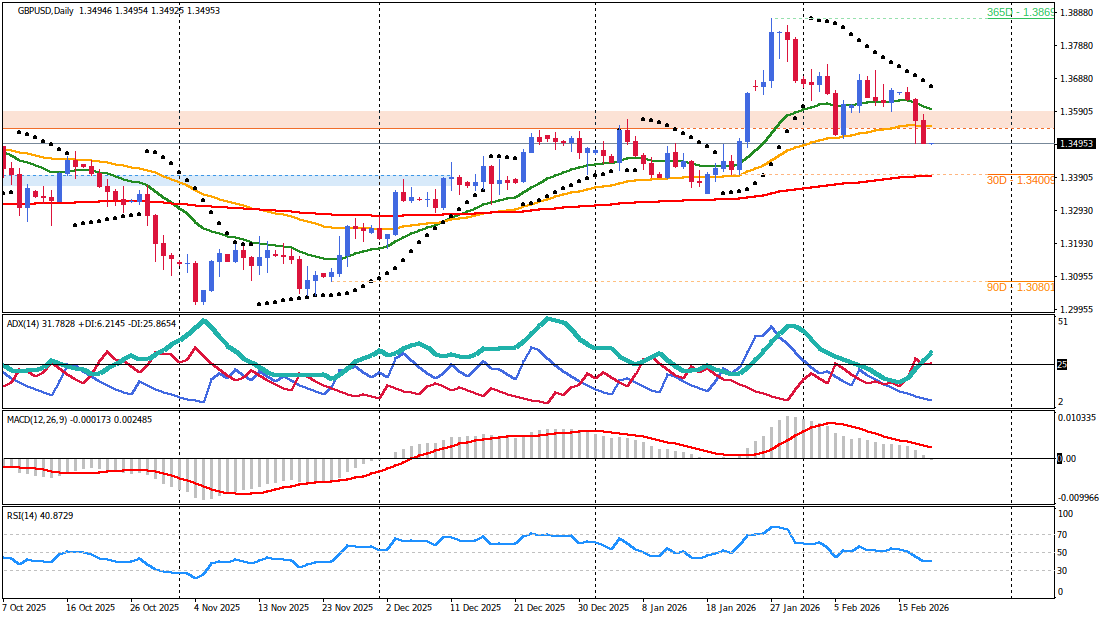
The GBP/USD currency pair, colloquially known as Cable, is currently navigating a period of significant structural weakness as technical breakdowns align with a shifting fundamental landscape. The primary driver for Sterling's recent underperformance is the cooling of United Kingdom inflation, which hit a nearly one-year low of 3.0% in January. This development has substantially increased market expectations for a Bank of England (BoE) interest rate cut as early as the March 19 meeting. Technical structure combined with the breach of the 1.3500 psychological level supports a sustained bearish outlook, as price action transitions from a corrective phase into a primary trend expansion. While the Bank of England faces pressure to ease policy, the U.S. Federal Reserve remains divided, as evidenced by the latest FOMC minutes, providing a hawkish backdrop for the U.S. Dollar. This policy divergence, coupled with safe-haven demand stemming from geopolitical tensions in the Middle East, reinforces the bearish technical signals observed across multiple timeframes. Traders should prepare for heightened volatility as a heavy slate of economic data, including U.S. Unemployment Claims and UK Retail Sales, looms over the current session and the upcoming European open.
Technical Analysis
Multi-Timeframe Market Structure
The technical framework for GBP/USD is characterized by a high-conviction bearish bias across the daily, four-hour, and hourly timeframes. On the Daily (D1) chart, the primary trend has turned decisively bearish following a close below the EMA20 and EMA50 clusters. This move has effectively invalidated previous bullish structures and shifted the focus toward the EMA200, which serves as the next major structural target. The Average Directional Index (ADX) on the daily timeframe is rising above 30, confirming that the downward momentum is gaining trend strength rather than merely reflecting a temporary correction.
The Four-Hour (H4) framework reveals an aggressive bearish sequence where major exponential moving averages are beginning to fan out, signaling a sustained distribution phase. The MACD histogram is expanding deeper into negative territory, while the RSI remains suppressed below the 31 level. On the Hourly (H1) timeframe, the pair is in a state of vertical decline, with the ADX exceeding 53, indicating an exceptionally strong intraday trend. Current price action shows consolidation between 1.3480 and 1.3495, which aligns with fundamental uncertainty ahead of high-impact U.S. labor data.
Critical Price Levels & Momentum Assessment
The 1.3500 level, previously a significant psychological and structural floor, has now transitioned into a formidable resistance zone. Price action aligns with the fundamental backdrop to favor a "sell the rally" approach, particularly as momentum indicators suggest the pair is in a momentum-driven decline with no evidence of a reversal base forming. Key levels include:
- Resistance 1.3495: This level represents the previous Daily close and the H4 structural breakdown point. It serves as the immediate ceiling for any corrective bounces.
- Resistance 1.3540: A major structural pivot where the D1 EMA50 and H1 EMA50 converge. A recovery to this level would be viewed as a significant corrective move within the broader downtrend.
- Support 1.3450: A psychological level and the primary intraday extension target for the current bearish leg.
- Support 1.3395: The D1 EMA200, representing the most critical structural support on the daily timeframe. A test of this level is likely if fundamental pressure on the Pound persists.
Fundamental Market Drivers
Central Bank Policy & Economic Outlook
The fundamental narrative for the British Pound has shifted dramatically following the release of the January Consumer Price Index (CPI) data. The drop in headline inflation to 3.0% from 3.4% has provided the Bank of England with the "green light" required to consider pivot strategies. While the BoE held rates at 3.75% in a narrow 5-4 vote earlier this month, the cooling of core inflation to 3.1%—the lowest in over four years—suggests that underlying price pressures are finally losing their grip. This fundamental development directly supports the technical breakdown below 1.3500 as markets price in a 0.25 percentage point cut to 3.5% in March.
However, the fundamental outlook is complicated by "sticky" services inflation, which remains elevated at approximately 4.5%. Analysts note that core services inflation actually nudged higher to 4.3% when volatile items are excluded. This persistence in the service sector, driven by domestic demand and hospitality costs, suggests that while the BoE may begin cutting rates, the pace of easing will likely be gradual. This "ease off the brake" approach rather than an aggressive "stomp on the gas" policy may provide some intermittent support for Sterling, though the immediate trend remains weighed down by the broader disinflationary trend in food and transport costs.
Market Sentiment & Risk Environment
The U.S. Dollar continues to exert dominance, bolstered by the January FOMC meeting minutes which revealed a Federal Reserve deeply divided over the timing of future rate cuts. Concerns over sticky inflation in the U.S. have led several officials to caution against easing too early, a stance that contrasts sharply with the growing consensus for a BoE cut. This policy divergence is a primary catalyst for the GBP/USD decline.
Furthermore, risk sentiment has turned defensive due to escalating geopolitical risks. Reports indicating potential U.S. military action in the Middle East as early as this weekend have assisted the safe-haven Greenback in preserving its recent gains. This risk-off environment typically weighs heavily on the Pound, which is more sensitive to global growth and risk appetite. Market positioning and sentiment indicators suggest that any attempted recovery in Cable will likely be met with fresh selling pressure as traders favor the liquidity and safety of the U.S. Dollar.
Integrated Trading Execution
Primary Trading Scenario
- Bias: High-conviction bearish continuation, as the technical breakdown of 1.3500 is reinforced by the BoE's dovish shift and hawkish FOMC sentiment.
- Trigger/Entry: Sell on a retracement to the 1.3495 zone (±3 pips). This entry aligns with the previous structural breakdown point and the intraday resistance established during the London session.
- Stop-Loss: 1.3515. This level is placed above the M30 EMA50 and accounts for 1.25x the H1 ATR to protect against intraday volatility spikes.
- Profit Targets:
- Target 1: 1.3410 - A major horizontal level ahead of structural support.
- Target 2: 1.3385 - Alignment with the D1 EMA200, representing a significant technical and fundamental target.
- Session Context: Best executed during the London/New York overlap to capitalize on maximum liquidity and the reaction to U.S. labor data.
Alternative Market Scenario
- Invalidation: A sustained M30 close above 1.3515, potentially triggered by significantly weaker-than-expected U.S. Unemployment Claims or a surprise hawkish shift in BoE rhetoric.
- Bias: Bullish relief rally/short-squeeze scenario.
- Trigger/Entry: 1.3520 on a confirmed breakout and retest of the 1.3515 level.
- Stop-Loss: 1.3490.
- Profit Targets:
- Target 1: 1.3540 - Resistance at the D1 EMA50.
- Target 2: 1.3575 - Previous swing high and structural resistance.
- Session Context: This scenario requires a specific U.S. Dollar weakness catalyst to overcome the current bearish technical momentum.
Risk Management & Catalyst Analysis
Trade Risk Assessment
The primary risk to the bearish scenario is the proximity of high-impact economic data. While technical and fundamental signals are in rare three-timeframe alignment, the "whipsaw" potential during the U.S. session is high. The "stickiness" of UK services inflation remains a wildcard; if upcoming PMI data suggests a resurgence in service sector strength, the BoE's path to a March cut could be questioned, leading to a sharp reversal in Sterling. Traders should reduce position sizes by half ahead of the U.S. Unemployment Claims today and the UK Retail Sales tomorrow to account for potential slippage and volatility spikes. The expanding ATR on the H1 timeframe necessitates wider stop-loss placement compared to standard conditions.
Economic Calendar & Event Impact
- US Unemployment Claims (Today, 13:30 UTC): Forecast 223K, Previous 227K - A lower-than-expected figure will likely accelerate the GBP/USD decline by reinforcing Fed hawkishness.
- US Philly Fed Manufacturing Index (Today, 13:30 UTC): Forecast 7.5, Previous 12.6 - A measure of regional manufacturing health that will influence USD intraday momentum.
- UK Retail Sales m/m (Tomorrow, 07:00 UTC): Forecast 0.2%, Previous 0.4% - Critical for assessing UK consumer health; a miss would further cement the case for a BoE rate cut.
- UK Flash Services PMI (Tomorrow, 09:30 UTC): Forecast 53.5, Previous 54.3 - The most important indicator for "sticky" services inflation; a strong beat could trigger the alternative bullish scenario.
- US Advance GDP q/q (Tomorrow, 13:30 UTC): Forecast 3.0%, Previous 3.0% - A key measure of U.S. economic resilience that supports the "higher for longer" Fed narrative.
- US Core PCE Price Index m/m (Tomorrow, 13:30 UTC): Forecast 0.3%, Previous 0.2% - The Fed's preferred inflation gauge; a high reading would be a major headwind for GBP/USD.
Synthesized Market Outlook
The outlook for GBP/USD remains heavily skewed to the downside as the pair grapples with a combination of technical exhaustion and a deteriorating fundamental backdrop for the Pound. The convergence of cooling UK inflation and a divided but ultimately cautious Federal Reserve creates a path of least resistance that points toward lower price levels. The technical breach of 1.3500 is a significant milestone that shifts the medium-term target to the 1.3395-1.3410 region. While intraday oversold conditions may prompt brief relief rallies, the fundamental divergence between the BoE and the Fed suggests these bounces will be viewed as distribution opportunities by institutional participants. Monitoring the 1.3515 level is critical; a failure to reclaim this zone on a closing basis maintains the high-conviction bearish bias. Conversely, traders must remain alert to the "sticky" services inflation narrative in the UK, as any signs of economic resilience in tomorrow's PMI data could provide the only credible catalyst for a structural trend reversal.


