
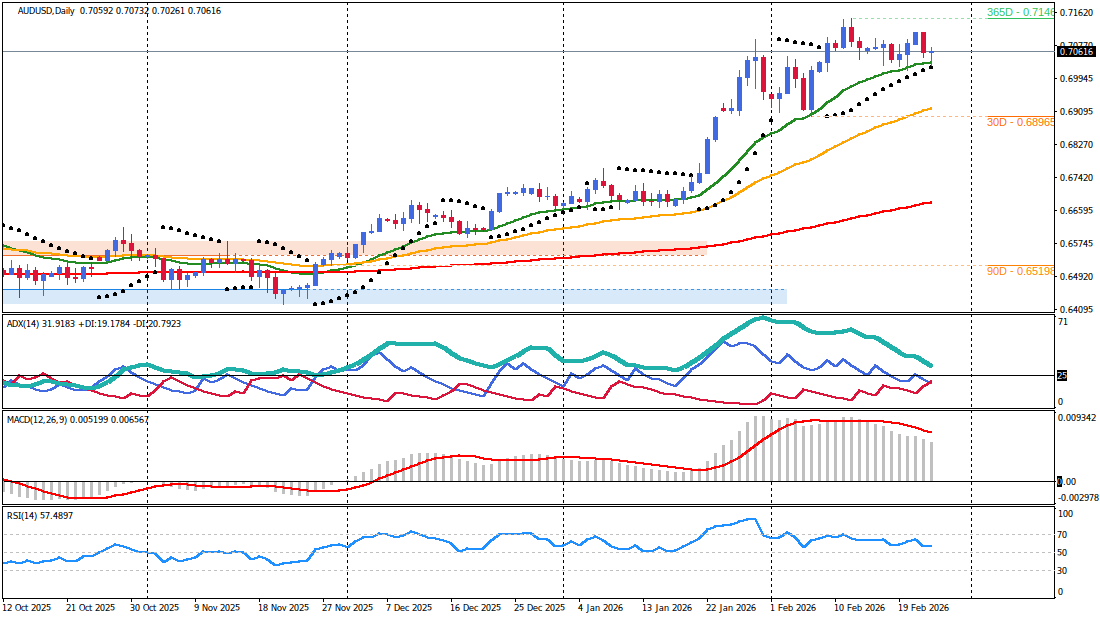
The AUD/USD pair currently maintains a neutral intraday bias as it consolidates within a broader long-term bullish structure. While price action remains compressed, the fundamental backdrop is increasingly supportive of the Australian Dollar due to the Reserve Bank of Australia's (RBA) significant hawkish pivot. The RBA has transitioned from pricing in rate cuts to a technical assumption of 60 basis points in additional hikes for 2026, keeping the Official Cash Rate (OCR) at 3.85% for now. Technical structure combined with persistent inflationary pressures supports a potential breakout if upcoming data confirms that price growth remains sticky. Markets are currently in a wait-and-see mode ahead of critical high-impact catalysts, including the Australian Monthly CPI Indicator and a scheduled address by US President Trump. This analysis explores the convergence of these fundamental drivers with current multi-timeframe technical levels to provide a definitive trading framework for the sessions ahead.
Technical Analysis
Multi-Timeframe Market Structure
The primary trend on the daily (D1) timeframe remains decidedly bullish. Price action continues to hold above the 20-day, 50-day, and 200-day Exponential Moving Averages (EMAs), signaling strong structural health. The ADX on the daily chart sits at 31.92, confirming that the long-term trend strength remains significant despite the recent correction from the 0.7111 peak. Fundamental support from a resilient labor market and high commodity prices for iron ore and gold aligns with this daily bullishness, suggesting that pullbacks are currently viewed as liquidity-seeking events rather than trend reversals.
In contrast, the H4 timeframe reveals a stalled momentum environment. The ADX has dropped to 14.24, indicating a non-trending phase where the EMA20 and EMA50 have converged near 0.7062. This convergence acts as a central pivot zone where buyers and sellers are reaching equilibrium. The H1 timeframe further confirms this neutrality, with the RSI hovering near the 50 midline. Intraday volatility, measured by the H1 ATR, is compressed at 11 pips, suggesting an imminent volatility expansion once the market receives fresh fundamental catalysts.
Critical Price Levels & Momentum Assessment
The current technical landscape is defined by the following key levels:
- Resistance 1: 0.7070 - This level represents the H4 EMA cluster and a significant intraday supply zone where selling pressure has previously emerged.
- Resistance 2: 0.7111 - The recent swing high and major structural resistance; a break above this level would signal a resumption of the primary daily uptrend.
- Support 1: 0.7048 - The recent session low and immediate H1 support.
- Support 2: 0.7035 - A critical confluence of the D1 EMA20 and major trend-line support, serving as the "line in the sand" for the bullish bias.
Momentum quality is currently categorized as weak due to the low ADX values across intraday timeframes. However, the MFI at 74.10 on the M30 timeframe suggests that liquidity is accumulating at the upper end of the current range, which could facilitate a breakout if the fundamental data provides the necessary impetus.
Fundamental Market Drivers
Central Bank Policy & Economic Outlook
The Reserve Bank of Australia (RBA) has adopted a notably cautious and hawkish stance compared to its global peers. In its recent Statement on Monetary Policy (SMP), the RBA highlighted that policy may not be sufficiently restrictive, and the technical assumption of 60 basis points in hikes this year marks a significant reversal from late 2025 expectations. This hawkishness is fueled by a resilient labor market, with unemployment holding at 4.1%, and growth forecasts being lifted to 2.1% by June. The fundamental narrative suggests that while other central banks are debating the timing of cuts, the RBA is focused on whether its current 3.85% OCR is enough to return inflation to the 2-3% target range.
The upcoming January CPI data is the primary driver for near-term direction. While the headline figure is forecast to ease slightly to 3.7% YoY from 3.8%, the RBA remains focused on the Trimmed Mean, which strips out volatile components. If core inflation remains sticky, the RBA is unlikely to relax its stance. This fundamental outlook provides a floor for the Australian Dollar, as the yield advantage and the RBA's reluctance to pivot toward easing differentiate the Aussie from other major currencies.
Market Sentiment & Risk Environment
Global risk sentiment remains a secondary but vital driver for AUD/USD. As a pro-cyclical currency, the Australian Dollar benefits from "risk-on" environments and strong demand for its primary exports, such as iron ore. However, the current sentiment is tempered by political uncertainty in the United States and Japan. In the US, markets are bracing for President Trump's State of the Union address, where comments on tariffs or geopolitical tensions could trigger a flight to the US Dollar, potentially pressuring the AUD/USD pair regardless of domestic Australian strength.
Furthermore, structural shifts in the US labor market, as highlighted by Fed officials regarding AI adoption and its impact on full employment, add a layer of complexity to the US Dollar's trajectory. If the USD strengthens on safe-haven flows or structural economic shifts, it could challenge the technical support at 0.7035. Conversely, the political pressure in Japan to keep rates low has weakened the Yen, indirectly supporting the AUD via cross-currency flows in the AUD/JPY pair, which often spills over into AUD/USD strength.
Integrated Trading Execution
Primary Trading Scenario
- Bias: Bullish breakout supported by RBA policy divergence and sticky inflation data.
- Trigger/Entry: M30 candle close above 0.7075 following a stronger-than-expected AU CPI print (above 0.2% m/m or 3.7% y/y).
- Stop-Loss: 0.7045 - Placed 1.5x H1 ATR below the entry to account for high-volatility spikes.
- Profit Targets:
- Target 1: 0.7110 - Recent swing high and significant psychological resistance.
- Target 2: 0.7150 - Structural target near the 2023 highs and February ceiling.
- Session Context: This setup is most likely to trigger during the Asian session immediately following the CPI release.
Alternative Market Scenario
- Invalidation: A break below 0.7035 triggered by a significant CPI miss or hawkish US Dollar rhetoric.
- Bias: Bearish breakdown targeting deeper structural supports.
- Trigger/Entry: Sustained break below 0.7035 on the H1 timeframe.
- Stop-Loss: 0.7065 - Above the H4 EMA cluster.
- Profit Targets:
- Target 1: 0.7000 - Key psychological level and liquidity zone.
- Target 2: 0.6950 - Major structural support level.
- Session Context: High volatility expected during the US session transition, particularly surrounding the US Presidential address.
Risk Management & Catalyst Analysis
Trade Risk Assessment
The primary risk to this outlook is the "whipsaw" potential inherent in the 90-minute window between the Australian CPI release and the US Presidential speech. These two high-impact events can produce conflicting signals, leading to rapid price reversals. Traders should account for the possibility that a strong Australian CPI print could be neutralized by aggressive US tariff rhetoric, which would favor the US Dollar. Given this environment, reducing position sizes by 50% is recommended to manage the increased liquidity risk and wider spreads expected during these releases.
Economic Calendar & Event Impact
The following events are critical for AUD/USD price action:
- AU CPI m/m (Tomorrow, 00:30 UTC): Forecast 0.2%, Previous 1.0% - Higher than forecast readings will solidify RBA hike expectations and drive AUD strength.
- AU CPI y/y (Tomorrow, 00:30 UTC): Forecast 3.7%, Previous 3.8% - A reading of 3.8% or higher would suggest inflation remains in the "danger zone."
- AU Trimmed Mean CPI m/m (Tomorrow, 00:30 UTC): Forecast 0.4%, Previous 0.2% - The RBA's preferred core inflation gauge; the most significant factor for medium-term policy.
- US President Trump Speaks (Tomorrow, 02:00 UTC): High-impact event - Focus on tariff policy and geopolitical commentary which could spark USD volatility.
- AU RBA Gov Bullock Speaks (Tomorrow, 08:40 UTC): Medium-impact event - Opportunity for the RBA to reinforce its hawkish stance post-CPI.
- US Unemployment Claims (February 26, 13:30 UTC): Forecast 217K, Previous 206K - Key for assessing US labor market resilience.
- US Core PPI m/m (February 27, 13:30 UTC): Forecast 0.3%, Previous 0.7% - Critical for US inflation outlook and Fed rate path.
Synthesized Market Outlook
The technical structure of AUD/USD aligns with the fundamental backdrop to favor a bullish continuation, provided the 0.7035 support level remains intact. The RBA's hawkish shift, underpinned by sticky core inflation and a robust labor market, creates a significant policy divergence with other G10 currencies. While the current market is characterized by range-bound consolidation and low volatility, the upcoming cluster of high-impact events—specifically the Australian CPI and the US Presidential address—will serve as the catalyst for the next major directional move.
Traders should monitor the 0.7070-0.7075 resistance zone for breakout confirmation. A successful breach of this level, supported by a sticky Trimmed Mean inflation print, would validate the RBA's hawkish assumptions and likely propel the pair toward the 0.7111 and 0.7150 targets. Conversely, any failure to hold the 0.7035 support would necessitate a reassessment of the bullish thesis, as it would signal that either the US Dollar's safe-haven appeal or a cooling Australian economy is beginning to dominate price action.


