
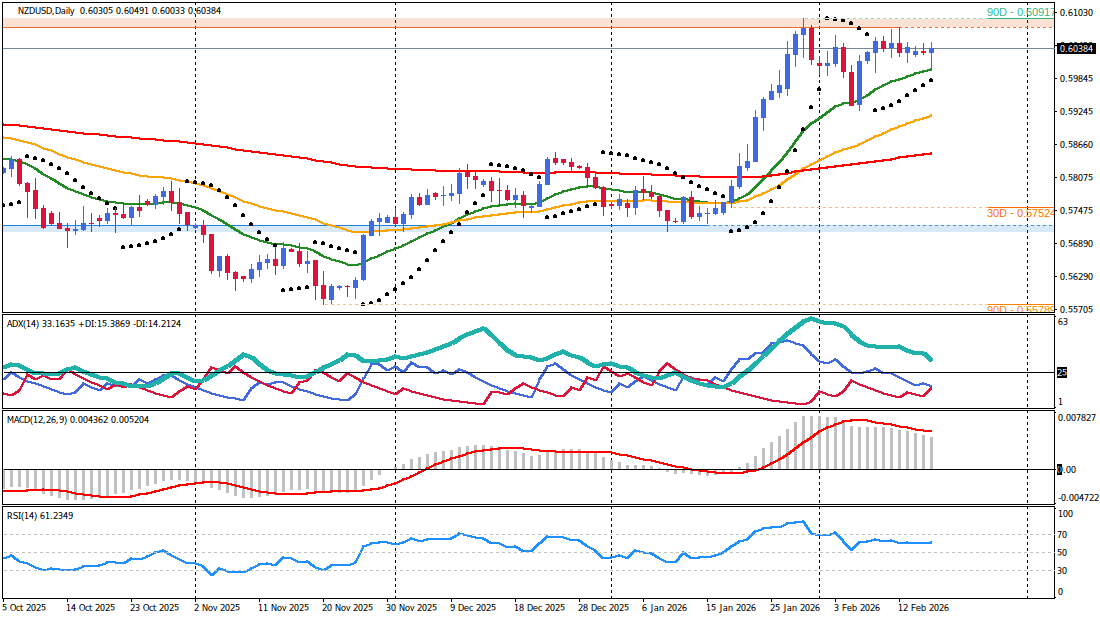
NZD/USD is currently maintaining a bullish consolidative posture, trading near the 0.6050 resistance level as the market prepares for a high-volatility sequence centered on the Reserve Bank of New Zealand (RBNZ). Technical structure combined with a backdrop of "hot" domestic inflation and a resilient labor market supports an underlying bullish bias, although immediate momentum is coiling within a narrow intraday range. The primary narrative for the pair involves the RBNZ’s first monetary policy meeting of 2026, where the central bank is widely expected to pause its interest-rate cutting cycle at 2.25%. Price action aligns with the fundamental backdrop to favor the upside, as market participants anticipate that Governor Anna Breman may validate hawkish expectations by revising Official Cash Rate (OCR) projections higher. With Q4 inflation surprising to the upside at 3.1% and employment growth beating forecasts at 0.5%, the Kiwi Dollar remains well-positioned to exploit any hawkish divergence against a US Dollar that awaits its own catalysts in the form of FOMC minutes and PCE inflation data later this week.
Technical Analysis
Multi-Timeframe Market Structure
The primary trend on the daily (D1) chart remains constructive, with price action holding firmly above the rising 20-day Exponential Moving Average (EMA) at 0.6001 and the 50-day EMA at 0.5919. This structural alignment is bolstered by a strongly positive MACD histogram and an RSI maintaining a bullish profile above 60. Technical structure combined with the emerging "Golden Cross"—where the 50-day Simple Moving Average (SMA) approaches a cross above the 200-day SMA—supports a medium-term bullish outlook targeting the 0.6100 psychological area. In the medium-term H4 framework, the pair is digesting a significant bullish breakout, with the RSI at 55 suggesting that momentum has not yet reached overbought extremes. On the intraday H1 and M30 timeframes, the pair is establishing a holding pattern above a cluster of moving averages near 0.6035, indicating a period of accumulation ahead of the RBNZ announcement.
Critical Price Levels & Momentum Assessment
Current price action is defined by a tight struggle at the 0.6050 horizontal barrier, which serves as the immediate H4 breakout trigger. Momentum indicators remain generally positive, but the stochastic oscillator on the M30 timeframe is deeply overbought, suggesting that a minor pause or shallow retest of support may precede the next directional leg. The fundamental significance of the 0.6000 level cannot be overstated, as it represents a major psychological floor and the location of the 20-day EMA, marking the line in the sand for the current bullish thesis.
- Resistance Levels: 0.6050 (Immediate barrier), 0.6070 (Swing high), 0.6100 (Psychological target), 0.6122 (52-week high).
- Support Levels: 0.6030 (H1 EMA cluster), 0.6015 (Breakout point), 0.6000 (Major psychological support), 0.5935 (Structural floor).
Fundamental Market Drivers
Central Bank Policy & Economic Outlook
The RBNZ is set to conclude its first meeting of the year on Wednesday, with a consensus expectation for the Official Cash Rate to remain steady at 2.25%. This marks a definitive pause following three consecutive rate cuts, a shift necessitated by New Zealand’s stubborn inflation profile. Fundamental analysis of the Q4 data reveals that headline inflation reached 3.1%, significantly exceeding the RBNZ’s own 2.7% estimate. Furthermore, non-tradable inflation at 3.5% suggests that domestic price pressures remain entrenched. This "hot" inflation data aligns with technical momentum to favor a hawkish interpretation of the upcoming Monetary Policy Statement.
The economic outlook is further supported by a labor market that continues to defy expectations. While the unemployment rate ticked up to 5.4%, this was largely due to a surge in the participation rate rather than a loss of jobs. Employment growth of 0.5% in Q4 doubled the RBNZ’s forecast, signaling that underlying economic momentum remains firm. Analysts from ING and BBH suggest that the RBNZ may be forced to bring forward its OCR hike projections, with some market pricing already reflecting the possibility of two rate hikes by the third quarter of 2026. This potential policy pivot provides the fundamental justification for the technical breakout above the 0.6050 level.
Market Sentiment & Risk Environment
Market sentiment is currently characterized by a "wait-and-see" approach, as the debut of Governor Anna Breman introduces an element of leadership uncertainty. While her previous reputation at the Riksbank leaned dovish, her initial communications in New Zealand have emphasized that policy will adjust if the inflation picture demands it. Risk sentiment remains a critical secondary driver for the New Zealand Dollar, given its status as a commodity-linked currency. Stabilizing dairy prices and improving PMIs—with the Services PMI recently crossing into expansionary territory at 51.5—support the Kiwi’s relative strength. However, the fragile global equity environment and the upcoming US FOMC minutes introduce two-way risk, as any hawkish surprise from the Federal Reserve could temporarily bolster the US Dollar and challenge the NZD/USD bullish trajectory.
Integrated Trading Execution
Primary Trading Scenario
- Bias: Bullish - Technical structure combined with expectations of a hawkish RBNZ policy pivot supports a continuation of the primary uptrend.
- Trigger/Entry: A sustained break and retest of the 0.6050 resistance level following the RBNZ announcement.
- Stop-Loss: 0.6030 - Placed below the H1 EMA cluster and recent intraday consolidation.
- Profit Targets:
- Target 1: 0.6070 - Previous swing high and intermediate psychological resistance.
- Target 2: 0.6100 - Major psychological target aligned with D1 structural objectives.
- Session Context: Execution is focused on the Asian session volatility surrounding the 01:00 UTC RBNZ release and the 02:00 UTC press conference.
Alternative Market Scenario
- Invalidation: A dovish policy statement that downplays inflation risks or a sustained drop below the 0.6030 support level.
- Bias: Bearish - A "sell the fact" reaction or a dovish surprise from Governor Breman would invalidate the immediate bullish setup.
- Trigger/Entry: Sustained break below 0.6030 on high volume.
- Stop-Loss: 0.6050 - Above the recent session highs.
- Profit Targets:
- Target 1: 0.6015 - Previous H4 breakout point.
- Target 2: 0.6000 - Major psychological support and D1 EMA20.
- Session Context: This scenario is most likely if the RBNZ emphasizes economic slack or global growth risks over domestic inflation pressures.
Risk Management & Catalyst Analysis
Trade Risk Assessment
The risk profile for NZD/USD is currently categorized as high due to the concentration of top-tier economic events. While technical indicators on the daily and four-hour charts are bullish, they are entirely subordinate to the imminent RBNZ headlines. The H1 ATR(14) of 11 pips serves as a baseline for volatility, but traders should expect this to expand significantly during the news release. To manage event risk, position sizing should be reduced by at least 50%, and stop-loss orders should be widened to approximately 2x the standard ATR to avoid being liquidated by news-driven whipsaws. The 0.6050 to 0.6000 range is the critical battlefield; a failure to hold the 0.6000 psychological level would signal a broader trend reversal.
Economic Calendar & Event Impact
The upcoming economic calendar is heavily weighted toward central bank policy and inflation data, which will dictate the medium-term path for NZD/USD:
- US Empire State Manufacturing Index (Today, 13:30 UTC): Forecast 6.4, Previous 7.7 - Provides an early look at US industrial health and near-term USD sentiment.
- NZ Official Cash Rate (Tomorrow, 01:00 UTC): Forecast 2.25%, Previous 2.25% - The primary catalyst for the week; a hold is expected, but the accompanying statement is critical.
- NZ RBNZ Monetary Policy Statement (Tomorrow, 01:00 UTC): High-impact event for NZD direction - Updated inflation and OCR projections will drive long-term positioning.
- NZ RBNZ Press Conference (Tomorrow, 02:00 UTC): Governor Breman’s debut press conference will offer insights into the bank's reaction function to "hot" inflation.
- US FOMC Meeting Minutes (Tomorrow, 19:00 UTC): Critical for assessing the Fed's stance on future rate cuts and USD strength.
- NZ RBNZ Gov Breman Speaks (Tomorrow, 19:10 UTC): Follow-up remarks that could clarify or reinforce the earlier policy message.
- US Unemployment Claims (February 19, 13:30 UTC): Forecast 223K, Previous 227K - Important labor market indicator for USD momentum.
- US Advance GDP q/q (February 20, 13:30 UTC): Forecast 3.0%, Previous 3.0% - Major growth data that will impact risk sentiment and USD valuation.
- US Core PCE Price Index m/m (February 20, 13:30 UTC): Forecast 0.3%, Previous 0.2% - The Fed's preferred inflation gauge; a beat would strengthen the USD and pressure NZD.
Synthesized Market Outlook
The outlook for NZD/USD is cautiously bullish, predicated on a technical breakout that finds fundamental validation from a hawkish-leaning RBNZ. The combination of a 3.1% inflation rate and a robust labor market makes it difficult for the central bank to maintain its previous dovish trajectory, suggesting that the "path of least resistance" for the Kiwi is higher. However, the market has already priced in a significant portion of this hawkish shift, making the 0.6050 to 0.6070 resistance zone a formidable obstacle. Traders should monitor the 0.6050 level for a clean breakout on the RBNZ announcement, while remaining vigilant for any dovish rhetoric from Governor Breman that could trigger a sharp reversal toward 0.6000. The end-of-week US PCE and GDP data will ultimately determine if the NZD/USD can sustain its gains or if a resurgent US Dollar will force a broader consolidation phase.


