
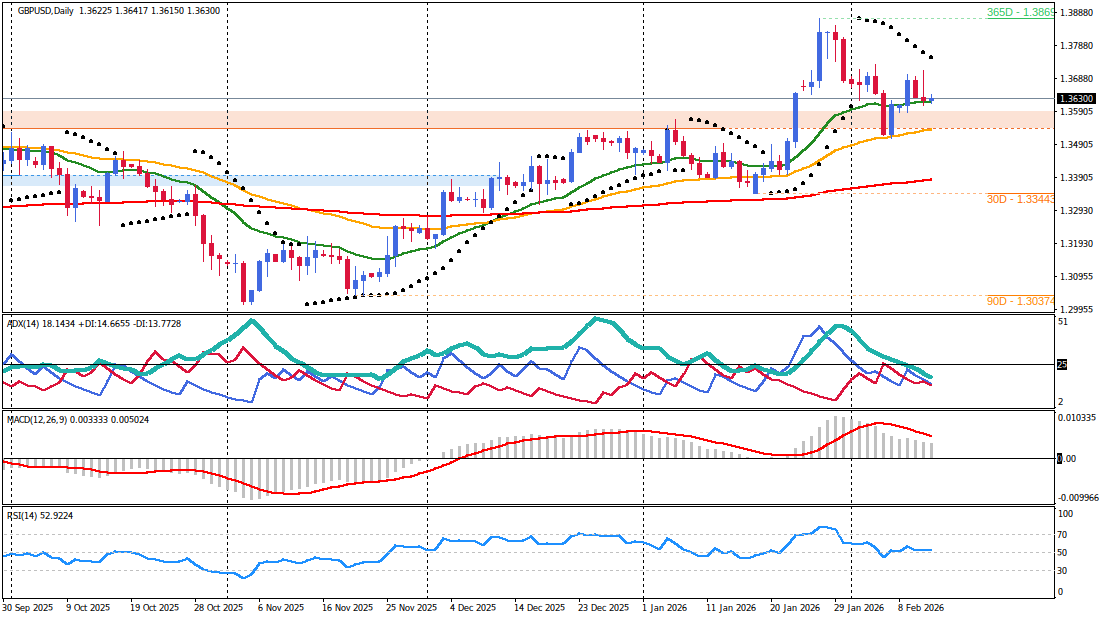
GBP/USD maintains a neutral to bearish technical bias as the pair enters a critical corrective phase following a sharp rejection of the 1.3700 psychological handle. Price action aligns with the fundamental backdrop of a resilient US labor market and a dovish shift within the Bank of England to favor the downside in the immediate term. Technical structure combined with deteriorating growth momentum in the United Kingdom supports a test of major structural support levels. The failure to sustain gains above 1.3710 indicates that the market is repricing the Sterling lower as investors anticipate a potential 25 basis point rate cut from the Bank of England in March. With high-impact UK Gross Domestic Product data and US inflation reports scheduled, the pair sits at a technical crossroads where the 1.3617 level serves as the primary line of defense for the broader bullish trend. A failure here confirms a transition from a simple correction to a more significant trend reversal.
Technical Analysis
Multi-Timeframe Market Structure
The dominant daily structure remains technically bullish as GBP/USD continues to trade above the 200-day and 50-day Exponential Moving Averages. However, this long-term stability is currently under threat. The previous session produced a notable rejection of 1.3712, with price closing near session lows, signaling that supply is overwhelming demand at higher levels. Technical structure combined with the current test of the 20-day EMA at 1.3617 indicates a loss of bullish conviction. A daily close below this level would signal a shift in the medium-term trend.
On the H4 timeframe, the framework has transitioned to a neutral-bearish stance. The pair has slipped below the H4 EMA20 and EMA50, which are currently converging near 1.3645. This convergence creates a formidable resistance zone that bulls must reclaim to restore any immediate upside momentum. The low ADX reading suggests a lack of a strong trending environment, which typically precedes a volatile breakout when fundamental catalysts like the UK GDP release are introduced.
The short-term intraday bias on the H1 and M30 timeframes is decisively bearish. Price action maintains a sequence of lower highs and lower lows, while H1 momentum is negative with the MACD histogram expanding below the zero line. While oversold oscillators on the M30 suggest a minor corrective bounce or consolidation might occur prior to the London session, the overall intraday pressure remains focused on the 1.3600 psychological level.
Critical Price Levels & Momentum Assessment
The technical significance of current levels is enhanced by the proximity of several structural barriers. Momentum indicators are currently in a state of conflict, reflecting the market's uncertainty ahead of high-impact data.
- Resistance 1.3645: This level represents the confluence of the H4 EMA20 and EMA50. It serves as a strong intraday barrier that must be cleared to invalidate the immediate bearish thesis.
- Resistance 1.3712: This is the previous session high and a key structural resistance point that marked the start of the current leg lower.
- Support 1.3617: The daily EMA20 is the critical trend-following support level. A breach of this level often precedes a deeper move toward the 50-day EMA.
- Support 1.3600: This psychological level and recent swing low form a 15-pip support zone that acts as a magnet for bearish targets.
- Support 1.3536: The daily EMA50 represents major structural support and the final target for a standard corrective move.
Fundamental Market Drivers
Central Bank Policy & Economic Outlook
The fundamental narrative for the British Pound has shifted toward a more cautious outlook as the Bank of England's Monetary Policy Committee shows signs of increasing dovishness. Despite headline inflation remaining stubbornly high at 3.4% and services inflation at 4.5%, the MPC recently displayed a 5-4 vote split, with four members backing an immediate interest rate cut. This internal division, combined with Governor Andrew Bailey’s comments that inflation may reach the 2% target sooner than expected, has led markets to price in a 25 basis point rate cut for the March 19 meeting.
The economic outlook for the UK remains subdued. While the BoE projects 1.5% growth for the year, the preliminary Q4 2025 GDP data is expected to show a modest expansion of only 0.2% on a quarterly basis. Momentum appears to be fading, with monthly output for December forecasted at a mere 0.1%. This lack of economic energy aligns with technical signals of a weakening trend, as stagnant growth provides little fundamental justification for the Pound to trade above the 1.3700 level.
Market Sentiment & Risk Environment
Market sentiment is currently being shaped by the divergence between the UK's slowing growth and the surprising resilience of the United States economy. The recent US Nonfarm Payrolls report, which showed 130,000 jobs added against a forecast of 70,000, has forced traders to trim their bets for an aggressive Federal Reserve easing cycle. This resilience in the US labor market provides a fundamental floor for the US Dollar, creating a "risk-off" environment for the Cable as the interest rate differential favors the greenback.
Geopolitical and domestic political factors are also weighing on Sterling sentiment. UK political risk has flared following calls for Prime Minister Keir Starmer to step down amid the Peter Mandelson scandal. While cabinet support has steadied the situation for now, the introduction of political uncertainty often leads to a "Sterling discount" in the FX markets. This political backdrop supports the bearish technical scenario, as investors are less likely to buy the Pound during periods of administrative instability.
Integrated Trading Execution
Primary Trading Scenario
- Bias: Bearish - Technical structure combined with BoE dovish signals and resilient US labor data supports further downside.
- Trigger/Entry: Sell on a sustained break below 1.3610 following the UK GDP release to confirm the violation of the daily EMA20.
- Stop-Loss: 1.3635 - Positioned above the H1 EMA20 to protect against minor corrective bounces.
- Profit Targets:
- Target 1: 1.3575 - Structural support near the recent consolidation zone.
- Target 2: 1.3540 - Alignment with the major daily EMA50 support level.
- Session Context: Best executed during the London session to capture the volatility of the GDP impact, followed by the New York open.
Alternative Market Scenario
- Invalidation: A sustained H1 candle close back above 1.3650 invalidates the immediate bearish thesis.
- Bias: Bullish - Contingent on a significant beat in UK GDP data and a softening of US labor market concerns.
- Trigger/Entry: Buy on a recovery and H1 candle close above 1.3645, targeting a reclaim of the H4 EMA confluence.
- Stop-Loss: 1.3620 - Positioned below the critical daily EMA20 support.
- Profit Targets:
- Target 1: 1.3685 - Intraday resistance and the 50% Fibonacci retracement level.
- Target 2: 1.3710 - Previous session high and major structural resistance.
- Session Context: This scenario requires a fundamental catalyst, such as a GDP print above 0.3%, to override the current bearish technical alignment.
Risk Management & Catalyst Analysis
Trade Risk Assessment
The primary risk to the bearish scenario is the "inflation league table" position of the UK. With services inflation remaining at 4.5%, any upside surprise in GDP could lead the market to believe the BoE will be forced to keep rates higher for longer, causing a sharp short-covering rally. Additionally, the proximity to the daily EMA20 (1.3617) introduces significant reversal risk if the level holds on the first test. Traders should adjust position sizes by 50% to account for the high-impact news environment and use a 1.5x ATR stop-loss buffer to avoid being cleared by pre-news volatility.
Economic Calendar & Event Impact
- US Average Hourly Earnings m/m (Yesterday, 13:30 UTC): Forecast 0.3%, Previous 0.3% - Indicated stable wage growth, supporting a cautious Fed approach.
- US Non-Farm Employment Change (Yesterday, 13:30 UTC): Forecast 66K, Previous 50K - The actual print of 130K significantly beat expectations, strengthening the USD.
- US Unemployment Rate (Yesterday, 13:30 UTC): Forecast 4.4%, Previous 4.4% - The drop to 4.3% reinforced the narrative of a non-cracking labor market.
- UK GDP m/m (Today, 07:00 UTC): Forecast 0.1%, Previous 0.3% - Critical for determining if the BoE will proceed with a March rate cut.
- UK Prelim GDP q/q (Today, 07:00 UTC): Forecast 0.2%, Previous 0.1% - The advance estimate for Q4 will drive immediate Sterling volatility.
- US Unemployment Claims (Today, 13:30 UTC): Forecast 222K, Previous 231K - Key indicator for the continued resilience of the US labor market.
- US Core CPI m/m (Tomorrow, 13:30 UTC): Forecast 0.3%, Previous 0.2% - High-impact event that will determine the Fed's next policy move.
- US CPI y/y (Tomorrow, 13:30 UTC): Forecast 2.5%, Previous 2.7% - A lower print could provide a temporary reprieve for the GBP/USD pair.
Synthesized Market Outlook
The outlook for GBP/USD remains precarious as technical weakness meets fundamental uncertainty. Price action aligns with the fundamental backdrop of a slowing UK economy and a dovish Bank of England to favor a test of lower support levels. While the long-term trend is structurally bullish, the immediate path of least resistance is to the downside, provided the 1.3645 resistance level holds. Traders should monitor the 1.3617 level closely; a decisive break below this point, confirmed by weak UK GDP data, will likely accelerate the move toward 1.3536. Conversely, a significant beat in growth data or a hotter-than-expected US inflation report tomorrow could rapidly shift the market's pricing of central bank policy, leading to volatile swings within the established 1.3500 to 1.3750 range.


