
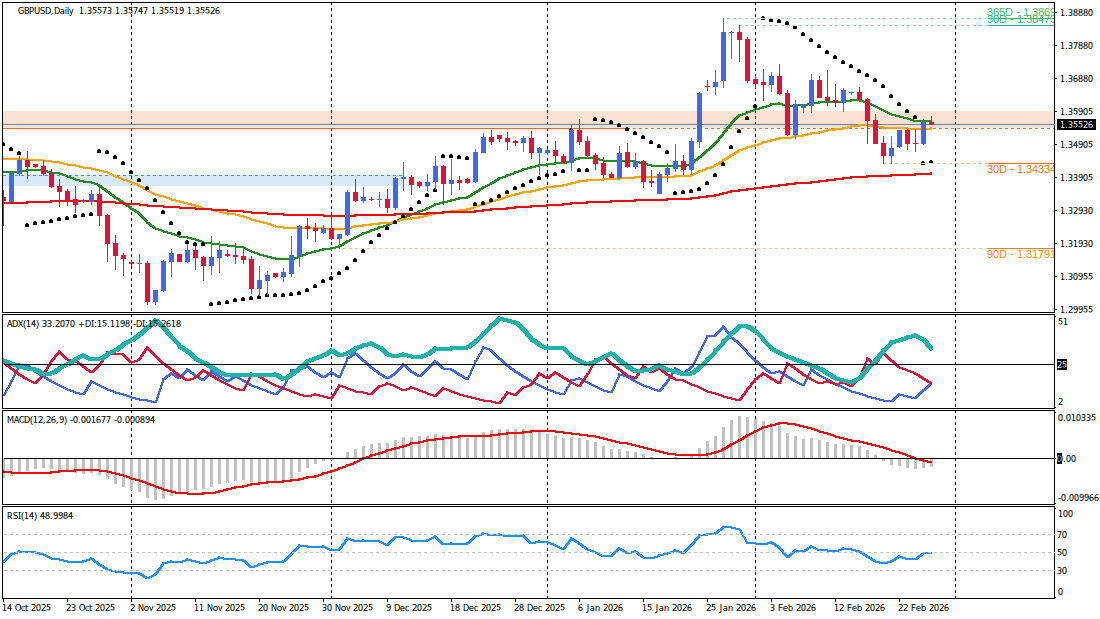
The GBP/USD pair is currently navigating a pivotal recovery phase, characterized by a technical rebound that is challenging a dense thicket of medium-term resistance. Technical structure combined with broad US Dollar weakness supports the current recovery attempt, though the upside remains tempered by shifting expectations for the Bank of England's monetary policy. While the Pound Sterling has found a foothold near 1.3565, it is caught between the fundamental tailwinds of a softening Greenback—driven by legal challenges to US trade policy—and the headwinds of cooling UK inflation. With the UK Consumer Price Index falling to 3.0%, the fundamental narrative is increasingly dominated by a potential Bank of England rate cut in March. This creates a complex environment where intraday bullish technical momentum must contend with a dovish fundamental backdrop. Traders are currently focused on high-impact US labor and inflation data as the ultimate catalysts for a decisive breakout or a technical rejection at structural levels.
Technical Analysis
Multi-Timeframe Market Structure
The dominant structure on the Daily (D1) timeframe shows a market in transition. After a sustained bearish move from the January highs near 1.3870, the pair is displaying signs of trend exhaustion. The DeMarker indicator, currently reading 0.25, highlights oversold conditions that have historically preceded corrective bounces. Price action is now testing the 20-day Exponential Moving Average (EMA) at 1.3561. A daily close above this level is essential to confirm a shift in the medium-term regime, potentially opening a path toward the 50-day EMA. While the Average Directional Index (ADX) at 33.47 indicates that the previous trend had significant strength, the current price cluster around the 20-day EMA suggests a period of consolidation and potential reversal.
On the H4 timeframe, a bullish EMA crossover has materialized, with the 20-period EMA climbing above the 50-period EMA. However, the pair is currently oscillating around the 200-period EMA at 1.3550, which acts as a significant psychological and technical pivot. The Stochastic oscillator is currently in overbought territory at 85.65, suggesting that the pair may require a brief period of consolidation or a minor pullback to the 1.3545 support zone before a sustained breakout above the recent high of 1.3575 can be achieved.
Critical Price Levels & Momentum Assessment
Intraday momentum remains robust, particularly on the H1 timeframe where the ADX stands at 44.35, indicating a strong trend. The RSI is holding firmly above 60, confirming that buyers maintain control in the short term. Price action aligns with the fundamental backdrop of US trade policy uncertainty to favor a test of upper resistance levels, provided the immediate support levels hold during the transition to the New York session.
- Resistance Levels:
- 1.3561: D1 20-period EMA - The primary structural hurdle for bulls.
- 1.3575: Recent H4 High - The immediate trigger for a momentum breakout.
- 1.3600: Psychological Level - A major supply zone and the secondary target for the current recovery.
- Support Levels:
- 1.3545: H1 EMA20 / M30 EMA50 Confluence - The critical intraday floor for the bullish bias.
- 1.3528: H1 EMA50 - Secondary support that must hold to prevent a bearish shift.
- 1.3490: Previous Daily Low - The major structural support level.
Fundamental Market Drivers
Central Bank Policy & Economic Outlook
The fundamental outlook for the Pound Sterling has been significantly reshaped by recent economic data from the Office for National Statistics. UK Consumer Price Index (CPI) inflation fell to 3.0% in January, down from 3.4% in December. This sharper-than-expected decline represents the lowest reading since mid-2025 and has drastically altered the Bank of England (BoE) policy trajectory. Market participants are now pricing in approximately 80% odds of a 25-basis point rate cut at the March 19 meeting. BoE Governor Andrew Bailey has characterized a March cut as a "genuinely open question," while labor market data showing unemployment at a five-year high of 5.2% further reinforces the case for monetary easing.
The technical recovery in GBP/USD is therefore not necessarily a reflection of Sterling strength, but rather a byproduct of US Dollar vulnerability. While BoE Chief Economist Huw Pill has warned against being "beguiled" by falling headline inflation, the combination of rising unemployment and cooling prices suggests that the BoE's hawkish stance is rapidly eroding. This creates a fundamental ceiling for the pair, as any technical breakout will likely face selling pressure from traders anticipating a narrowing interest rate differential between the UK and the US.
Market Sentiment & Risk Environment
Market sentiment is currently being driven by significant uncertainty regarding United States trade policy. The US Dollar Index (DXY) has come under pressure following a Supreme Court ruling that deemed certain tariffs "unlawful" because they were backed by economic emergency powers. This legal setback for the US administration has led to concerns that trading partners may demand revisions to existing trade deals, weighing on the Greenback's safe-haven appeal. Despite President Trump's warnings of steeper levies for nations that "dishonor" trade deals, the immediate market reaction has been a pullback in USD long positions.
This "risk-on" sentiment in the currency markets, stemming from US policy confusion, provides the necessary liquidity for GBP/USD to challenge its 20-day EMA. However, the sentiment is fragile. The upcoming US labor data and PPI figures serve as critical risk triggers that could rapidly restore USD strength if they signal persistent domestic inflationary pressures or labor market resilience. Consequently, the bullish technical setup is highly dependent on the continuation of the current "soft USD" narrative.
Integrated Trading Execution
Primary Trading Scenario
- Bias: Bullish - Technical structure combined with US trade policy uncertainty supports a continuation of the recovery toward 1.3600.
- Trigger/Entry: Long entry on a decisive M30 close above 1.3565 or a limit order at 1.3545 upon a successful retest of the H1 EMA20 confluence.
- Stop-Loss: 1.3530 - Placed below the H1 EMA50 to allow for standard market noise and a 1.3x ATR buffer.
- Profit Targets:
- Target 1: 1.3575 - Alignment with the recent H4 high and a key liquidity pocket.
- Target 2: 1.3600 - Psychological resistance and the 38.2% Fibonacci retracement level of the recent major decline.
- Session Context: This setup is best executed during the London session. If the price fails to clear 1.3565 by 13:00 UTC, the trade should be considered high-risk due to the impending US Unemployment Claims release.
Alternative Market Scenario
- Invalidation: A failure to hold the 1.3540 level following a rejection at the 1.3565 resistance zone, particularly if triggered by strong US economic data.
- Bias: Bearish - Price action aligns with the fundamental expectation of a BoE rate cut to favor a resumption of the broader downtrend.
- Trigger/Entry: Short entry on a break below 1.3540 with confirmation on the H1 timeframe.
- Stop-Loss: 1.3575 - Placed above the recent H4 high to invalidate the bearish thesis.
- Profit Targets:
- Target 1: 1.3500 - Psychological support and recent consolidation floor.
- Target 2: 1.3485 - Structural support near the previous daily lows.
- Session Context: This scenario is most likely to play out during the New York session if US Unemployment Claims print significantly lower than the 217K forecast.
Risk Management & Catalyst Analysis
Trade Risk Assessment
The primary risk to the bullish scenario is the high-impact event cluster in the US session. Technical levels, regardless of their historical significance, are frequently bypassed during news-driven volatility spikes. Furthermore, the divergence between the bullish intraday technical signals and the dovish fundamental outlook for the BoE suggests that any upward move may be a "bear market rally" rather than a true trend reversal. Traders should account for potential slippage and thin liquidity approximately 30 minutes prior to the US data releases. Reducing position sizes by 50% for trades held through the 13:30 UTC window is a prudent risk management strategy in the current environment.
Economic Calendar & Event Impact
The following high-impact events are the primary catalysts for GBP/USD volatility over the next 48 hours:
- US Unemployment Claims (Today, 13:30 UTC): Forecast 217K, Previous 206K - A lower-than-expected number would likely catalyze a USD recovery and invalidate the bullish GBP setup.
- BoE Lombardelli Speaks (Today, 13:55 UTC): No Forecast - Comments regarding the March rate cut probability will directly impact Sterling's intraday strength.
- US Core PPI m/m (Tomorrow, 13:30 UTC): Forecast 0.3%, Previous 0.7% - Critical for assessing US inflationary trends and Federal Reserve policy expectations.
- US PPI m/m (Tomorrow, 13:30 UTC): Forecast 0.3%, Previous 0.5% - Secondary inflation gauge that will influence the DXY's closing tone for the week.
Synthesized Market Outlook
The synthesized outlook for GBP/USD remains cautiously bullish for the immediate term, as the pair attempts to capitalize on US trade policy confusion. However, the technical hurdle at 1.3561 represents a formidable barrier that requires a fundamental catalyst—specifically, a weak US labor print—to overcome. The Bank of England's shifting stance toward a March rate cut serves as a persistent anchor on Sterling's value, suggesting that any gains toward the 1.3600 level may be short-lived. Traders should monitor the 1.3565 level for a decisive breakout and use the 1.3545 support as a barometer for intraday trend health. A failure to maintain the current recovery pace ahead of the US session would signal that the market is ready to price in the BoE's dovish transition, potentially returning the pair to the 1.3430-1.3450 support zone.


