
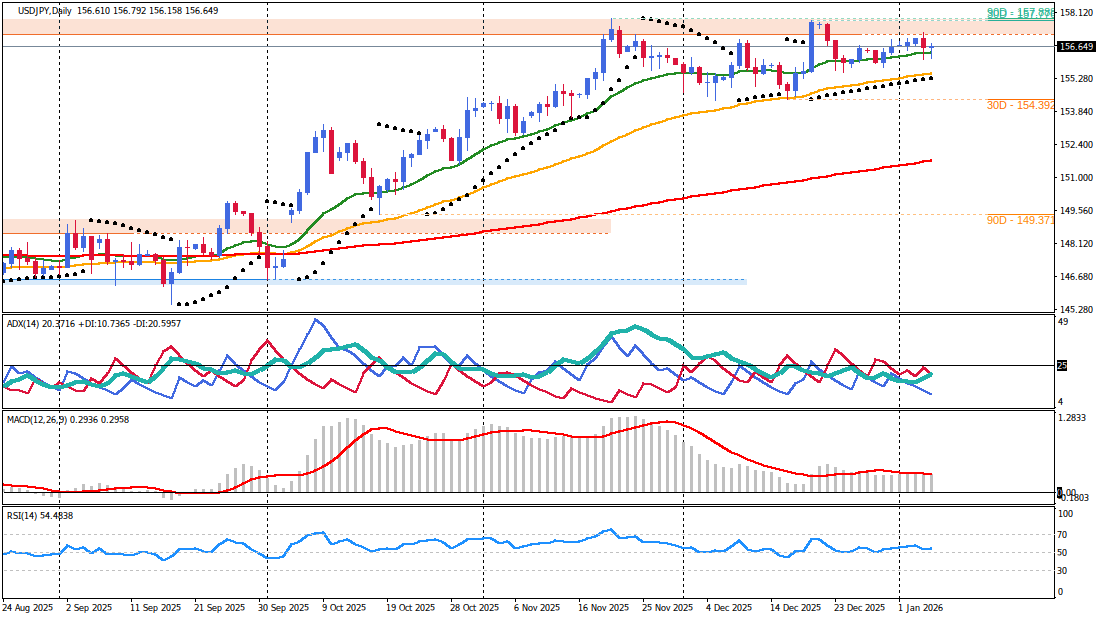
USD/JPY is currently consolidating within a tight range, holding above key short-term moving averages but facing resistance from the H4 Parabolic SAR around 156.856. The daily chart maintains a bullish structure, yet immediate directional clarity is constrained by mixed signals on lower timeframes and the imminent release of high-impact US economic data. Fundamentally, the pair is influenced by a prevailing risk-on sentiment that weighs on the safe-haven Japanese Yen, while the Bank of Japan's hawkish rhetoric, anticipating further rate hikes around mid-year, offers underlying support for the JPY. Conversely, the US Dollar's trajectory is highly dependent on a heavy slate of upcoming US labor market and sentiment data, which will shape Federal Reserve policy expectations. Traders are positioning defensively, anticipating significant volatility as these critical catalysts unfold later today and throughout the week.
Technical Analysis
Multi-Timeframe Market Structure
The overarching daily (D1) trend for USD/JPY remains bullish, with price closing the previous session at 156.611, well above its EMA20 (156.409), EMA50 (155.517), and EMA200 (151.713). This sustained position above major moving averages, combined with a positive MACD at 0.296 and a Parabolic SAR at 155.277 (below price), firmly establishes a dominant bullish bias on the higher timeframe. This daily bullish structure aligns with the broader USD strength driven by a risk-on sentiment and the still-present interest rate differential.However, the medium-term (H4) framework presents a more nuanced picture. While the H4 candle closed at 156.626, trading above its EMA20 (156.596), EMA50 (156.493), and EMA200 (155.761), suggesting a bullish lean, the Parabolic SAR at 156.856 is currently positioned above price. This indicates a potential medium-term bearish signal or resistance, creating a mixed technical picture that reflects market indecision ahead of significant fundamental catalysts. A weakly positive MACD (0.008) and neutral RSI (52.88) further underscore this lack of strong conviction.
On the short-term intraday charts (H1/M30), price is trading around its short-term EMAs, indicating consolidation. The H1 chart shows price near its EMA20 (156.573) and EMA50 (156.584), with a slight bullish bias from a positive MACD (0.039) and the H1 Parabolic SAR at 156.401 providing intraday support. Similarly, the M30 timeframe shows price above its EMA20 (156.623), EMA50 (156.570), and EMA200 (156.576), with a positive MACD (0.049). However, low ADX readings across H1 (13.39) and M30 (13.81) confirm the absence of strong directional momentum, indicating a range-bound environment as traders await high-impact US data.
Critical Price Levels & Momentum Assessment
Resistance:- 156.856 (H4 Parabolic SAR) - This level represents robust medium-term resistance, coinciding with recent intraday highs and serving as a critical barrier for bullish continuation. A break above this would negate the H4 bearish SAR signal.
- 157.000 (Psychological level) - A significant psychological round number, often attracting orders and acting as a resistance point, especially as the market anticipates a clear fundamental catalyst.
- 157.293 (D1 previous high) - This level provides strong structural resistance from the prior daily session, a key hurdle for the daily bullish trend to extend.
- 156.570-156.620 (M30/H1 EMA cluster, H1/M30 previous candle lows) - This zone forms a critical confluence of short-term moving averages, offering immediate intraday support. Its integrity is vital for maintaining the current consolidation range.
- 156.401 (H1 Parabolic SAR, D1 EMA20) - A key intraday support level with daily timeframe confluence, representing a significant area where buying interest could emerge.
- 156.111 (D1 previous low) - This level functions as a major structural support from the prior daily session, marking a crucial area for the daily bullish trend to hold.
Fundamental Market Drivers
Central Bank Policy & Economic Outlook
The monetary policy divergence between the Bank of Japan (BoJ) and the Federal Reserve (Fed) remains a primary driver for USD/JPY. The Bank of Japan is steadfastly moving along a gradual path toward policy normalization, with Governor Kazuo reiterating a hawkish bias. He stated that rate increases will continue if economic and price trends align with the central bank's forecasts of a sustained inflation cycle, particularly after the spring "shunto" wage negotiations confirm solid wage increases. Most analysts anticipate the next BoJ rate hike around mid-year 2026. Persistent Yen weakness strengthens the case for further BoJ tightening and revives concerns over possible intervention, as Japanese officials have issued repeated verbal warnings regarding sharp currency moves. This tightening bias from the BoJ provides an underlying supportive factor for the JPY, potentially capping USD/JPY's upside over the medium term.In contrast, the Federal Reserve's policy outlook presents a more complex picture. While markets are currently pricing in two Fed rate cuts over the course of the year, policymakers remain divided on the pace and timing of further easing. Fed Governor Stephen Miran, whose term concludes this month, advocated for aggressive rate cuts to support the economy, while Minneapolis Fed President Neel Kashkari noted the risk of a higher jobless rate. Despite these dovish comments, the Fed is widely expected to keep interest rates unchanged at its January 27-28 meeting, with CME FedWatch indicating an 85% probability of a hold. Recent softer US S&P Global Services PMI (slipping to 52.5 in December from 54.1) and Composite PMI (easing to 52.7 from 54.2) did not significantly dent the Dollar's momentum, suggesting market focus is firmly on the upcoming robust US labor market data. The direction of US Treasury yields, influenced by these shifting Fed expectations and economic data, will significantly impact the Greenback's strength against the Yen.
Market Sentiment & Risk Environment
The broader market sentiment currently favors a risk-on environment, which generally undermines safe-haven currencies like the Japanese Yen. USD/JPY has advanced above 156.50 as cooling demand for safe-haven assets creates a tailwind for the pair. This risk-on mood has largely shrugged off recent geopolitical developments, specifically the US military strike against Venezuela and the capture of President Nicolas Maduro. While the event initially introduced some uncertainty, markets have largely moved past it, preventing a sustained flight to safety that would typically benefit the JPY. However, any unexpected escalation in geopolitical tensions or a sudden shift in global risk appetite could quickly reverse this dynamic, increasing safe-haven demand for the US Dollar and potentially supporting USD/JPY, or, in a more severe risk-off scenario, strengthening the JPY. For now, the prevailing risk-on sentiment and the ongoing policy divergence between the Fed and BoJ continue to exert selling pressure on the Yen, supporting the higher timeframe bullish technical structure of USD/JPY.Integrated Trading Execution
Primary Trading Scenario
The primary trading scenario anticipates a bullish breakout for USD/JPY, supported by continued risk-on sentiment and potentially stronger-than-expected US economic data. This would align with the daily bullish trend and invalidate the H4 bearish Parabolic SAR signal.- Bias: Bullish - The daily chart maintains a strong bullish bias, which a breakout above H4 resistance would confirm, reinforced by a generally risk-on market and potential positive US data surprises.
- Trigger/Entry: Buy on a confirmed H1 candle close above 156.860 (±3 pips), signaling a decisive break of the H4 Parabolic SAR resistance.
- Stop-Loss: Place at 156.650, positioned just below the H4 EMA20 and recent intraday support, allowing for a 1.25x H1 ATR buffer to manage risk effectively.
- Profit Targets:
- Target 1: 157.000 (Psychological resistance) - This round number frequently acts as a near-term magnet for price action.
- Target 2: 157.250 (Near D1 previous high) - A significant structural resistance level where profit-taking is likely to occur.
- Session Context: Optimal during London or early New York session, prior to the US ADP Non-Farm Employment Change release, leveraging increased liquidity for a decisive move.
Alternative Market Scenario
The alternative scenario involves a bearish retracement if USD/JPY fails to breach the 156.860 resistance, potentially triggered by weaker-than-expected US data or a shift in risk sentiment.- Invalidation: H1 candle close above 156.860.
- Bias: Bearish - A rejection of the H4 SAR and a break below short-term EMAs would suggest a pre-data consolidation or a minor correction, aligning with the H4 mixed signals.
- Trigger/Entry: Sell on a confirmed H1 candle close below 156.550 (±3 pips), breaking the confluence of M30/H1 EMAs and short-term support.
- Stop-Loss: Place at 156.760, above the H4 EMA20 and recent intraday high, allowing for a 1.25x H1 ATR buffer.
- Profit Targets:
- Target 1: 156.400 (H1 SAR / D1 EMA20 support zone) - A strong confluence of intraday and daily support.
- Target 2: 156.150 (Near D1 previous low) - A key structural support level from the prior day's trading.
- Session Context: Optimal during Asian or early London session, with potential extension into New York, anticipating pre-event consolidation or a minor correction.
Risk Management & Catalyst Analysis
Trade Risk Assessment
The current market environment for USD/JPY presents a medium confluence quality due to the divergence between the daily bullish trend and the mixed signals on the H4 timeframe, particularly the Parabolic SAR resistance. This lack of strong multi-timeframe alignment reduces confidence in immediate directional moves. Intraday, lower liquidity during the Asian session can lead to exaggerated price swings on smaller volumes. The most significant risk factor is the proximity of multiple high-impact US economic events scheduled for today and the remainder of the week. These events introduce substantial event risk, making current technical levels highly vulnerable to sudden invalidation. Session transitions, especially into London and New York, are likely to bring increased volatility. Given the cluster of high-impact US events starting today, a 50% reduction in position size is prudent for any trades initiated within four hours of these releases. Traders should avoid holding significant positions through these announcements if not explicitly part of an event-driven strategy. Any intraday trade setups today carry limited time validity and should be actively managed, with consideration for closing positions before major US data if targets are not met.Economic Calendar & Event Impact
The upcoming economic calendar features several high-impact US events that will significantly influence USD/JPY, shaping Federal Reserve policy expectations and overall market direction:- US ADP Non-Farm Employment Change (Today, 13:15 UTC): Forecast 49K, Previous -32K - This report is a crucial precursor to the official Non-Farm Payrolls and will provide an early indication of US labor market health, directly impacting USD sentiment.
- US ISM Services PMI (Today, 15:00 UTC): Forecast 52.2, Previous 52.6 - A key indicator of the health of the US services sector, which accounts for a large portion of the economy. A deviation from forecast could alter Fed rate cut expectations.
- US JOLTS Job Openings (Today, 15:00 UTC): Forecast 7.61M, Previous 7.67M - This report offers insights into labor demand, with significant implications for wage inflation and future Fed policy.
- US Unemployment Claims (Tomorrow, 13:30 UTC): Forecast 213K, Previous 199K - A weekly gauge of labor market strength. A significant increase could signal weakening employment and boost Fed dovish bets.
- US Average Hourly Earnings m/m (January 9, 13:30 UTC): Forecast 0.3%, Previous 0.1% - A critical inflation indicator. Higher-than-expected wage growth would support a hawkish Fed bias, while softer data could fuel rate cut speculation.
- US Non-Farm Employment Change (January 9, 13:30 UTC): Forecast 66K, Previous 64K - The most impactful labor market report, driving significant USD volatility. A strong reading would reinforce USD strength and potentially delay Fed cuts.
- US Unemployment Rate (January 9, 13:30 UTC): Forecast 4.5%, Previous 4.6% - Another key component of the labor market report, influencing Fed's dual mandate assessment.
- US Prelim UoM Consumer Sentiment (January 9, 15:00 UTC): Forecast 53.5, Previous 53.3 - Provides insight into consumer confidence and spending intentions, impacting the overall economic outlook.
- US Prelim UoM Inflation Expectations (January 9, 15:00 UTC): Previous 4.1% - Directly informs the Fed's inflation outlook, with significant market implications if expectations shift materially.
Synthesized Market Outlook
USD/JPY finds itself in a pivotal consolidation phase, caught between a dominant daily bullish trend and intraday technical indecision, all while anticipating a barrage of high-impact US economic data. The technical structure, characterized by price holding above key daily moving averages but encountering H4 Parabolic SAR resistance, suggests a market awaiting a fundamental catalyst. Fundamentally, the prevailing risk-on sentiment is a tailwind for USD/JPY by undermining the safe-haven Yen. However, the Bank of Japan's clear path towards policy normalization and potential rate hikes around mid-year offers underlying JPY support, indicating that any significant upside in USD/JPY could face resistance from BoJ intervention concerns or a narrowing policy differential in the longer term.The immediate direction of USD/JPY hinges critically on the upcoming US labor market and services data. Stronger-than-expected reports, particularly ADP and Non-Farm Payrolls, would likely bolster the US Dollar, reinforce Fed hawkishness, and trigger a bullish breakout in USD/JPY above 156.860. Conversely, a series of weaker US data points could fuel Fed rate cut expectations, weaken the Dollar, and prompt a bearish retracement in USD/JPY towards 156.400 and potentially 156.150. Traders must closely monitor the 156.860 resistance and 156.550 support levels for definitive breaks, as these will signal the market's reaction to the incoming data and dictate the pair's near-term trajectory. The market remains highly sensitive, and swift reactions to data releases are expected.


