
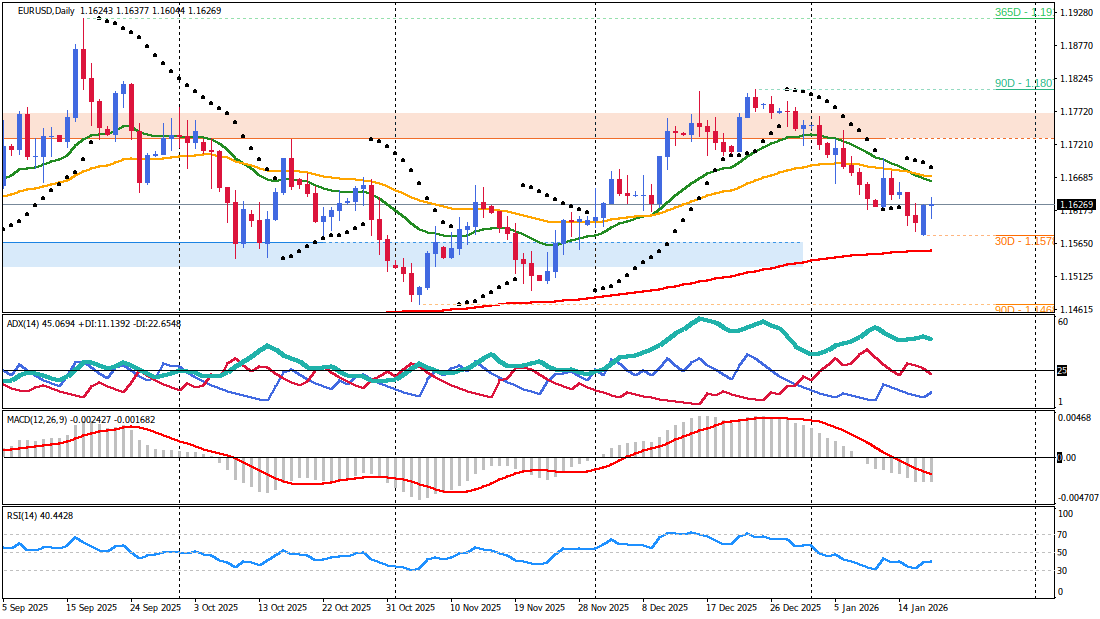
The EUR/USD pair is currently navigating a complex transitional phase, characterized by a short-term corrective recovery within a dominant long-term bearish trend. Technical structure combined with an emerging political risk premium on the US Dollar supports a tactical move toward intermediate resistance levels. The primary catalyst for this shift is the recent announcement of proposed 10% tariffs by the US administration on eight European nations, which has introduced selling pressure on the Greenback despite the underlying strength of the US labor market. While the daily chart remains firmly under bearish control, intraday momentum has pivoted, with price action finding stability above the 1.1600 psychological threshold. Market participants are now weighing the potential for a deeper mean-reversion move against the reality of a hawkish Federal Reserve and a sluggish Eurozone economy. Critical volatility is expected mid-week as central bank rhetoric and high-impact geopolitical speeches provide the next directional impulse for the pair.
Technical Analysis
Multi-Timeframe Market Structure
The primary trend assessment on the daily (D1) timeframe remains decisively bearish. This is confirmed by an ADX reading of 45.07, indicating a strong trend, and price action that continues to trade below the EMA20 at 1.1663 and the EMA50 at 1.1670. However, the pair has recently reached a point of exhaustion after testing the critical EMA200 at 1.1553, which has served as a long-term structural floor. The Daily RSI at 40.88 suggests that while the bears maintain control, the market is no longer in extreme oversold territory, providing the technical vacuum necessary for a corrective bounce.
On the medium-term H4 framework, the pair is attempting to pivot around the EMA20 at 1.1623. The narrowing of the MACD histogram signals a loss of bearish conviction, and the RSI has neutralized at 49.71. This equilibrium reflects a market in a wait-and-see mode ahead of major fundamental triggers. A sustained close above 1.1637 is required to shift this timeframe's bias toward the bulls and clear a path for a test of the EMA50 at 1.1647.
The short-term intraday H1 timeframe maintains a bullish bias, with price holding above the EMA20 at 1.1616 and the parabolic SAR at 1.1591. While the MACD is positive, the Stochastic oscillator at 86.33 warns of overbought conditions, suggesting that a minor retracement toward the 1.1617–1.1620 support zone is likely before any further extension. Technical structure combined with the ascending troughs on the M30 chart aligns with the fundamental backdrop to favor a buy-on-dips approach for intraday traders.
Critical Price Levels & Momentum Assessment
The technical landscape is defined by several high-confluence zones that will determine the pair's trajectory for the current week:
- Resistance 1.1637: This level represents the recent H4 swing high and the immediate hurdle for the current recovery. A breakout here confirms intraday bullish strength.
- Resistance 1.1663: The D1 EMA20 serves as the primary structural target for this correction. This level is expected to attract significant selling interest.
- Resistance 1.1675: A confluence of the H4 EMA200 and a major psychological zone; a breach of this level would invalidate the medium-term bearish thesis.
- Support 1.1617: The H1 EMA20, which acts as the primary floor for intraday long positions.
- Support 1.1591: The H1 Parabolic SAR and the base of the recent consolidation phase.
- Support 1.1554: The D1 EMA200, representing the critical long-term structural support that must hold to prevent a deeper slide toward 1.1400.
Fundamental Market Drivers
Central Bank Policy & Economic Outlook
The fundamental divergence between the European Central Bank (ECB) and the Federal Reserve continues to be a primary driver of EUR/USD valuation. The ECB is currently perceived to be in a "hold phase" as Eurozone GDP growth slows and inflation data softens. This lack of a hawkish tailwind for the Euro makes it difficult for the pair to sustain long-term rallies. In contrast, the US Federal Reserve is expected to keep interest rates steady at its upcoming January meeting, with market pricing showing a 95% probability of no change. Improving US labor market data has pushed the timeline for potential rate cuts back to June, maintaining the US Dollar's yield advantage over the Euro.
Price action aligns with fundamental backdrop to favor a bearish long-term outlook, as the Euro lacks the domestic economic strength to challenge the Dollar's dominance. However, the immediate focus is on the upcoming Flash PMI data for Germany and France. If these indicators show further deterioration in the manufacturing or services sectors, the Euro's current corrective bounce may find its ceiling sooner than technical levels suggest.
Market Sentiment & Risk Environment
Geopolitical factors have taken center stage following US President Donald Trump’s threat to impose a 10% tariff on goods from eight European countries, including Germany and France. This move, linked to opposition regarding the acquisition of Greenland, has introduced a political risk premium that is currently weighing on the US Dollar. Traders are pricing in the uncertainty of a renewed trade war, which has allowed the EUR/USD to snap its four-day losing streak.
Technical structure combined with the "risk-off" sentiment regarding the Greenback supports the current mean-reversion move. However, the US Dollar's status as a safe-haven asset remains a complicating factor. While the tariffs are a negative for the US political outlook, they also threaten European export stability, which could ultimately cap the Euro's gains. The market is currently in a state of flux, waiting for the emergency meeting of European leaders and the response from the ECB President Christine Lagarde to determine if the tariff threats will result in a sustained trend reversal or merely a temporary volatility spike.
Integrated Trading Execution
Primary Trading Scenario
- Bias: Bullish recovery toward structural resistance (Short-term)
- Trigger/Entry: Long entry on a retracement to 1.1620 (±3 pips) or on a clean H1 candle close above 1.1637.
- Stop-Loss: 1.1600, placed below the H1 EMA20 and Parabolic SAR with a 1.5x ATR buffer.
- Profit Targets:
- Target 1: 1.1660 - This aligns with the D1 EMA20 and represents the primary structural resistance.
- Target 2: 1.1675 - The H4 EMA200 and a major psychological level where the broader trend may resume.
- Session Context: Best executed during the London and early New York sessions to capitalize on peak liquidity. Traders should be aware that US markets are closed today for a public holiday, which may lead to thinner liquidity and erratic moves.
Alternative Market Scenario
- Invalidation: A break above 1.1640 on a closing basis invalidates the immediate bearish resumption thesis.
- Bias: Bearish resumption in line with the long-term trend.
- Trigger/Entry: Short entry on a decisive H1 close below 1.1590.
- Stop-Loss: 1.1610, placed above recent M30 structural pivots.
- Profit Targets:
- Target 1: 1.1555 - Proximity to the D1 EMA200.
- Target 2: 1.1520 - Structural support from previous price action.
- Session Context: This scenario is likely to trigger if the New York session sees a sudden US Dollar bid or if technical support fails under low liquidity conditions.
Risk Management & Catalyst Analysis
Trade Risk Assessment
The current trade risk is classified as medium due to the conflict between intraday bullish momentum and the dominant bearish daily trend. Proximity to overbought Stochastic levels on the H1 and M30 timeframes increases the risk of "stop-hunting" pullbacks. Furthermore, the low volatility environment characteristic of the pre-event phase of the week may lead to false breakouts. It is recommended to maintain a 1.25x ATR buffer for intraday trades to account for session transition noise. Given the magnitude of the upcoming geopolitical and economic catalysts, position sizes should be reduced by 50% starting four hours before the high-impact speeches on January 21st to mitigate gap risk and potential slippage.
Economic Calendar & Event Impact
The following high-impact events are scheduled to influence EUR/USD volatility and direction:
- EZ ECB President Lagarde Speaks (January 21, 07:30 UTC): Expected to provide insight into the ECB's response to US tariff threats and the Eurozone inflation outlook.
- US President Trump Speaks (January 21, 13:30 UTC): High-impact event for USD direction; further details on tariff implementation will drive substantial volatility.
- EZ ECB President Lagarde Speaks (January 21, 16:45 UTC): Follow-up remarks that could cement the Euro's reaction to the day's geopolitical news.
- US Core PCE Price Index m/m (January 22, 13:30 UTC): Forecast 0.2% - The Fed's preferred inflation gauge; a higher-than-expected reading will reinforce the "higher for longer" rate narrative.
- US Final GDP q/q (January 22, 13:30 UTC): Forecast 4.3%, Previous 4.3% - Critical for assessing the resilience of the US economy.
- GE Flash Manufacturing PMI (January 23, 08:30 UTC): Forecast 47.6%, Previous 47.7% - A key indicator for German industrial health; a miss will likely trigger Euro selling.
- US Flash Manufacturing PMI (January 23, 14:45 UTC): Forecast 52.1%, Previous 51.8% - Essential for comparing US and European economic momentum.
Synthesized Market Outlook
The EUR/USD is currently trapped between a deteriorating geopolitical landscape and a robust long-term technical downtrend. While the immediate price action favors a corrective bounce toward 1.1663–1.1675, this move is fundamentally fragile. The US Dollar's recent weakness is primarily driven by political risk rather than a shift in economic fundamentals. As long as the Federal Reserve maintains its hawkish posture and the US labor market remains tight, any Euro recovery is likely to be met with aggressive selling at structural resistance levels. Traders should monitor the 1.1637 level closely for a breakout confirmation while remaining vigilant of the D1 EMA200 at 1.1554, which remains the ultimate target for bears if geopolitical tensions subside or if US inflation data surprises to the upside.


