
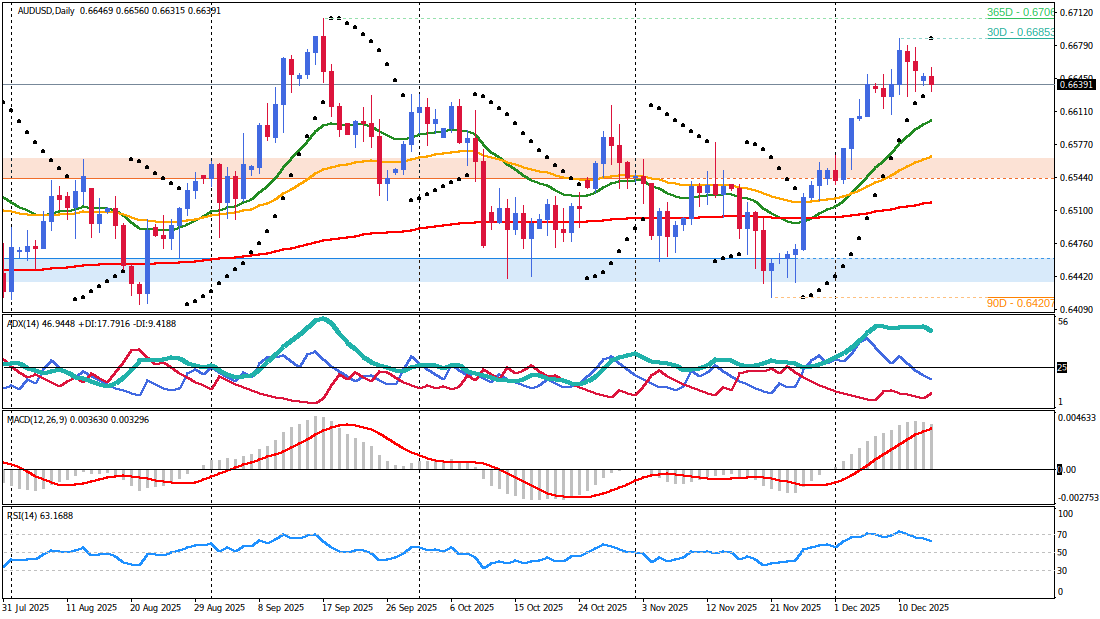
AUD/USD is currently navigating a period of tight consolidation, technically ranging within its medium-term moving averages following a strong daily uptrend. This price action reflects underlying market caution driven by a repricing of Reserve Bank of Australia (RBA) policy expectations towards a more dovish stance, alongside persistent concerns about China's economic health. The primary catalyst for near-term direction will be a cluster of high-impact US economic data releases, including crucial employment and retail sales figures, which hold the potential to significantly shift Federal Reserve policy outlook and USD strength. The technical structure combined with slowing Australian and Chinese economic momentum suggests a fragile Aussie dollar, poised for a decisive move based on the upcoming US data.
Technical Analysis
Multi-Timeframe Market Structure
The dominant daily (D1) trend for AUD/USD remains robustly bullish, with price trading firmly above its EMA20 (0.66020), EMA50 (0.65655), and EMA200 (0.65179), all aligned in an uptrend. MACD is positive at 0.003684, and RSI is elevated at 65.27, indicating strong buying pressure. ADX at 46.94 confirms a very strong trend. However, the daily SAR at 0.66853 is currently above the price, hinting at a potential short-term pullback within this larger uptrend. This D1 bullishness is fundamentally supported by Australia's recent manufacturing PMI improvement, but faces headwinds from a re-evaluation of RBA policy and China's economic slowdown.In the medium-term (H4) framework, the pair exhibits a clear loss of bullish momentum. Price trades below the EMA20 (0.66489) but remains above the EMA50 (0.66315) and EMA200 (0.65700). MACD is positive but near zero at 0.000218, signaling waning upward pressure. RSI is neutral at 49.63, and Stochastic is low at 32.19, suggesting a bearish correction or oversold conditions. ADX at 13.50 indicates a weak or non-trending market. The H4 SAR at 0.66690, positioned above price, reinforces the bearish pressure in this timeframe. This medium-term consolidation aligns with market uncertainty ahead of significant US economic data.
The short-term intraday (H1/M30) charts show a cautious neutral to slightly bearish bias. On H1, price trades marginally below both EMA20 (0.66450) and EMA50 (0.66490), with MACD negative at -0.000266. RSI and Stochastic are neutral around 49.34 and 48.57, respectively. The M30 chart mirrors this sentiment, trading below its EMA50 (0.66454) and EMA200 (0.66468), with a negative MACD at -0.000139. However, the M30 SAR at 0.66318 is below the current price, indicating a slight bullish attempt. The immediate intraday bias is cautiously neutral, confined within a tight range, as price struggles to push above the H1/M30 EMAs in the Asian session, primarily due to low liquidity and pre-event positioning.
Critical Price Levels & Momentum Assessment
Resistance:- 0.66490: Confluence of H1 EMA50 and H4 EMA20, acting as immediate intraday resistance. A sustained break above this level is required to alleviate short-term bearish pressure and would signal a renewed attempt towards higher levels, particularly if supported by weaker-than-expected US data.
- 0.66511: H1 SAR, a dynamic resistance point. Clearing this level indicates a shift in short-term momentum.
- 0.66690: H4 SAR, representing a stronger medium-term resistance level. A break above this level would challenge the current H4 bearish correction and align price action more closely with the underlying daily uptrend.
- 0.66318: Confluence of M30 SAR and H4 EMA50, forming significant intraday support. Holding this level is crucial for preventing a deeper retracement.
- 0.66300: H1 EMA200, a key psychological and technical intraday support. A break below this level would invalidate the immediate range-bound consolidation and open the path for further declines.
- 0.66020: D1 EMA20, the primary trend support. This level represents a critical line in the sand for the daily bullish trend. A sustained break below this would signal a significant bearish reversal for the pair, likely triggered by a hawkish shift in Fed expectations or severe deterioration in Australian/Chinese fundamentals.
Fundamental Market Drivers
Central Bank Policy & Economic Outlook
The Reserve Bank of Australia's (RBA) policy path is undergoing a significant repricing. While the RBA maintained interest rates at its last meeting and signaled that future rate hikes were more likely than cuts, recent weaker Australian labor market data has prompted markets to push back expectations for a rate hike into the second half of 2026. This shift in market expectations for RBA policy, driven by softer employment figures, effectively introduces a more dovish lean to the Aussie dollar. The recent S&P Global Manufacturing PMI climbed to 52.2 in December from 51.6, indicating expansion, which is a positive factor. However, this is partially offset by the S&P Global Services PMI easing to 51.0 from 52.8, and the Composite PMI declining to 51.1 from 52.6, suggesting a mixed and possibly slowing overall economic picture for Australia.In contrast, the US Dollar's trajectory is heavily influenced by the Federal Reserve's (Fed) monetary policy outlook. The Fed recently implemented a 25 basis point interest rate cut, and while Chair Jerome Powell cautioned against near-term rate cuts, policymakers acknowledged increased downside risks to employment. Market pricing, however, suggests an expectation for extended easing further into 2026, especially if US labor market conditions continue to cool. This expectation has kept US yields under pressure and limited the dollar's ability to rebound. The upcoming US Non-Farm Payrolls (NFP), Average Hourly Earnings, Retail Sales, and PMI data are critical for validating or challenging these dovish Fed expectations. Stronger-than-expected data would likely prompt a reassessment of Fed easing, potentially strengthening the USD and pressuring AUD/USD, while weaker data would reinforce dovish expectations, providing fundamental support for AUD/USD.
Market Sentiment & Risk Environment
Australia's close trade ties with China mean that the health of the Chinese economy is a major influence on the AUD. Recent weak economic data from China is adding to the downside pressure on the Aussie. November data revealed industrial output rising 4.8% YoY, below expectations and slightly slower than October, while Retail Sales increased a mere 1.3%, marking their weakest gain since late 2022. Fixed asset investment also missed forecasts, reinforcing concerns about fragile demand conditions. These signs of slowing momentum in the world’s second-largest economy fundamentally weigh on the Australian dollar. While Chinese authorities have signaled plans to issue ultra-long-term bonds in 2026 to support growth initiatives, offering some longer-term reassurance, markets remain focused on the near-term activity data, where momentum is still lacking. The combination of a dovish RBA repricing and weak Chinese data creates a challenging fundamental backdrop for the AUD, aligning with the observed technical consolidation and short-term bearish pressure. The US Dollar's struggle to gather recovery momentum, driven by expectations for a more accommodative Fed, provides some counterbalancing support for AUD/USD, but this is highly contingent on upcoming US economic releases.Integrated Trading Execution
Primary Trading Scenario
- Bias: Neutral/Ranging (Asian session)
- Trigger/Entry: The AUD/USD is expected to remain range-bound in the Asian session due to low liquidity and pre-event positioning ahead of critical US data. Traders can consider short-term range trades:
- Sell near 0.66490 (H1 EMA50/H4 EMA20) on bearish confirmation.
- Buy near 0.66318 (M30 SAR/H4 EMA50) on bullish confirmation.
- Stop-Loss: Approximately 10 pips (1.25x H1 ATR) beyond the chosen range boundary. For a sell entry at 0.66490, stop-loss at 0.66590. For a buy entry at 0.66318, stop-loss at 0.66218.
- Profit Targets:
- Target 1 (Sell): 0.66318 (M30 SAR/H4 EMA50) - Represents strong intraday support, acting as a bounce zone within the range.
- Target 1 (Buy): 0.66490 (H1 EMA50/H4 EMA20) - Represents immediate intraday resistance, likely to cap upward moves in a range-bound environment.
- Session Context: This scenario is valid only during the Asian session. All positions must be closed well ahead of the high-impact US data releases scheduled for the London/New York overlap.
Alternative Market Scenario
- Invalidation: The primary range-bound scenario is invalidated by a decisive H1 candle close above 0.66511 or below 0.66300, particularly during the London or New York sessions, driven by market reaction to the upcoming US economic data.
- Bias: Bullish (post-US data, if USD weakens) or Bearish (post-US data, if USD strengthens)
- Trigger/Entry:
- Bullish Breakout: A decisive H1 close above 0.66511, triggered by significantly weaker-than-expected US Non-Farm Payrolls, Retail Sales, or PMI data, reinforcing dovish Fed expectations.
- Bearish Breakdown: A decisive H1 close below 0.66300, triggered by stronger-than-expected US Non-Farm Payrolls, Retail Sales, or PMI data, challenging dovish Fed expectations and strengthening the USD. This would also align with the dovish RBA repricing and weak China data.
- Stop-Loss: Approximately 12 pips (1.5x H1 ATR) beyond the breakout/breakdown level. For a bullish breakout above 0.66511, stop-loss at 0.66391. For a bearish breakdown below 0.66300, stop-loss at 0.66420.
- Profit Targets:
- Target 1 (Bullish): 0.66690 (H4 SAR)
- Target 2 (Bullish): 0.66853 (D1 SAR)
- Target 1 (Bearish): 0.66020 (D1 EMA20)
- Target 2 (Bearish): 0.65700 (H4 EMA200)
- Session Context: This scenario carries extreme event risk and requires confirmation from post-event price action during the London or New York sessions.
Risk Management & Catalyst Analysis
Trade Risk Assessment
The current market environment for AUD/USD carries a medium confluence quality due to the divergence between the strong D1 bullish trend and the H4/H1 consolidation. This divergence is primarily driven by the extreme event risk posed by the upcoming cluster of high-impact US economic data. These events have the potential to instantly invalidate existing technical levels and trigger sharp, unpredictable price movements. The fundamental backdrop of a dovish RBA repricing and weak Chinese economic data further complicates the AUD's position, increasing sensitivity to USD-side catalysts. Intraday, lower liquidity during the Asian session can lead to exaggerated moves. Position sizing must be highly conservative, especially for any trades taken prior to or around the high-impact data releases. Any pre-event trades should be closed before the data, or protected with very wide stops if attempting to capture event-driven volatility.Economic Calendar & Event Impact
The upcoming economic calendar features several high-impact events that will significantly influence AUD/USD direction, primarily through their impact on the US Dollar:- US ADP Weekly Employment Change (Today, 13:20 UTC): Previous 4.8K - High-impact precursor to NFP, providing insights into private sector job creation. A significantly lower reading would reinforce dovish Fed expectations, weakening USD.
- US Average Hourly Earnings m/m (Today, 13:30 UTC): Forecast 0.3%, Previous 0.2% - Critical for inflation expectations and Fed policy. A higher-than-forecast reading would be USD positive, signaling wage pressures.
- US Core Retail Sales m/m (Today, 13:30 UTC): Forecast 0.2%, Previous 0.3% - Key indicator of consumer spending, impacting growth outlook. A weak reading reinforces economic slowdown fears, pressuring USD.
- US Non-Farm Employment Change (Today, 13:30 UTC): Forecast 51K, Previous 119K - The most significant labor market indicator. A substantially lower figure than forecast would strongly support further Fed easing, significantly weakening USD.
- US Retail Sales m/m (Today, 13:30 UTC): Forecast 0.1%, Previous 0.2% - Broader measure of consumer spending. A soft print would weigh on USD.
- US Unemployment Rate (Today, 13:30 UTC): Forecast 4.5%, Previous 4.4% - Another crucial labor market health indicator. A higher-than-forecast rate reinforces downside risks to employment, USD negative.
- US Flash Manufacturing PMI (Today, 14:45 UTC): Forecast 52.0, Previous 51.9 - Indicator of manufacturing sector health. A strong reading supports USD, a weak reading pressures it.
- US Flash Services PMI (Today, 14:45 UTC): Forecast 54.0, Previous 55.0 - Indicator of services sector health. A strong reading supports USD, a weak reading pressures it.
- US FOMC Member Waller Speaks (Tomorrow, 13:15 UTC): Medium-impact event. Any hawkish or dovish commentary on monetary policy will influence USD direction.
- US CPI y/y (December 18, 13:30 UTC): Previous 3.0% - Major inflation gauge. A higher-than-expected print challenges dovish Fed expectations, strengthening USD.
- US Unemployment Claims (December 18, 13:30 UTC): Forecast 225K, Previous 236K - Important weekly labor market data. A higher number signals weakening labor conditions, USD negative.
- US Philly Fed Manufacturing Index (December 18, 13:30 UTC): Forecast 2.7, Previous -1.7 - Regional manufacturing gauge. A positive surprise would be USD supportive.
- US Existing Home Sales (December 19, 15:00 UTC): Forecast 4.15M, Previous 4.10M - Housing market indicator. Stronger sales reflect economic resilience, USD positive.
- US Revised UoM Consumer Sentiment (December 19, 15:00 UTC): Forecast 53.5, Previous 53.3 - Consumer confidence gauge. A higher reading supports general economic optimism, USD positive.
Synthesized Market Outlook
AUD/USD currently finds itself in a precarious consolidation phase. The underlying daily technical structure remains bullish, supported by positive long-term momentum indicators, but this is increasingly challenged by a clear loss of momentum on medium and short-term timeframes. Fundamentally, the Aussie dollar faces headwinds from a repricing of RBA policy towards a more dovish stance, driven by recent weak labor market data, and ongoing concerns about the health of China's economy. These factors suggest that any upside for AUD/USD from its current levels will likely be constrained unless there is a significant shift in the USD's trajectory.The immediate market focus is squarely on the deluge of high-impact US economic data scheduled for today and the rest of the week, particularly the employment and retail sales figures. A weaker-than-expected set of US data would reinforce market expectations for a more aggressive Fed easing cycle, putting significant downward pressure on the USD and potentially allowing AUD/USD to challenge higher resistance levels, despite its own fundamental weaknesses. Conversely, stronger-than-expected US data would likely strengthen the USD, prompting a deeper technical retracement for AUD/USD towards its daily trend support. Traders must closely monitor the 0.66490-0.66511 resistance zone and the 0.66300-0.66318 support zone for decisive breaks post-data, as these will indicate the next directional move. Position sizing should remain conservative, reflecting the heightened volatility and event risk associated with these upcoming catalysts.


