
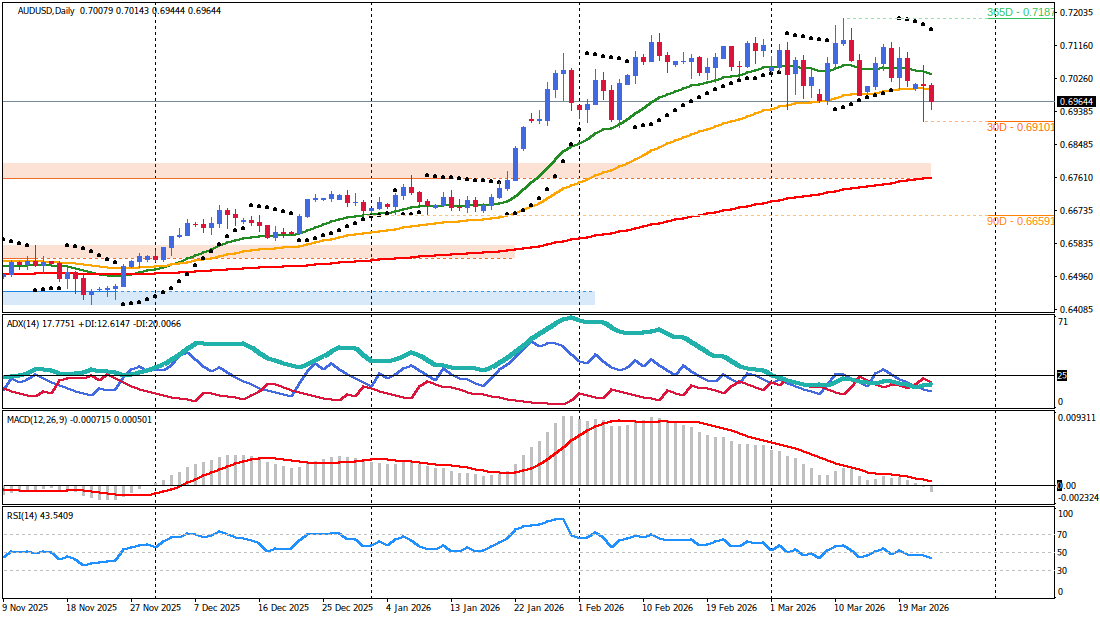
Technical structure combined with expectations for a hawkish Reserve Bank of Australia (RBA) supports the current corrective recovery phase in AUD/USD. The pair is presently engaged in a significant battle for the 0.7000 psychological handle, a level that serves as a pivot for medium-term sentiment. While the broader technical framework remains under pressure from earlier bearish momentum, price action aligns with the fundamental backdrop of sticky inflation to favor a test of overhead resistance. Markets are currently pre-positioning for critical Australian Consumer Price Index (CPI) data, which acts as the primary fundamental catalyst for the Aussie. Despite recent domestic growth shocks evidenced by contracting economic activity, the persistence of price pressures and escalating geopolitical tensions in the Middle East provide a complex but supportive floor for the currency. High-impact volatility is expected as technical levels converge with major economic releases from both Australia and the United States.
Technical Analysis
Multi-Timeframe Market Structure
The dominant structure on the Daily (D1) chart remains neutral to slightly bearish, with price action currently oscillating around the 50-period Exponential Moving Average (EMA50) at 0.6998. This level represents a critical line in the sand for trend direction. While the pair remains below the EMA20 at 0.7045, it maintains a healthy distance above the long-term EMA200 at 0.6757, suggesting that the broader bullish cycle is not yet invalidated. The Daily RSI at 46.99 confirms a lack of immediate directional conviction, pointing toward the current consolidation phase.
On the H4 timeframe, the secondary momentum is bearish but appears overextended. The ADX reading of 49.58 signifies a very strong trend, yet the recent stabilization of price suggests this move is reaching exhaustion. Fundamental headwinds from the Middle East conflict have previously fueled this bearishness, but the technical structure is now attempting a mean-reversion move toward the 0.7003 area, where the H4 EMA20 resides. Short-term momentum on the H1 and M30 charts has already transitioned to a bullish bias, with price crossing above its immediate EMAs and the H1 RSI rising to 56.31. This intraday recovery finds technical support from an ADX of 31.18 on the M30 chart, indicating sufficient strength for a test of the 0.7013 resistance zone.
Critical Price Levels & Momentum Assessment
The significance of technical levels is currently enhanced by the fundamental wait-and-see approach ahead of the AU CPI release. The following levels are critical for the current session:
- Resistance Levels:
- 0.7013: Intraday High and M30 EMA200 confluence, acting as the immediate gateway for further recovery.
- 0.7035: A major structural barrier formed by the H1 EMA200 and H4 EMA50 zone.
- 0.7062: Previous swing high and 0.7050 psychological extension, marking the limit of the current corrective phase.
- Support Levels:
- 0.6966: Recent H1 swing low and intraday pivot point where buyers have recently stepped in.
- 0.6940: H4 Lower Bollinger Band and recent session lows, providing a technical floor.
- 0.6910: Major daily support level and psychological floor that aligns with the long-term bullish defense.
Fundamental Market Drivers
Central Bank Policy & Economic Outlook
The fundamental narrative for the Australian Dollar is currently dominated by a divergence between sticky inflation and deteriorating growth. The Reserve Bank of Australia has maintained a hawkish stance, with the key policy rate at 4.10%. Despite this, recent preliminary Purchasing Managers Index (PMI) data shows the Australian Composite PMI dropping to 47, signaling a return to contraction territory after eighteen months of expansion. This growth shock, primarily driven by a sharp decline in the services sector, complicates the RBA's path forward.
However, technical resilience aligns with the fundamental reality of persistent inflation. Annual inflation is expected to remain steady at 3.8%, well above the RBA’s 2-3% target range. The "Trimmed Mean" CPI, the RBA's preferred gauge, is also forecast to hold steady at 3.4%. These figures do not yet fully account for the recent surge in energy prices caused by disruptions in the Strait of Hormuz and the ongoing Middle East conflict. Westpac forecasts suggest inflation could rise toward 4.6% in the coming quarter due to these energy shocks, reinforcing expectations that the RBA will maintain higher rates for longer, or even consider further tightening in May. This hawkish bias provides the fundamental justification for the technical defense of the 0.6960 support zone.
Market Sentiment & Risk Environment
Global risk sentiment is currently fragile, characterized by a "trust gap" regarding potential de-escalation in the Middle East. Escalating tensions between Iran and Israel have revived safe-haven demand, supporting the US Dollar and weighing on risk-sensitive currencies like the Aussie. While US President Trump has signaled constructive discussions with Tehran, denials from Iranian officials and fresh strikes have kept markets on edge. This geopolitical uncertainty supports the US Dollar's stability, which explains why AUD/USD has struggled to maintain a clean breakout above 0.7000.
The US economic backdrop also presents a mixed signal. Recent US Flash Manufacturing PMI rose to 52.4, exceeding expectations and showcasing economic resilience that supports a "higher for longer" Federal Reserve outlook. Conversely, the US services sector is softening, with the PMI easing to 51.1. This uneven economic performance in the US, combined with the stagflation risks emerging in Australia, creates a volatile environment where technical levels are frequently tested but rarely broken without a significant fundamental catalyst.
Integrated Trading Execution
Primary Trading Scenario
- Bias: Cautiously Bullish (Neutral/Bullish technical structure supported by hawkish RBA expectations)
- Trigger/Entry: 0.7015 (±3 pips) on a confirmed breakout above the H1 intraday high during the Asian or London sessions.
- Stop-Loss: 0.6985 (Placed below the M30 EMA50 to protect against intraday volatility).
- Profit Targets:
- Target 1: 0.7050 - Psychological resistance and H4 EMA50 confluence.
- Target 2: 0.7075 - Structural resistance near the descending trend line.
- Session Context: This scenario is most valid if the Asian session establishes a base above 0.7000 ahead of the London open.
Alternative Market Scenario
- Invalidation: A failure to reclaim 0.7013 followed by a fundamental catalyst (such as strong US data or a downside AU CPI surprise) that breaks 0.6960.
- Bias: Bearish (Resumption of the H4 dominant bearish trend).
- Trigger/Entry: 0.6960 on a decisive break of H1 support with bearish confirmation.
- Stop-Loss: 0.6995 (Positioned above the 0.7000 psychological resistance).
- Profit Targets:
- Target 1: 0.6925 - H4 lower Bollinger Band extension.
- Target 2: 0.6900 - Major daily support and psychological floor.
- Session Context: This scenario is likely to play out if US PMIs today significantly exceed forecasts or if Middle East tensions escalate further, driving safe-haven USD flows.
Risk Management & Catalyst Analysis
Trade Risk Assessment
The current environment carries a high "Event Risk Multiplier" due to the proximity of the Australian CPI release. While H1 and M30 technicals show bullish alignment, they are operating counter to the dominant H4 bearish trend, which increases the probability of whipsaw price action around the 0.7000 level. Traders should account for the current volatility by using a 1.25x ATR buffer (approximately 30 pips) for stop-loss placements. Given the high-impact nature of the upcoming inflation data, it is recommended to reduce position sizes by 50% or move stops to break-even before the 00:30 UTC release tomorrow.
Economic Calendar & Event Impact
The following high-impact events are critical for AUD/USD price action during the current trade window:
- US Flash Manufacturing PMI (Today, 13:45 UTC): Forecast 51.5, Previous 51.2 - Stronger data will support the USD and pressure the AUD/USD recovery.
- US Flash Services PMI (Today, 13:45 UTC): Forecast 52.0, Previous 52.3 - Key indicator for US economic momentum and Fed policy expectations.
- AU CPI y/y (Tomorrow, 00:30 UTC): Forecast 3.8%, Previous 3.8% - The primary catalyst for the Aussie; an upward surprise cements RBA hawkishness.
- AU Trimmed Mean CPI m/m (Tomorrow, 00:30 UTC): Forecast 0.3%, Previous 0.3% - Critical core inflation measure for assessing second-round effects.
- US Unemployment Claims (March 26, 12:30 UTC): Forecast 211K, Previous 205K - Important for assessing the resilience of the US labor market.
- US Revised UoM Consumer Sentiment (March 27, 14:00 UTC): Forecast 53.9, Previous 55.5 - Late-week sentiment indicator that could influence USD positioning.
Synthesized Market Outlook
The outlook for AUD/USD is currently balanced between a technical relief rally and fundamental stagflation risks. Price action aligns with the fundamental backdrop of a hawkish RBA to favor a move toward 0.7050, provided that the 0.6960 support level remains intact through the US session. The market is effectively in a "pre-event" phase, where technical levels provide the boundaries for positioning ahead of the Australian inflation data. While the domestic growth shock evidenced by the 47.0 PMI reading is a concern, the RBA's mandate for price stability suggests that sticky inflation remains the more potent driver for the currency in the near term.
Traders should monitor the 0.7013 level for a bullish breakout and the 0.6960 level for signs of technical failure. A sustained move above 0.7035 would signal a more significant shift in sentiment, while a drop below 0.6940 would likely open the door for a retest of the 0.6900 psychological floor. Caution is advised as geopolitical developments in the Middle East continue to act as a wildcard for global risk appetite and US Dollar demand.


