
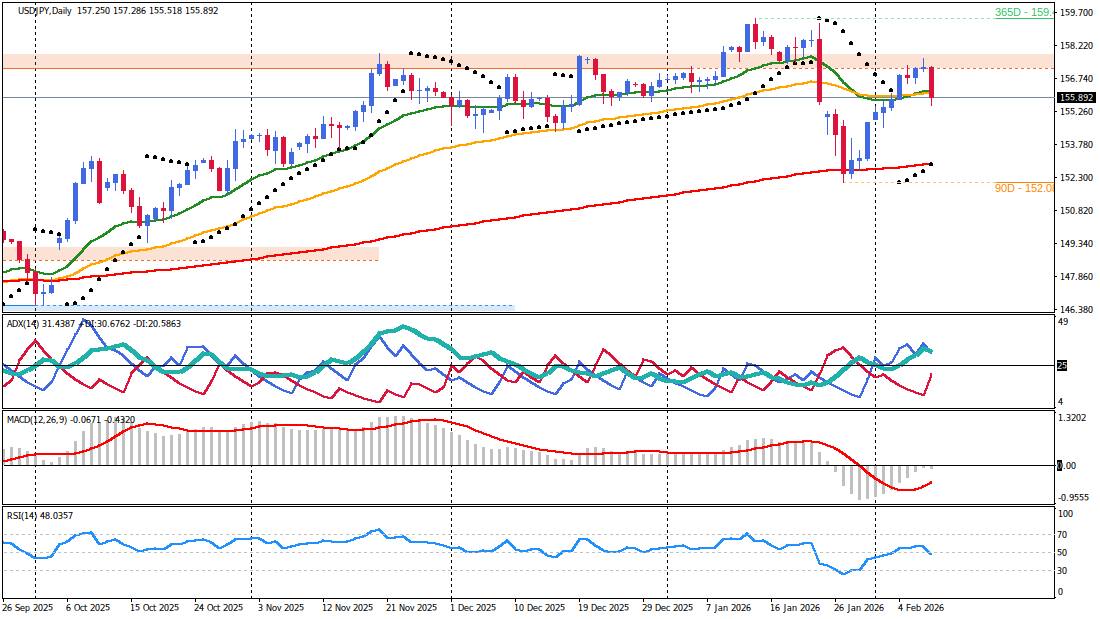
The USD/JPY pair currently maintains a bearish technical bias as it navigates a corrective phase following a significant downward impulse. This technical structure aligns with a fundamental backdrop defined by the Japanese Yen's stabilization following Prime Minister Sanae Takaichi’s landslide election victory and a broadly defensive US Dollar. While the pair has recovered from late-January lows, price action remains capped by a formidable cluster of exponential moving averages (EMAs) between 156.10 and 156.45. The market is currently digesting the "buy the rumor, sell the fact" reaction to the Liberal Democratic Party’s (LDP) historic supermajority, which has cleared the path for an expansionary fiscal agenda. Technical structure combined with the anticipation of high-impact US economic data supports a cautious bearish outlook, as the market awaits confirmation of whether the US consumer remains resilient enough to halt the Greenback’s recent slide. Critical resistance at 156.20 serves as the primary pivot point for the current session, with a failure to reclaim this level on a daily closing basis favoring a move toward structural support at 155.00 and 153.00.
Technical Analysis
Multi-Timeframe Market Structure
The dominant structure on the daily (D1) timeframe has shifted bearish, with price trading decisively below its previous session close. The market is currently testing the 156.10-156.20 zone from below, a region where the 20-day and 50-day EMAs converge to form a significant barrier. The ADX remains above 30, confirming that the underlying bearish trend possesses substantial strength. Fundamental drivers, specifically the LDP's election victory, have introduced volatility, yet the technical failure to breach these moving average clusters suggests that sellers retain control of the medium-term narrative.
On the H4 framework, momentum remains skewed to the downside. Price is trading well below the H4 EMA20, currently situated at 156.45. While the Stochastic oscillator is in oversold territory at 14.75, the lack of a bullish crossover indicates that any near-term bounces are likely corrective rather than a structural reversal. The RSI at 42.78 further confirms that bearish momentum is not yet exhausted, providing room for further downside development toward psychological support levels.
Critical Price Levels & Momentum Assessment
The technical framework identifies several pivotal levels that will dictate near-term direction:
- Resistance 156.16 - 156.20: This is the primary hurdle for bulls, representing a confluence of D1/H1 EMA20 and D1 EMA50. Price action aligns with fundamental caution to favor a rejection at this level.
- Resistance 156.45: A secondary barrier formed by the H4 EMA20 and H1 EMA50. A sustained break above this level is required to invalidate the current bearish bias.
- Support 155.63: The recent intraday low and immediate H4 support zone. A breach here would accelerate momentum toward the 155.00 handle.
- Support 152.93: Long-term structural support at the D1 EMA200, which serves as the ultimate target for the current bearish wave.
Momentum quality is currently moderate. While the D1 ADX shows trend strength, the H1 RSI is not yet in extreme territory. Volatility, as measured by the H1 ATR (0.237), is currently compressed but is expected to expand significantly during the New York session as US Retail Sales data is released.
Fundamental Market Drivers
Central Bank Policy & Economic Outlook
The fundamental landscape for the Japanese Yen has been reshaped by the historic victory of the Liberal Democratic Party under Prime Minister Sanae Takaichi. Securing 316 of the 465 seats in the Lower House, the LDP now holds a two-thirds supermajority. This mandate empowers Takaichi to pursue an expansionary fiscal agenda, including a proposed suspension of the 8% consumption tax on food and targeted tax cuts. While such measures are typically viewed as inflationary, which could pressure the Bank of Japan (BoJ) to tighten policy, the immediate market reaction has been a stabilization of the Yen as the "Takaichi trade" moves into a profit-taking phase.
Bank of Japan policy remains a critical component of the USD/JPY equation. Analysts expect the BoJ to maintain a policy pause in the near term, with a potential rate hike to 1.00% projected for the third quarter of 2026. This gradual approach to normalization, combined with the government's strong mandate, suggests that while the Yen is no longer in a freefall, it lacks the aggressive central bank backing for a rapid appreciation. However, nominal wages in Japan rose 2.4% in December, the smallest real wage contraction in a year, suggesting that the economic groundwork for future BoJ action is slowly firming.
Market Sentiment & Risk Environment
Risk sentiment has stabilized globally, reducing the safe-haven demand for the US Dollar. The S&P 500's recent rally and the recovery in gold prices above $5,000 per ounce indicate a shift away from defensive positioning. In the United States, the Dollar is under pressure due to concerns over trade policies and the independence of the Federal Reserve. Furthermore, a partial government shutdown has delayed key economic data, creating a vacuum that has allowed the Dollar to drift lower.
The upcoming cluster of US data, including Retail Sales, Non-Farm Payrolls, and CPI, is critical. Markets are currently pricing in a high probability of Fed rate cuts later this year, and any weakness in these delayed reports will likely reinforce the technical bearish structure on USD/JPY. Conversely, Japanese authorities remain on high alert regarding "rapid and one-sided" moves in the Yen, with verbal interventions serving as a floor for the currency whenever it approaches extreme weakness.
Integrated Trading Execution
Primary Trading Scenario
- Bias: Bearish continuation on rejection of resistance, supported by the technical cap at the EMA clusters and the fundamental "sell the fact" sentiment following the Japan election.
- Trigger/Entry: Sell limit or price action rejection at 156.15 (±3 pips). This level aligns with the confluence of daily and hourly moving averages.
- Stop-Loss: 156.50. Placed above the H4 EMA20 with a 1.5x ATR buffer to protect against volatility spikes.
- Profit Targets:
- Target 1: 155.65 - This level represents the recent intraday low and immediate H4 support.
- Target 2: 155.10 - A target just above the major 155.00 psychological level, where structural buying is expected.
- Session Context: Entry is optimal during the London or early New York sessions, particularly as US Retail Sales data provides the necessary volatility for a directional move.
Alternative Market Scenario
- Invalidation: A sustained H1 candle close above 156.45, which would signal a break of the H4 EMA20 and a shift in intraday momentum.
- Bias: Bullish mean reversion if resistance is breached, likely triggered by a significant miss in US economic data.
- Trigger/Entry: Buy on a confirmed H1 close above 156.45.
- Stop-Loss: 156.10, protecting the position below the broken resistance-turned-support.
- Profit Targets:
- Target 1: 157.20 - Previous session high and a key structural pivot.
- Target 2: 157.70 - The upper boundary of the current consolidation range.
- Session Context: This scenario is dependent on a US Dollar rebound or a significant fundamental shift that overrides the current technical bearishness.
Risk Management & Catalyst Analysis
Trade Risk Assessment
The primary risk to the bearish scenario is the proximity of high-impact US economic news. While technical timeframes are aligned bearishly, the oversold nature of H4 stochastics suggests a risk of sharp, data-driven reversals. Additionally, the Asian session's lower liquidity can lead to "stop hunts" around the 156.00 psychological level. Traders should reduce position sizes by 50% ahead of the US Retail Sales release to mitigate the risk of slippage and unexpected volatility. The use of the H1 ATR (24 pips) for stop-loss calibration is essential to account for current market noise.
Economic Calendar & Event Impact
The following high-impact events are the primary catalysts for USD/JPY volatility this week:
- US Core Retail Sales m/m (Today, 13:30 UTC): Forecast 0.3%, Previous 0.5% - A key indicator of consumer health that will influence USD momentum.
- US Retail Sales m/m (Today, 13:30 UTC): Forecast 0.4%, Previous 0.6% - High-impact data that could trigger the primary bearish scenario if results miss expectations.
- US Non-Farm Employment Change (Tomorrow, 13:30 UTC): Forecast 66K, Previous 50K - Critical labor market data delayed by the government shutdown.
- US Unemployment Rate (Tomorrow, 13:30 UTC): Forecast 4.4%, Previous 4.4% - A key metric for Federal Reserve policy expectations.
- US Core CPI m/m (February 13, 13:30 UTC): Forecast 0.3%, Previous 0.2% - Vital inflation data that will determine the long-term sustainability of the USD/JPY trend.
Synthesized Market Outlook
The technical structure of USD/JPY combined with the fundamental aftermath of the Japanese election favors a bearish outlook in the near term. The pair’s inability to penetrate the EMA clusters at 156.20 and 156.45 underscores the persistence of selling pressure. Fundamentally, the "Takaichi victory" has provided a mandate for fiscal expansion, yet the market is currently more focused on the potential for Yen intervention and the BoJ's eventual path toward a 1.00% rate. The immediate direction will be dictated by the US Retail Sales report; a weak print would likely catalyze a move toward the 155.00 support zone. Traders should monitor the 156.20 level closely; as long as price remains below this resistance, the path of least resistance remains lower. However, a break above 156.45 would signal a temporary exhaustion of bearish momentum and necessitate a shift toward a neutral or mean-reversion strategy.


