
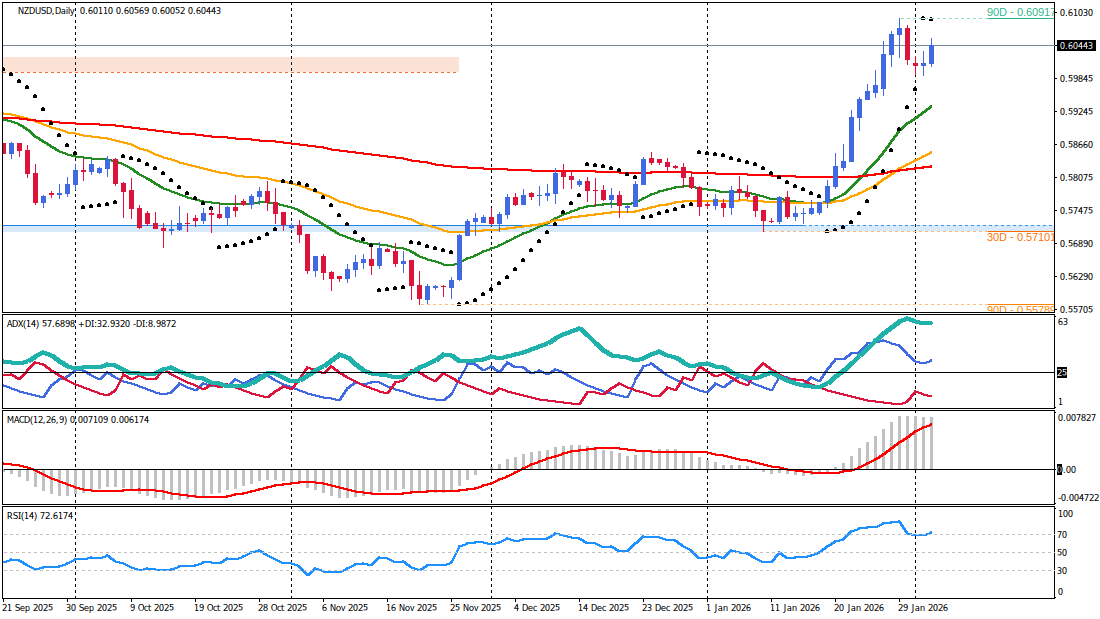
The NZD/USD pair enters a critical juncture as its dominant bullish technical structure encounters a complex fundamental landscape following the release of New Zealand's fourth-quarter labor market statistics. While the primary trend remains aggressively bullish across daily and four-hour timeframes, the immediate price action is dictated by a mixed employment report that has introduced significant intraday volatility. The technical framework, characterized by prices holding above major exponential moving averages and a high Average Directional Index (ADX), aligns with a fundamental backdrop where the Reserve Bank of New Zealand (RBNZ) is expected to maintain or even increase its restrictive policy stance later this year. However, the rise in the unemployment rate to 5.4% creates a friction point against the otherwise strong employment growth of 0.5%. Traders must now navigate a market where technical overextension on the daily chart meets a "buy the rumor, sell the fact" fundamental reaction, making the 0.6061 resistance level the primary pivot for the remainder of the week.
Technical Analysis
Multi-Timeframe Market Structure
The primary trend on the daily (D1) timeframe is aggressively bullish, evidenced by a very high ADX of 57.78. This reading indicates extreme trend strength, with price action characterized by consistent higher lows. The technical structure is supported fundamentally by the market's anticipation of RBNZ tightening, which keeps the pair positioned well above the EMA20, EMA50, and EMA200. These moving averages are in perfect bullish alignment, suggesting that any short-term dips are currently viewed as liquidity-seeking moves rather than trend reversals. However, the daily RSI at 73.85 signals overbought conditions, and the Parabolic SAR at 0.60897 remains an untested structural ceiling that may limit immediate upside without a fresh catalyst.
On the four-hour (H4) timeframe, the medium-term framework remains supportive of the bullish bias. Price continues to trade above the EMA20 (0.60306), and an ADX of 24.14 suggests the pair is in a steady advancing phase. Unlike the daily chart, the H4 RSI at 59.37 indicates that there is still technical "headroom" for further appreciation before the pair becomes overextended on this timeframe. This suggests that while the daily trend is mature, the medium-term momentum has not yet reached a point of exhaustion.
Critical Price Levels & Momentum Assessment
Immediate intraday action shows a unified bullish bias, with price testing the 0.6061 resistance zone. The short-term momentum is building, though the M30 RSI at 67.10 and Stochastic at 96.04 suggest the pair is hitting an exhaustion point following the reaction to the New Zealand labor data. Technical structure combined with the recent fundamental data release supports the following key levels:
- Resistance 0.6061: The immediate intraday high and M30 resistance zone; a break here confirms the resumption of the H1 bullish trend.
- Resistance 0.6090: Primary structural resistance derived from the D1 Parabolic SAR and a significant psychological level.
- Support 0.6038: The H1 EMA20 and a critical intraday pivot zone that must hold to maintain the immediate bullish thesis.
- Support 0.6000: Major psychological support where the D1 EMA20 converges, representing the "line in the sand" for the broader bullish trend.
Fundamental Market Drivers
Central Bank Policy & Economic Outlook
The fundamental narrative for the New Zealand Dollar is currently dominated by expectations of RBNZ monetary policy tightening. Investors are positioning for a hawkish shift later this year, particularly as the central bank transitions under the leadership of Governor Anna Breman. Markets are closely monitoring for guidance that confirms the RBNZ will remain an outlier among G10 central banks by potentially raising rates while others consider easing. This policy divergence is a primary driver for the NZD's resilience against the US Dollar.
The recent Q4 labor market data provides a mixed but ultimately supportive backdrop for this hawkish view. While the unemployment rate rose to 5.4%, exceeding the 5.3% forecast, this was accompanied by a stronger-than-expected employment change of 0.5% (versus 0.3% forecast) and a higher participation rate of 70.5%. The rise in unemployment appears to be a function of more people entering the labor force rather than a loss of jobs, which suggests the economy remains productive. Furthermore, the Labour Cost Index (YoY) remaining at 2% indicates that while wage pressure is present, it is not yet spiraling, giving the RBNZ room to maneuver without immediate emergency action.
Market Sentiment & Risk Environment
Risk sentiment aligns with the bullish technical structure to favor the Kiwi. Encouraging manufacturing data from China, New Zealand’s largest trading partner, has reinforced the outlook for growth-sensitive currencies. This external support helps offset some of the domestic fragility seen in sectors like housing, where building permits recently declined. The broader "risk-on" tone in global markets provides the necessary liquidity for the NZD/USD to maintain its upward trajectory.
Conversely, the US Dollar side of the pair remains anchored by elevated US Treasury yields. The 10-year yield hovering around 4.27% provides a fundamental floor for the Greenback, as solid US manufacturing data (ISM PMI) suggests the Federal Reserve can afford to keep policy restrictive. This creates a "clash of the titans" scenario where both currencies are supported by hawkish domestic outlooks, leading to the current technical consolidation and the need for a decisive breakout above 0.6061 to confirm direction.
Integrated Trading Execution
Primary Trading Scenario
- Bias: Bullish continuation supported by RBNZ tightening expectations and strong H4/D1 trend alignment.
- Trigger/Entry: A clean M30 candle close above the 0.6065 resistance level following the absorption of labor data volatility.
- Stop-Loss: 0.6035, placed below the H1 EMA20 and recent intraday support, providing a 1.5x H1 ATR buffer.
- Profit Targets:
- Target 1: 0.6090 - Alignment with the D1 Parabolic SAR and psychological resistance.
- Target 2: 0.6115 - Extension level if US Dollar weakness intensifies during the upcoming ISM Services release.
- Session Context: Best executed during the transition from the Asian to the London session to capture peak liquidity following the New Zealand data release.
Alternative Market Scenario
- Invalidation: A sustained break below the 0.6035 support zone, triggered by a hawkish repricing of the US Dollar or a negative shift in global risk sentiment.
- Bias: Bearish corrective phase targeting structural support.
- Trigger/Entry: Sell stop at 0.6035 if price fails to hold the H1 EMA20.
- Stop-Loss: 0.6065, located above the recent intraday high to account for event-driven volatility.
- Profit Targets:
- Target 1: 0.6022 - H1 Parabolic SAR and recent swing low.
- Target 2: 0.6000 - Major psychological support and D1 EMA20 convergence.
- Session Context: Likely to occur if US economic data (ADP or ISM Services) significantly outperforms expectations, reviving USD demand.
Risk Management & Catalyst Analysis
Trade Risk Assessment
The "Event Risk Multiplier" is currently in full effect. While technical timeframes are aligned, the immediate reaction to New Zealand's labor data has expanded the H1 ATR to 0.0013 (13 pips), suggesting that stop-losses require a minimum 2x ATR buffer to survive initial spikes. There is a high risk of slippage and spread widening during the transition into the Asian session. Consequently, position sizing should be reduced by 50% until the pair establishes a clear directional hold above 0.6065 or below 0.6035. The conflict between the beat in employment change and the miss in the unemployment rate may lead to "choppy" price action as the market digests which metric the RBNZ will prioritize.
Economic Calendar & Event Impact
The following high-impact events will dictate the trajectory of NZD/USD over the coming sessions:
- NZ Employment Change q/q (Today, 21:45 UTC): Actual 0.5%, Forecast 0.3%, Previous 0.0% - Stronger employment growth supports the hawkish RBNZ outlook.
- NZ Unemployment Rate (Today, 21:45 UTC): Actual 5.4%, Forecast 5.3%, Previous 5.3% - Higher unemployment provides a slight bearish counter-argument but is mitigated by high participation.
- US ADP Non-Farm Employment Change (Tomorrow, 13:15 UTC): Forecast 46K, Previous 41K - Key indicator for USD strength and Fed policy expectations.
- US ISM Services PMI (Tomorrow, 15:00 UTC): Forecast 53.5, Previous 54.4 - Critical for assessing US economic resilience and the "higher for longer" narrative.
- US Unemployment Claims (February 5, 13:30 UTC): Forecast 212K, Previous 209K - Weekly labor market gauge that could trigger USD volatility.
- US Prelim UoM Consumer Sentiment (February 6, 15:00 UTC): Forecast 55.0, Previous 54.0 - Impactful for assessment of US consumer demand and inflation expectations.
Synthesized Market Outlook
The NZD/USD remains in a structural bull market, but the current phase is one of high-volatility consolidation. The technical breakout above 0.6061 finds fundamental support from the resilience of the New Zealand labor market and the hawkish expectations surrounding the RBNZ. However, the rise in the headline unemployment rate to 5.4% acts as a temporary brake on momentum, preventing a vertical move. The pair is essentially caught between a hawkish RBNZ and a resilient US economy supported by high Treasury yields.
For the bullish scenario to maintain its validity, price must hold above the 0.6035/0.6038 pivot zone on a closing basis. A failure to do so would suggest that the market is prioritizing the rise in unemployment over the growth in jobs, potentially leading to a deeper correction toward the 0.6000 handle. Traders should monitor the 0.6065 level closely; a decisive breach there, confirmed by tomorrow's US ISM data, would likely clear the path for a test of long-term resistance at 0.6120.


