
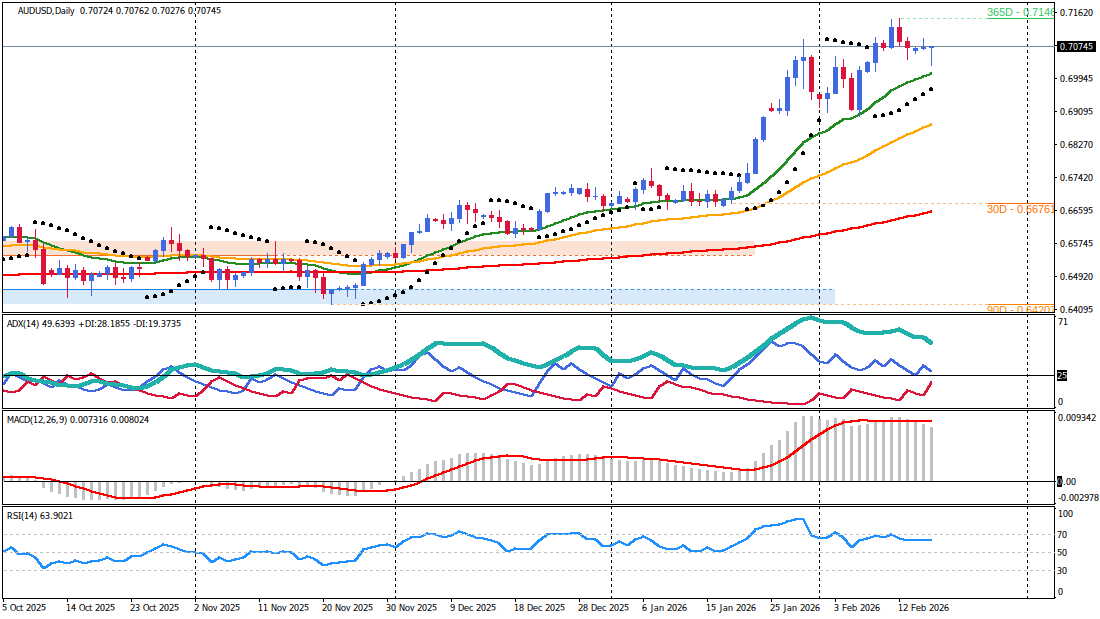
The AUD/USD pair maintains a decisive bullish bias as it trades near three-year highs, supported by a significant divergence in central bank policy and a robust technical structure. Technical structure combined with the Reserve Bank of Australia’s (RBA) hawkish stance supports a primary uptrend, even as the pair enters a high-volatility window characterized by top-tier economic releases. While the pair is currently consolidating just below recent multi-month highs, the underlying momentum remains firm, validated by a recent Golden Cross on the daily timeframe. The RBA’s commitment to curbing persistent inflation, highlighted by the February rate hike to 3.85%, contrasts with market expectations of Federal Reserve easing later in 2026. This fundamental backdrop provides the necessary tailwinds for the Aussie dollar to challenge psychological resistance at 0.7100. Traders should anticipate heightened volatility surrounding the upcoming Australian employment data and US FOMC minutes, which will serve as the primary catalysts for the next directional leg.
Technical Analysis
Multi-Timeframe Market Structure
The dominant structure on the daily (D1) chart is aggressively bullish, defined by a classic bullish fan alignment where price trades comfortably above the 20-day, 50-day, and 200-day Exponential Moving Averages (EMAs). A critical technical milestone was recently achieved with a Golden Cross, as the 50-day EMA crossed above the 200-day EMA, confirming a long-term trend reversal from the 2025 lows. The ADX remains well above 30, signaling that this trend possesses significant directional strength rather than being a mere corrective rally.
On the H4 timeframe, the market is currently in a ranging/transitional phase. A triple-top pattern has emerged near the 0.7140 to 0.7160 resistance zone, leading to a healthy consolidation. Price action aligns with fundamental backdrop to favor a continuation of the trend once this liquidity-seeking phase completes. The H1 chart shows bullish consolidation above the 0.7080 level, with price successfully reclaiming short-term moving averages after brief intraday dips. However, momentum oscillators such as the RSI and Stochastic are approaching overbought territory on lower timeframes, suggesting that a brief pullback or further sideways movement may be required to gather the fuel necessary for a breakout above 0.7100.
Critical Price Levels & Momentum Assessment
The technical framework identifies several pivotal levels that will dictate near-term price action:
- Resistance 0.7096: The previous daily high and immediate structural barrier that must be cleared to signal trend resumption.
- Resistance 0.7100: A major psychological hurdle where profit-taking is expected to cluster.
- Resistance 0.7160: The year-to-date high; a breach here opens the path toward 0.7200.
- Support 0.7070: The intraday pivot zone and H1 EMA50 confluence, serving as the first line of defense for bulls.
- Support 0.7043: A recent H4 swing low; failure to hold this level would signal a shift in short-term sentiment.
- Support 0.7000: Critical psychological and structural support, aligning with the daily EMA20.
Fundamental Market Drivers
Central Bank Policy & Economic Outlook
The fundamental narrative is dominated by the Reserve Bank of Australia's hawkish posture. The RBA minutes from the February meeting revealed a unanimous decision to raise the cash rate to 3.85%, citing concerns that inflation remains stubbornly above the 2% to 3% target band. With trimmed mean CPI printing at 3.4% and consumer inflation expectations rising to 5.0%, Governor Michele Bullock has signaled a willingness to tighten further if data proves persistent. This hawkishness is a primary driver for AUD strength, especially as the Australian Wage Price Index and employment figures are due this week.
In contrast, the US Federal Reserve is expected to maintain a steady hand at 3.50% to 3.75% through mid-2026, with market participants pricing in approximately 66 basis points of rate cuts. This policy divergence creates a favorable yield spread environment for the AUD. Technical structure combined with this widening interest rate differential supports the sustainability of the current uptrend. While the RBA remains skeptical about the role of the exchange rate in dampening inflation, the exogenous sell-off in the USD and associated hedging behavior provide an additional layer of support for the Aussie dollar that may not yet be fully priced in by the central bank's models.
Market Sentiment & Risk Environment
Market sentiment remains generally "risk-on," which historically benefits commodity-linked currencies like the Australian Dollar. As Australia's largest trading partner, the health of the Chinese economy continues to influence AUD valuation; any positive surprises in Chinese growth or iron ore demand would likely accelerate the pair's ascent. Current client sentiment data shows that 59% of traders are net-short on AUD/USD. From a contrarian perspective, this heavy short positioning suggests that the path of least resistance remains to the upside as short-sellers may be forced to cover positions during a breakout.
Integrated Trading Execution
Primary Trading Scenario
- Bias: Bullish continuation supported by RBA-Fed policy divergence and daily Golden Cross.
- Trigger/Entry: Long positions on a confirmed H1 candle close above 0.7103 to ensure the psychological barrier has been neutralized.
- Stop-Loss: 0.7083, placed below the recent intraday consolidation zone to protect against volatility spikes.
- Profit Targets:
- Target 1: 0.7120 - Recent swing extension and psychological resistance.
- Target 2: 0.7150 - Major structural resistance near the year-to-date highs.
- Session Context: Execution is optimal during the London/New York overlap when liquidity is at its peak and US data catalysts are released.
Alternative Market Scenario
- Invalidation: A sustained break below the 0.7070 pivot zone accompanied by hawkish FOMC minutes.
- Bias: Mean reversion pullback toward structural support.
- Trigger/Entry: Short positions on a confirmed break below 0.7070.
- Stop-Loss: 0.7090, placed above the recent intraday high.
- Profit Targets:
- Target 1: 0.7045 - Alignment with recent H4 swing lows.
- Target 2: 0.7010 - Test of the 0.7000 psychological support and daily EMA20.
- Session Context: This scenario is most likely to play out if the US FOMC minutes provide an unexpectedly hawkish surprise, reviving USD demand.
Risk Management & Catalyst Analysis
Trade Risk Assessment
The primary risk to the bullish thesis is "whipsaw" price action during the high-impact news window. The proximity of the AU Wage Price Index, FOMC minutes, and Australian employment data creates a cluster of volatility that could trigger stop-losses before the primary trend resumes. Traders should consider using 1.25x to 2x ATR for stop-loss placement to account for widening spreads and rapid price fluctuations. Furthermore, if US inflation data (Core PCE) prints significantly higher than expected, the policy divergence narrative could be challenged, leading to a deeper correction toward the 0.6940 role-reversal zone.
Economic Calendar & Event Impact
- US Empire State Manufacturing Index (Today, 13:30 UTC): Forecast 6.4, Previous 7.7 - Provides an early look at US industrial health and near-term USD sentiment.
- AU Wage Price Index q/q (Tomorrow, 00:30 UTC): Forecast 0.8%, Previous 0.8% - Critical for RBA inflation projections; a beat would bolster the hawkish case.
- US FOMC Meeting Minutes (Tomorrow, 19:00 UTC): High-impact event likely to redefine US Dollar direction based on the Fed's internal view of inflation persistence.
- AU Employment Change (February 19, 00:30 UTC): Forecast 20.0K, Previous 65.2K - The most significant domestic catalyst; strong labor data supports further RBA tightening.
- AU Unemployment Rate (February 19, 00:30 UTC): Forecast 4.2%, Previous 4.1% - Key metric for assessing economic capacity and wage pressure.
- US Advance GDP q/q (February 20, 13:30 UTC): Forecast 3.0%, Previous 3.0% - Major growth indicator that will influence broad market risk appetite.
- US Core PCE Price Index m/m (February 20, 13:30 UTC): Forecast 0.3%, Previous 0.2% - The Fed's preferred inflation gauge; a high reading could trigger a USD rally and AUD pullback.
Synthesized Market Outlook
The AUD/USD pair remains in a position of strength, where technical price action aligns with the fundamental backdrop to favor higher prices. The combination of a daily Golden Cross and the RBA's proactive stance against inflation provides a compelling case for the continuation of the multi-month uptrend. While short-term fatigue is evident near the 0.7100 handle, the consolidation appears corrective rather than a reversal. The upcoming 48 hours represent a critical juncture; a successful defense of the 0.7070 support level during the AU jobs and US FOMC releases will likely provide the springboard needed to target 0.7160 and eventually 0.7200. Conversely, a failure to hold the 0.7000 psychological level would necessitate a reassessment of the bullish thesis, suggesting a deeper retracement toward the 200-day EMA. Monitoring these key levels alongside the evolving interest rate outlook remains paramount for navigating this high-impact trading week.


