
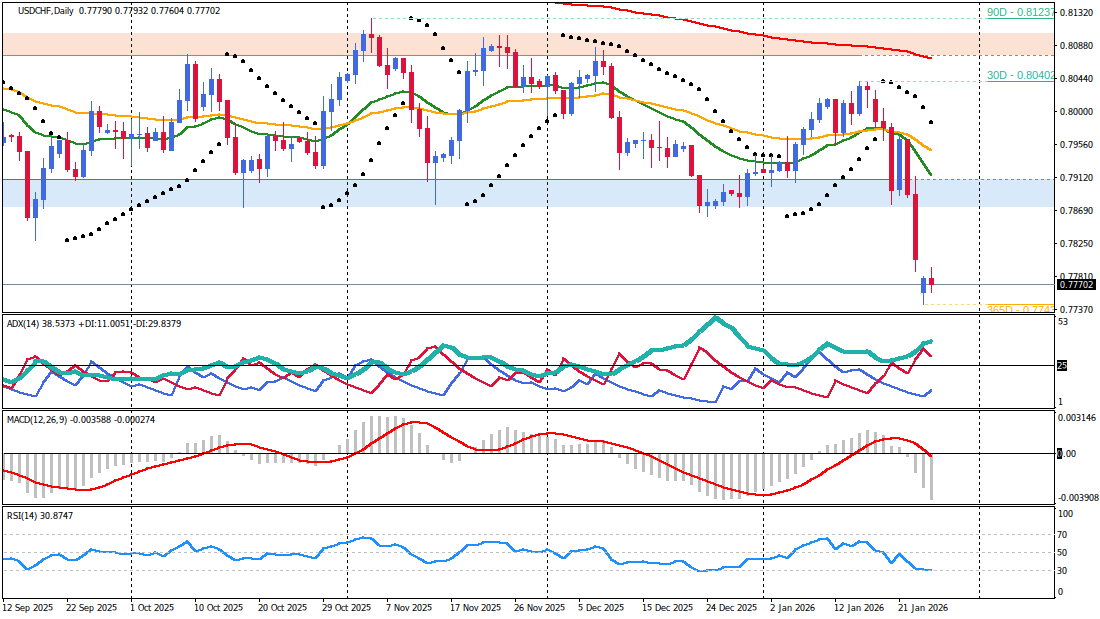
The USD/CHF pair exhibits a decisive bearish structure as technical momentum aligns with a fundamental backdrop characterized by safe-haven demand for the Swiss Franc and mounting uncertainty regarding US trade policy. The pair has recently confirmed a resumption of its long-term downtrend following a breach of the 0.7828 support level, a move that reinforces the dominant sell bias across multiple timeframes. While the US Dollar finds intermittent support from aggressive tariff rhetoric out of the Trump administration, the Swiss Franc remains fundamentally resilient, bolstered by its status as a premier global hedge against central bank subordination and fiscal instability. Technical structure combined with the Swiss National Bank’s (SNB) commitment to price stability supports a primary bearish outlook, though the upcoming Federal Open Market Committee (FOMC) decision on January 28th serves as a critical volatility catalyst that necessitates disciplined risk management. Currently, the pair trades below all major exponential moving averages, signaling that the path of least resistance remains to the downside as markets weigh US inflationary pressures against the Franc’s safe-haven appeal.
Technical Analysis
Multi-Timeframe Market Structure
The primary trend on the Daily (D1) timeframe is firmly bearish, characterized by a sustained series of lower highs and lower lows. Price action remains suppressed below the EMA20, EMA50, and EMA200, indicating that institutional selling pressure is consistent. The Daily RSI resides in bearish territory, and a negative MACD crossover reinforces the prevailing momentum. Fundamental resilience in the Swiss economy aligns with this technical structure to suggest that the long-term downtrend, originating from the 2017 highs, is resuming with a primary target at the 0.7382 projection level.
On the H4 timeframe, the bearish intensity is even more pronounced. The Average Directional Index (ADX) is approaching the 50 level, which signifies an exceptionally strong trend. The RSI is deeply oversold, but in the context of a powerful downtrend, this often serves as a sign of trend strength rather than an immediate reversal signal. The medium-term framework remains locked in a sell-side configuration as price continues to distance itself from the H4 exponential moving averages.
Short-term intraday analysis on the H1 and M30 charts shows price consolidating during the Asian session following a gap down. While the H1 chart remains bearishly aligned, the M30 RSI is less extreme, suggesting that the initial selling pressure may be stabilizing. This provides a technical window for a retracement toward structural resistance before the next leg lower. Technical structure aligns with the fundamental narrative to favor selling into rallies rather than chasing the move at current lows.
Critical Price Levels & Momentum Assessment
The technical landscape is defined by the following key levels:
- Resistance Levels:
- 0.7793: Recent H4 session high and immediate intraday hurdle.
- 0.7820: A critical confluence zone featuring the H1 EMA50 and significant prior structure; this level serves as the line in the sand for the short-term bearish bias.
- 0.7916: The D1 EMA20, representing the broader trend-following resistance.
- Support Levels:
- 0.7760: The current H4 swing low where buyers have previously stepped in.
- 0.7750: A psychological round number that may trigger minor profit-taking.
- 0.7744: Proximity to the Daily low and the H1 Parabolic SAR, representing the immediate floor for the current move.
Fundamental Market Drivers
Central Bank Policy & Economic Outlook
The fundamental divergence between the Federal Reserve and the Swiss National Bank remains a primary driver for USD/CHF. The SNB maintains a unique position among global central banks, meeting only quarterly to set monetary policy. With an inflation target of less than 2%, the SNB’s hawkish leanings in the face of global price pressures provide a structural floor for the Swiss Franc. Higher interest rates in Switzerland, or even the expectation of policy stability compared to a potentially pivoting Fed, make the Franc an attractive destination for capital seeking yield and security.
The Federal Reserve's upcoming policy announcement on January 28th is the most significant fundamental catalyst for the US Dollar. While the market anticipates the Fed Funds Rate to remain at 3.75%, the accompanying FOMC statement and press conference will be scrutinized for signals regarding future rate cuts. Economic data trends, including the recent US Core Durable Goods Orders, align with a cooling economic outlook that could weaken the Greenback. Conversely, the Swiss Manufacturing PMI, expected at 50.2, suggests a stabilizing industrial sector in Switzerland, further supporting the Franc against a softening USD.
Market Sentiment & Risk Environment
Risk sentiment is currently dominated by US trade policy and geopolitical maneuvering. President Trump’s threat to impose 100% tariffs on Canadian goods if Ottawa pursues a trade deal with China has introduced a fresh wave of volatility. While such threats often provide a temporary boost to the USD through "safe-haven" flows into the Dollar, the Swiss Franc is increasingly viewed as the superior hedge. Analysis from Goldman Sachs supports this view, highlighting the Franc as the best-placed global FX hedge against central bank subordination risks and global inflation pressures.
Furthermore, rumors of intervention in the FX markets—specifically reports of the New York Fed conducting rate checks to support the Japanese Yen—have created a cautious environment for US Dollar bulls. If authorities are indeed preparing to intervene against USD strength in other pairs, the spillover effect is likely to accelerate the USD/CHF downtrend. Switzerland’s strong fiscal fundamentals and political neutrality reinforce the Franc’s safe-haven appeal, shielding it from the cross-market spillovers that typically affect more risk-correlated currencies.
Integrated Trading Execution
Primary Trading Scenario
- Bias: Bearish continuation supported by multi-timeframe technical alignment and safe-haven CHF demand.
- Trigger/Entry: Await a corrective retracement toward the 0.7790-0.7800 resistance zone. Entry should be confirmed by bearish price action (e.g., an engulfing candle or pin bar) on the H1 timeframe during the London or New York session.
- Stop-Loss: 0.7825, placed above the H1 EMA50 and structural resistance, utilizing a 1.5x ATR buffer to avoid premature exit during volatility spikes.
- Profit Targets:
- Target 1: 0.7760 - The H4 swing low and a significant intraday liquidity pool.
- Target 2: 0.7740 - Proximity to the Daily low and a major psychological support level.
- Session Context: London and New York sessions provide the necessary liquidity for trend resumption; however, position sizing should be reduced by 50% ahead of the FOMC events.
Alternative Market Scenario
- Invalidation: A sustained H1 candle close above the 0.7820 resistance level, which would signal a shift in short-term momentum.
- Bias: Bullish reversal or deep consolidation triggered by a dovish Fed surprise or extreme oversold technical conditions.
- Trigger/Entry: Speculative long entry near the 0.7760 support level, contingent on a failure to break lower during the New York open.
- Stop-Loss: 0.7740, placed below the psychological support and recent H1 lows.
- Profit Targets:
- Target 1: 0.7800 - Retesting the broken psychological barrier and EMA resistance.
- Target 2: 0.7820 - The primary structural resistance level.
- Session Context: This scenario is highly dependent on a fundamental shift in USD sentiment, specifically regarding Federal Reserve forward guidance.
Risk Management & Catalyst Analysis
Trade Risk Assessment
The technical bearish alignment is high, but the confluence of high-impact US economic data creates a high-risk environment for trend-following strategies. The primary risk involves a "short squeeze" triggered by better-than-expected US PPI data or a hawkish surprise from the Federal Reserve. Traders must account for the possibility of widened spreads and slippage during the FOMC press conference. To mitigate these risks, stop-losses should be widened to 2x ATR during the New York session overlap, and all positions should be managed aggressively as price approaches the 0.7760 support zone.
Economic Calendar & Event Impact
The following events are critical for the USD/CHF trajectory this week:
- US Core Durable Goods Orders m/m (Today, 13:30 UTC): Forecast 0.3%, Previous 0.2% - A miss here would reinforce the bearish technical structure by signaling US manufacturing weakness.
- US CB Consumer Confidence (Tomorrow, 15:00 UTC): Forecast 90.1, Previous 89.1 - Higher confidence could provide the US Dollar with a temporary intraday lift.
- US Federal Funds Rate & FOMC Statement (January 28, 19:00 UTC): Forecast 3.75%, Previous 3.75% - The primary volatility driver; any hint of a "dovish hold" will likely accelerate the USD/CHF decline.
- US FOMC Press Conference (January 28, 19:30 UTC): Chair Powell's tone regarding inflation and labor market cooling will determine the medium-term trend direction.
- US Unemployment Claims (January 29, 13:30 UTC): Forecast 202K, Previous 200K - Key for assessing labor market resilience and its impact on Fed policy.
- US Core PPI m/m (January 30, 13:30 UTC): Forecast 0.3%, Previous 0.0% - Significant for late-week volatility as it shapes the inflation outlook for the next Fed cycle.
- CH Manufacturing PMI (January 31, 01:30 UTC): Forecast 50.2, Previous 50.1 - A print above 50 would confirm the resilience of the Swiss industrial sector, supporting the Franc.
Synthesized Market Outlook
The USD/CHF outlook remains decisively bearish as the technical breakdown below 0.7828 aligns with the fundamental preference for the Swiss Franc as a premier safe-haven asset. While geopolitical tensions and US tariff threats introduce noise, the structural downtrend is reinforced by the SNB's stability and the broader market's pivot away from the US Dollar ahead of the FOMC decision. Traders should prioritize sell-side opportunities on retracements to the 0.7790-0.7800 zone, while remaining vigilant for an invalidation of this bias above 0.7820. The key monitoring levels for the remainder of the week are 0.7820 on the upside and 0.7744 on the downside, with the January 28th FOMC meeting serving as the ultimate arbiter of trend sustainability.


