
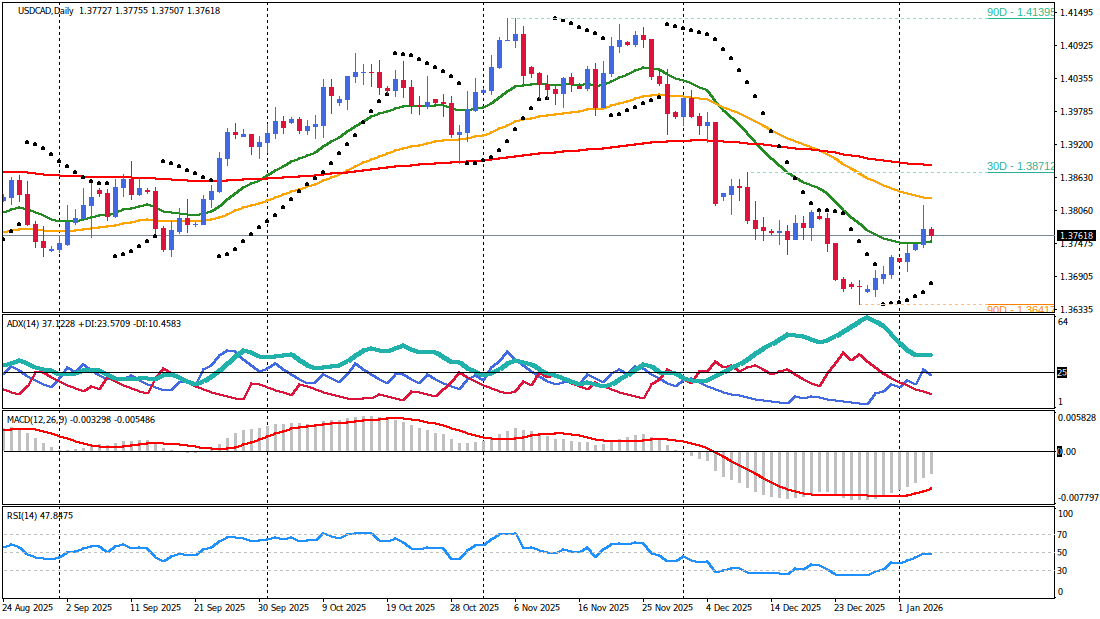
USD/CAD maintains a bullish bias on medium-term charts, driven by persistent Canadian dollar weakness stemming from geopolitical oil supply risks and speculation surrounding Bank of Canada policy. While the daily and four-hour timeframes exhibit strong upward momentum, shorter-term charts indicate significant overbought conditions, suggesting an imminent pullback or consolidation before any sustained advance. The US dollar, despite recent softness due to dovish Federal Reserve expectations and mixed PMI data, finds underlying support from its safe-haven appeal and potentially stronger labor market data later this week. Critical US and Canadian employment figures, along with broader sentiment shifts, are poised to introduce substantial volatility, making a tactical entry on a pullback the preferred strategy to capitalize on the underlying bullish trend.
Technical Analysis
Multi-Timeframe Market Structure
The daily chart for USD/CAD shows price action trading above the EMA20, confirming short-term bullishness. However, the pair remains below the EMA50 and EMA200, which suggests the longer-term trend has not fully confirmed an upward trajectory. This mixed long-term outlook aligns with the ongoing tug-of-war between a generally softer US dollar on dovish Fed expectations and the specific vulnerabilities weighing on the Canadian dollar. The MACD is negative, yet the ADX at 37.12 signals a strong trend is present. The Stochastic at 73.96 indicates potential overextension on this timeframe.On the H4 chart, a strong bullish picture prevails. Price trades well above the EMA20 and EMA50, supported by a positive MACD reading of 0.001816. The RSI at 66.17 reinforces strong upward momentum, while an exceptionally high ADX at 59.19 confirms a very strong trend. This robust medium-term bullishness is fundamentally supported by the Canadian dollar's underperformance relative to its G10 peers, as markets price in increased Venezuelan oil supply and USMCA renegotiation risks. However, the Parabolic SAR at 1.38091 indicates potential overhead resistance, suggesting the current upward drive might be nearing a pause.
The short-term intraday perspective (H1/M30) reflects immediate bullish momentum, with price above all key EMAs and MACD in positive territory. RSI at 61.37 and Stochastic at 75.58 on the H1 chart indicate strong buying pressure. The M30 chart also shows a bullish bias, but its ADX at 18.19 suggests weakening trend strength on this shorter timeframe. Critically, RSI at 67.02 and Stochastic at 89.47 on M30 are deep into overbought territory, particularly following a rapid intraday surge. This overextension on shorter timeframes implies that while the underlying bias remains bullish, a pullback or consolidation is highly probable, offering more favorable entry points.
Critical Price Levels & Momentum Assessment
Current price action indicates a market in a Moderate Trend phase overall, with strong intraday momentum that demands caution due to overextension. The confluence of signals is moderate, as higher timeframes support bullishness, but short-term charts signal overbought conditions and a potential for pullback.- Resistance:
- 1.38091 (H4 Parabolic SAR - immediate structural resistance) - This level is critical as a break would imply continued strength, potentially fueled by negative CAD news or stronger USD data.
- 1.38145 (Previous D1 High - psychological and structural resistance) - A clear break here would indicate a strong conviction move, likely on significant fundamental catalysts.
- 1.38273 (D1 EMA50 - major dynamic resistance) - Overcoming this dynamic resistance would suggest a more sustained shift in the longer-term trend, requiring robust fundamental backing for the USD.
- Support:
- 1.37671 (M5 Parabolic SAR - immediate intraday support) - A hold above this level indicates intraday strength, while a break could signal the start of a deeper pullback.
- 1.37536 (D1 EMA20 - short-term structural support) - This is a key level for the primary trading scenario, where fundamental factors supporting CAD weakness could see buyers re-engage.
- 1.37477 (H4 EMA20 - medium-term dynamic support) - A strong bounce from here would confirm the underlying medium-term bullish trend remains intact, likely as CAD's fundamental headwinds persist.
Fundamental Market Drivers
Central Bank Policy & Economic Outlook
The Federal Reserve's increasingly cautious tone and growing expectations for interest rate cuts later in 2026 continue to weigh on the US dollar. Recent mixed US PMI data, including the ISM Manufacturing PMI declining further into contraction territory at 47.9, indicates continued softness in US industrial activity. This backdrop contributes to a softer US Dollar Index (DXY) and reduces demand for conventional safe havens, despite some stability in employment and price components. Political unpredictability and concerns about central bank independence under President Trump's administration further prompt investors to reduce long USD positions ahead of key data.In contrast, the Bank of Canada (BoC) maintains a comparatively firm policy stance. Recent statements from policymakers suggest officials remain acutely aware of inflation risks, providing a degree of support for the Canadian dollar. This policy divergence helps to limit upside for USD/CAD, even as the US dollar experiences broader weakness. However, the CAD's vulnerability extends beyond monetary policy, as external factors significantly influence its performance.
Market Sentiment & Risk Environment
The Canadian dollar currently stands as the weakest G10 currency, reflecting a market that is actively pricing in several significant risks. A primary concern is the potential for increased supply of Venezuelan oil. Should US control over Venezuela's oil industry lead to higher global supply, it would disadvantage Canadian heavy, high-sulphur crude, which had previously traded at a premium. This expectation has already led to a widening of the Western Canadian Select-WTI differential, confirming the commodities market's cautious stance on these geopolitical developments. Any prolonged decline in energy prices would significantly jeopardize one of Canada’s primary sources of external assistance.Beyond oil, the Canadian dollar faces vulnerability from uncertainty surrounding USMCA renegotiations. Analysts suggest that markets might be underestimating the potential economic impact of these renegotiations, adding another layer of risk to the Canadian economy. ING's fair value model indicates USD/CAD should be trading above 1.380, implying that current market pricing might not fully reflect these risks, and sees risks extending towards the 1.390 area. While overall market sentiment has improved, leading to reduced demand for safe-haven assets like the USD, the specific and acute risks facing the CAD ensure that the USD/CAD pair remains bid on dips. Traders are currently hesitant to place large directional bets ahead of a busy data calendar, with US Nonfarm Payrolls and Canadian employment statistics expected to be key determinants of near-term trends.
Integrated Trading Execution
Primary Trading Scenario
- Bias: Bullish - The underlying technical bullish momentum on H4, combined with persistent fundamental weaknesses for the Canadian dollar (Venezuelan oil risks, USMCA uncertainty, and potential BoC cuts), strongly favors buying USD/CAD on pullbacks.
- Trigger/Entry: Buy on bounce from 1.37536 (+/- 3 pips) - This entry aligns with the D1 EMA20, a key short-term structural support. A pullback to this level provides a more attractive entry point following the intraday overbought conditions, allowing buyers to re-engage on the expectation that CAD's fundamental headwinds will persist.
- Stop-Loss: 1.37400 (below H4 EMA20 and 1.25x H1 ATR buffer) - This stop-loss is placed below significant technical support, offering protection if the underlying bullish thesis is invalidated or if a deeper correction takes hold due to unexpected fundamental shifts.
- Profit Targets:
- Target 1: 1.38090 (H4 SAR) - This target aligns with immediate structural resistance, representing a conservative profit-taking level as the pair approaches prior highs, potentially driven by further CAD weakness or a resilient USD ahead of US data.
- Target 2: 1.38250 (near D1 EMA50) - This target aims for a more significant resistance level, anticipating a stronger bullish continuation if fundamental drivers for USD/CAD remain strong, such as disappointing Canadian employment data or robust US labor figures.
- Session Context: Execute during the current London/NY overlap or early NY session, but remain highly cautious due to the upcoming cluster of high-impact US and Canadian economic data tomorrow and Friday.
Alternative Market Scenario
- Invalidation: Failure to sustain above 1.37671 - A sustained break below this immediate intraday support would suggest the pullback is deeper than anticipated or that intraday bullish momentum has completely dissipated.
- Bias: Neutral/Bearish - A significant shift in sentiment or data, such as unexpectedly strong Canadian data or a dovish surprise from the Fed, could invalidate the primary bullish bias.
- Trigger/Entry: Buy on M30 close above 1.38100 (+/- 3 pips) - This scenario is less probable given current overbought conditions but could materialize if an aggressive break above immediate resistance occurs, potentially fueled by a strong fundamental catalyst like extremely hawkish Fed rhetoric or a severe, unexpected negative development for the Canadian economy.
- Stop-Loss: 1.37850 (below H4 SAR and 1.25x H1 ATR buffer)
- Profit Targets:
- Target 1: 1.38350 (above D1 EMA50)
- Target 2: 1.38500 (psychological level)
- Session Context: This high-risk scenario would require significant fundamental validation, likely from tomorrow's or Friday's high-impact data, making it suitable for aggressive traders with strict risk management.
Risk Management & Catalyst Analysis
Trade Risk Assessment
The confluence quality for USD/CAD is currently medium. While higher timeframes show robust bullish momentum, intraday charts signal overextension and overbought conditions, creating a mixed signal that necessitates caution. Intraday risks include potential sharp reversals from overbought levels, especially during the high-liquidity London/NY overlap. The most significant risk factor is the upcoming cluster of high-impact US and Canadian economic events, including employment figures and ISM data, which can override technical setups and introduce substantial volatility. Position sizing must be conservative, with stops set using a 1.25x H1 ATR buffer (approximately 12 pips). Any positions held into tomorrow's US high-impact events or Friday's employment reports should have their size reduced by 50% to mitigate event risk.Economic Calendar & Event Impact
The upcoming economic calendar features several high-impact events that will significantly influence USD/CAD, shaping both US dollar and Canadian dollar dynamics:- US ADP Non-Farm Employment Change (Tomorrow, 13:15 UTC): Forecast 50K, Previous -32K - A stronger-than-forecast reading would support USD, suggesting resilience in the US labor market despite broader economic softness. Conversely, a weaker print could reinforce Fed dovish expectations.
- CA Ivey PMI (Tomorrow, 15:00 UTC): Forecast 49.5, Previous 48.4 - This Canadian sentiment indicator provides insight into economic activity. A reading above 50 suggests expansion, while below 50 indicates contraction. A stronger reading could offer some relief for CAD, while a weaker one would exacerbate its vulnerabilities.
- US ISM Services PMI (Tomorrow, 15:00 UTC): Forecast 52.2, Previous 52.6 - A key indicator for the dominant US services sector. A decline would align with recent manufacturing weakness, potentially adding to USD downside. A surprise increase could provide USD support.
- US JOLTS Job Openings (Tomorrow, 15:00 UTC): Forecast 7.64M, Previous 7.67M - This labor market metric is closely watched by the Fed. A significant deviation from forecast could alter interest rate expectations and USD valuation.
- US Unemployment Claims (January 8, 13:30 UTC): Forecast 211K, Previous 199K - A higher-than-expected number of claims indicates a weakening labor market, typically negative for USD. A lower number would suggest resilience.
- CA Employment Change (January 9, 13:30 UTC): Forecast -1.8K, Previous 53.6K - A critical Canadian labor market report. A negative forecast indicates a contraction in employment, which would significantly weigh on CAD and reinforce BoC dovish risks. A surprise positive figure could boost CAD.
- CA Unemployment Rate (January 9, 13:30 UTC): Forecast 6.7%, Previous 6.5% - An increase in the unemployment rate would signal further weakness in the Canadian economy, likely pressuring CAD.
- US Average Hourly Earnings m/m (January 9, 13:30 UTC): Forecast 0.3%, Previous 0.1% - A key inflation-related labor metric. Higher wage growth could spark inflation concerns, potentially supporting USD and delaying Fed rate cut expectations.
- US Non-Farm Employment Change (January 9, 13:30 UTC): Forecast 62K, Previous 64K - The most impactful US labor market report. A strong beat could significantly strengthen USD, while a miss would reinforce dovish Fed expectations.
- US Unemployment Rate (January 9, 13:30 UTC): Forecast 4.5%, Previous 4.6% - A falling unemployment rate supports a strong labor market narrative, generally positive for USD.
- US Prelim UoM Consumer Sentiment (January 9, 15:00 UTC): Forecast 53.5, Previous 53.3 - Consumer confidence can influence spending and economic outlook.
- US Prelim UoM Inflation Expectations (January 9, 15:00 UTC): Previous 4.1% - Closely watched by the Fed for future inflation trends. Higher expectations could support a hawkish Fed stance.
Synthesized Market Outlook
USD/CAD maintains a robust bullish bias on medium-term charts, primarily driven by persistent fundamental vulnerabilities impacting the Canadian dollar. While short-term technical indicators suggest the pair is overbought, implying a probable pullback, this correction is viewed as an opportunity to join the underlying uptrend. The Canadian dollar faces significant headwinds from geopolitical risks surrounding Venezuelan oil supply, which disadvantages its heavy crude, and ongoing uncertainty related to USMCA renegotiations. Furthermore, the Bank of Canada's policy stance, though firm on inflation, carries risks of further cuts in 2026, exacerbating CAD's vulnerability.The US dollar, despite recent softness linked to dovish Federal Reserve expectations and mixed economic data, may find renewed support from upcoming high-impact labor market reports, which could shift Fed policy expectations. Critical monitoring levels for the primary bullish scenario include the 1.37536 support level for a tactical entry, targeting 1.38090 and 1.38250. Conversely, a sustained break below 1.37671 would suggest a deeper correction or invalidation of the immediate bullish setup. The dense economic calendar this week, particularly US and Canadian employment data, will serve as crucial catalysts, validating or challenging these technical and fundamental alignments. Traders must exercise caution and adhere to strict risk management, especially around these high-impact event releases.


