
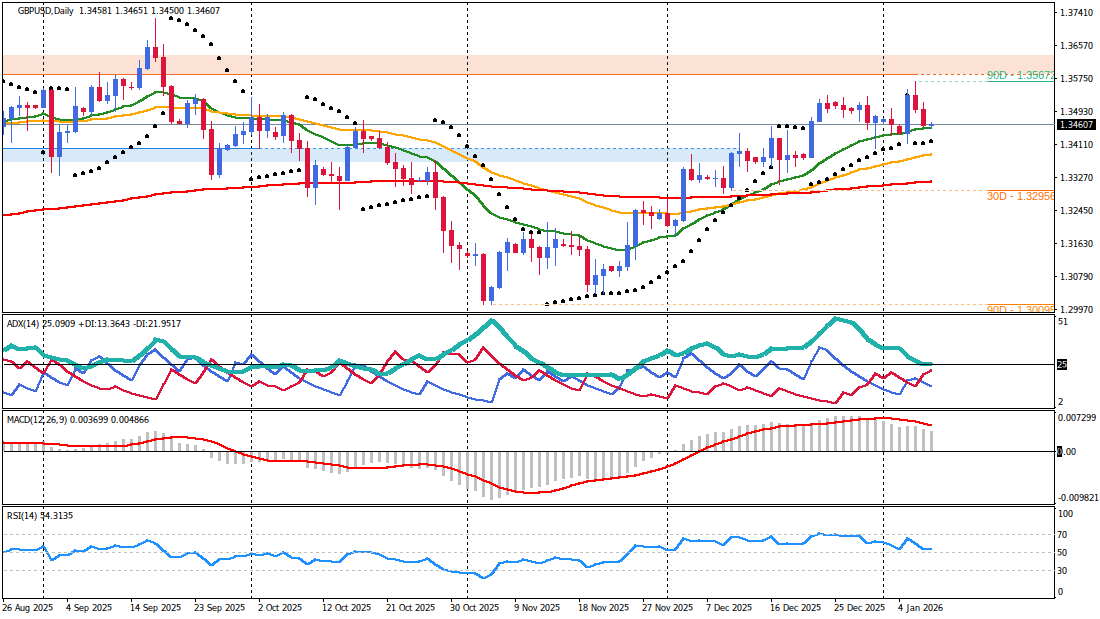
GBP/USD currently experiences strong bearish momentum across short and medium timeframes, pushing price towards critical structural support levels. This immediate downside pressure aligns with a prevailing cautious market sentiment and anticipation of pivotal US employment data, including today's Unemployment Claims and tomorrow's Non-Farm Payrolls report. While the daily chart retains an underlying bullish structure, recent price action indicates a healthy correction that has extended into bearish control on shorter timeframes. The Bank of England's (BoE) cautious but less dovish outlook, suggesting a gradual easing path in 2026, provides some underlying support for the Pound, yet the dominant narrative remains centered on US economic strength and its implications for Federal Reserve policy. The upcoming data releases for the US are significant catalysts that will either reinforce the current bearish technical bias or trigger a counter-trend rebound.
Technical Analysis
Multi-Timeframe Market Structure
GBP/USD closed the previous session with a bearish candle at 1.34580, challenging the overarching bullish structure seen on the daily chart. Price remains above the D1 EMA20 (1.34506), EMA50 (1.33849), and EMA200 (1.33173), suggesting that the current decline is a correction within a broader uptrend. The MACD on the daily timeframe is positive at 0.003670, but its histogram shows slowing momentum, indicating a potential weakening of bullish conviction. RSI at 53.85 is neutral, while ADX at 25.09 points to a developing trend. The D1 SAR at 1.34167 acts as underlying bullish trend protection. This daily perspective suggests that while the long-term trend remains positive, the pair is vulnerable to near-term downside, particularly given the strength of recent US economic data which bolsters the US Dollar.The H4 chart confirms the immediate bearish pressure, with price trading at 1.34628, firmly below both the EMA20 (1.34839) and EMA50 (1.34777). The MACD is negative at -0.000401, and RSI is in bearish territory at 42.95. ADX at 29.10 indicates a strong developing bearish trend, aligning with the market's cautious stance ahead of US jobs data. The H4 SAR at 1.35292 is above the price, providing clear bearish trend protection. This medium-term framework highlights a decisive shift towards bearish control, with momentum indicators signaling further downside.
On the short-term intraday charts, the H1 exhibits a strong bearish trend, with price at 1.34576 significantly below its EMAs. MACD is deeply negative at -0.001111, and RSI is approaching oversold conditions at 34.00. The ADX at 40.34 confirms robust bearish momentum. The M30 chart, while still bearish, shows a slight bullish candle forming, indicating a potential minor bounce or consolidation. This suggests that while the strong H1 bearish bias prevails, a temporary pause in selling could occur before further declines, especially as the London session approaches. This short-term bearish dominance is heavily influenced by market positioning ahead of high-impact US economic events.
Critical Price Levels & Momentum Assessment
The market's current trajectory is defined by key technical levels that will be tested by upcoming fundamental catalysts.Resistance:
- 1.34688 (H1 EMA20, immediate intraday resistance) - A failure to break above this level reinforces short-term bearish control.
- 1.34839 (H4 EMA20, key medium-term resistance) - Reclaiming this level would challenge the H4 bearish trend, but strong US data makes this unlikely in the near term.
- 1.35165 (Previous D1 high, structural resistance) - A significant hurdle requiring substantial bullish momentum, likely from a strong dovish shift from the Fed or significant positive UK news.
Support:
- 1.34506 (D1 EMA20 / H1 SAR, critical immediate support zone) - A decisive break below this level, particularly on stronger-than-expected US jobs data, confirms further bearish extension.
- 1.34167 (D1 SAR, medium-term trend support) - This level represents a key target for bearish continuation, aligning with the H4 bearish structure.
- 1.33849 (D1 EMA50, strong structural support) - A break below this level would severely challenge the daily bullish structure and indicate a deeper correction.
Momentum consensus is bearish across the H1 and H4 timeframes, driven by negative MACD readings and high ADX values, particularly on H1 (40.34). Volatility remains moderate, with H1 ATR at 0.000652. The current strong trend phase on H1 confirms bearish dominance. The D1 timeframe, while fundamentally bullish, shows a pullback, creating a conflict for longer-term directional conviction. The confluence for bearish continuation is strong for the short and medium term, with the D1 providing a potential long-term floor.
Fundamental Market Drivers
Central Bank Policy & Economic Outlook
The primary fundamental driver for GBP/USD is the significant divergence in economic outlooks and monetary policy expectations between the US Federal Reserve (Fed) and the Bank of England (BoE). Markets are highly sensitive to US economic data, particularly employment figures, which directly influence the Fed's interest rate path. Earlier data this week, such as the US ISM Services PMI, unexpectedly picked up in December, signaling resilience in the US economy. While ADP payrolls rebounded less than expected, the focus remains on the more comprehensive Non-Farm Payrolls (NFP) report due tomorrow. If upcoming US jobs data, including today's Unemployment Claims and tomorrow's NFP, Average Hourly Earnings, and Unemployment Rate, show stronger-than-expected outcomes, it would likely weigh on expectations for further Fed easing. This scenario would lead to a stronger US Dollar as the market scales back bets on aggressive rate cuts, reinforcing the current bearish technical bias on GBP/USD. Conversely, any signs of weakness in the US labor market or dovish rhetoric from Fed officials, such as Governor Stephen Miran's call for aggressive rate cuts, could undermine the USD and provide a tailwind for GBP/USD, potentially triggering a technical rebound.In the United Kingdom, the Bank of England is expected to follow a gradual monetary easing path in 2026. Inflation remains above the central bank’s 2% target, which provides some support for the Pound Sterling, preventing excessive weakness. Financial markets anticipate at least one BoE rate reduction in the first half of the year, with nearly 50% odds priced in for a second cut before year-end. Despite economic data "screaming" that the Bank's work is not done, the BoE committee remains divided and cautious. Key factors influencing the BoE include falling wage growth, a weaker jobs market (vacancies per unemployed worker are down dramatically), and declining services inflation. The BoE's survey of corporates on expected wage growth, which has leveled out in the 3.5-3.8% area, is a critical data point. The Bank is likely to wait for more benign wage growth and potentially a higher unemployment rate before confirming further cuts, with expectations for the next cut in March and another in June. This cautious stance by the BoE, while still signaling cuts, is less dovish than the market's initial pricing for the Fed, which creates a dynamic where the Pound could find some support against currencies other than the USD, but struggles against a strong Greenback.
Market Sentiment & Risk Environment
Global risk sentiment currently exhibits a mildly risk-off tone, as indicated by gains in the CBOE Volatility Index (VIX). This environment generally benefits safe-haven currencies like the US Dollar. Geopolitical factors, including the US military attack on Venezuela, US President Trump's confrontational rhetoric towards Colombia and Mexico, and discussions about acquiring Greenland, contribute to heightened global uncertainty. Additionally, the protracted Russia-Ukraine war continues to fuel risk aversion. This flight to safety channels capital towards the US Dollar, reinforcing its strength against the Pound. While the Japanese Yen also benefits from safe-haven flows, the broader market's preference for the USD in the current context of robust US economic data and potential hawkish shifts in Fed expectations creates a strong headwind for GBP/USD. This risk-off sentiment aligns with and strengthens the prevailing bearish technical structure observed on shorter timeframes for GBP/USD.Integrated Trading Execution
Primary Trading Scenario
- Bias: Bearish - The strong bearish momentum on H1 and H4, combined with the US Dollar's strength driven by resilient US economic data and anticipation of hawkish Fed policy shifts, supports further downside.
- Trigger/Entry: A clear break and close below 1.34506 (H1 SAR / D1 EMA20 confluence) confirms bearish continuation. An optimal entry zone is 1.34490-1.34500, ideally triggered by stronger-than-expected US Unemployment Claims data.
- Stop-Loss: Place stop-loss above the H1 EMA20 at 1.34780, which is a key intraday resistance level. This placement protects against a false breakdown and aligns with the 1.25x H1 ATR rule.
- Profit Targets:
- Target 1: 1.34170 (D1 SAR) - This level represents medium-term trend support, a logical first target for bearish momentum.
- Target 2: 1.33850 (D1 EMA50) - This strong structural support aligns with a deeper correction within the daily timeframe and would be reached on sustained USD strength.
- Session Context: This scenario is best executed during the London session, as increased volatility is expected to drive the move. Heightened vigilance is required as the US Unemployment Claims event approaches.
Alternative Market Scenario
- Invalidation: Invalidation of the primary bearish scenario occurs with an H1 close above 1.34700, indicating that bearish pressure is easing. This could be triggered by weaker-than-expected US Unemployment Claims or dovish comments from Fed officials.
- Bias: Bullish (Intraday Rebound) - A temporary rebound is possible if bearish momentum stalls and key support holds.
- Trigger/Entry: A long entry could be considered on a confirmed M30 bullish candle close above 1.34690, signaling a reclaim of immediate intraday resistance.
- Stop-Loss: Place stop-loss below the D1 EMA20 at 1.34480, protecting against a resumption of the bearish trend.
- Profit Targets:
- Target 1: 1.34840 (H4 EMA20) - This level represents the first significant resistance point for an intraday rebound.
- Target 2: 1.35000 (psychological level) - A round number resistance that may attract profit-taking.
- Session Context: This scenario carries higher risk due to the prevailing bearish H1/H4 trend and is best suited for nimble trading during the London open, with quick profit-taking in mind. This pre-event setup requires constant awareness of upcoming high-impact US data.
Risk Management & Catalyst Analysis
Trade Risk Assessment
The current market environment for GBP/USD presents medium confluence quality. While the H1 and H4 timeframes exhibit strong bearish alignment, the underlying D1 bullish structure creates a conflict for longer-term directional conviction. The agreement among indicators for the short-term bearish bias is high, but the proximity of high-impact US economic data introduces significant event risk. Intraday-specific risks include potential spikes during the London open and unexpected headlines ahead of the heavy US economic calendar. Position sizing must be conservative, especially given the cluster of high-impact US events scheduled for today and tomorrow. Using the H1 ATR (0.000652) for stop-loss placement, a 1.25x ATR stop equates to approximately 8 pips for intraday trades. Traders are advised to reduce position size by 50% within four hours of high-impact events due to the increased potential for sharp and unpredictable market reactions. The validity of any trade setup is limited by the proximity of the US Unemployment Claims report today and the Non-Farm Payrolls report tomorrow.Economic Calendar & Event Impact
The upcoming economic calendar features several high-impact US events that will significantly influence GBP/USD direction and volatility:- US Unemployment Claims (Today, 13:30 UTC): Forecast 213K, Previous 199K - This weekly labor market indicator is crucial for assessing the health of the US job market. A higher-than-forecast figure could weaken the USD, while a lower figure strengthens it, potentially triggering the primary bearish scenario.
- US Average Hourly Earnings m/m (Tomorrow, 13:30 UTC): Forecast 0.3%, Previous 0.1% - A key inflation-related labor market indicator. Stronger wage growth would bolster Fed hawkish expectations, supporting the USD.
- US Non-Farm Employment Change (Tomorrow, 13:30 UTC): Forecast 66K, Previous 64K - The most anticipated US jobs report. A significantly higher print would strongly favor USD strength, while a miss could trigger a sharp GBP/USD rebound.
- US Unemployment Rate (Tomorrow, 13:30 UTC): Forecast 4.5%, Previous 4.6% - A lower unemployment rate reinforces a strong labor market, supporting the USD.
- US Prelim UoM Consumer Sentiment (Tomorrow, 15:00 UTC): Forecast 53.5, Previous 53.3 - Indicates consumer confidence, which can influence spending and economic growth expectations.
- US Prelim UoM Inflation Expectations (Tomorrow, 15:00 UTC): Previous 4.1% - This data point is closely watched by the Fed for signs of future inflationary pressures, impacting policy outlook.


