
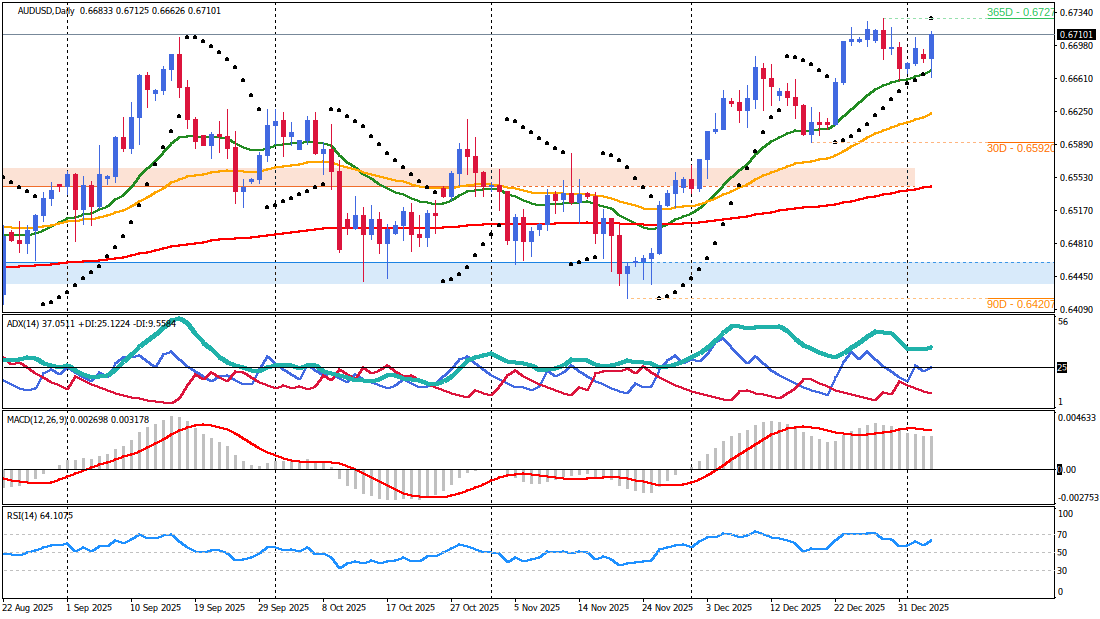
The AUD/USD pair maintains a strong bullish posture across multiple timeframes, driven by a hawkish Reserve Bank of Australia outlook and recent disappointing US economic data. While technical indicators point to robust upward momentum, short-term oscillators signal overbought conditions, suggesting the potential for a temporary pullback or consolidation. This technical setup aligns with market expectations for a potential RBA rate hike in February, contingent on forthcoming inflation data, contrasting with dovish Federal Reserve expectations. The upcoming Australian CPI data is a critical catalyst that will determine the pair's immediate trajectory, potentially validating either a bullish continuation after a retracement or triggering a more significant correction.
Technical Analysis
Multi-Timeframe Market Structure
The dominant trend on the D1 timeframe for AUD/USD is unequivocally bullish. Price action trades well above the EMA20, EMA50, and EMA200, which are in a clear bullish alignment (EMA20 > EMA50 > EMA200). The MACD remains strongly positive, and the RSI at 64.80 confirms robust upward momentum. An ADX reading of 37.23 indicates a strong, well-defined trend, which finds fundamental support from the RBA's hawkish rhetoric and the prospect of further monetary tightening. The D1 Parabolic SAR at 0.67270 acts as a significant resistance level that recent price action approaches.The H4 chart reinforces the bullish bias, with price positioned above its EMAs, also aligned in an uptrend. MACD is positive, and RSI stands at a bullish 61.90. However, the Stochastic at 93.20 is deeply overbought, and the ADX at 18.54 suggests a weak or ranging trend on this timeframe, indicating potential for exhaustion or consolidation following the recent advance. This H4 observation suggests that while the overarching trend is bullish, a near-term correction is plausible, especially ahead of high-impact fundamental releases like Australian CPI. The H4 SAR at 0.66626 provides dynamic support.
On the short-term intraday charts (H1/M30), the immediate trading bias is bullish, with price above bullishly aligned EMAs. H1 MACD is positive at 0.000834, and RSI is strong at 66.31, supported by a robust ADX of 31.45. M30 indicators mirror this strength. However, both H1 Stochastic (93.51) and M30 Stochastic (89.16) are in overbought territory. This indicates that while the intraday trend is up, a pullback is likely before any further significant advance, aligning with the H4 overbought signals. Optimal execution timing on the M30 involves waiting for a slight retracement towards intraday support levels, coinciding with a reset in overbought oscillators, particularly during the Asian session when liquidity may be thinner.
Critical Price Levels & Momentum Assessment
Resistance:- 0.67185 - 0.67200 (H4 high, immediate intraday resistance) - This level represents a key hurdle for continued upside, and a rejection here could signal a short-term top, especially if Australian CPI data disappoints.
- 0.67270 (D1 Parabolic SAR, strong structural resistance) - A break above this level would confirm a robust continuation of the D1 bullish trend, likely fueled by strong Australian economic data or significant USD weakness.
- 0.67060 - 0.67070 (M30 Parabolic SAR, intraday support) - This intraday support zone is crucial for maintaining the immediate bullish structure. A hold here would provide a strong base for further upside.
- 0.67000 (Psychological level, confluence with recent swing lows) - This psychological level often attracts buying interest and serves as a strong foundational support, particularly ahead of significant economic releases.
- 0.66930 - 0.66980 (H4 EMA20 & H1 EMA20 zone, key dynamic support) - This dynamic support area represents a critical line in the sand for the short-term bullish trend. A break below this zone would signal a deeper correction.
Fundamental Market Drivers
Central Bank Policy & Economic Outlook
The Reserve Bank of Australia (RBA) policy outlook provides significant underlying support for the Australian Dollar. RBA Governor Michele Bullock recently noted that while the board did not explicitly consider an immediate rate hike, discussions centered on conditions that might necessitate monetary tightening. This hawkish stance supports market expectations for a potential rate hike at the February 3 meeting, particularly if Australia's fourth-quarter Consumer Price Index (CPI), due on January 28, shows a stronger-than-expected core inflation reading. Higher interest rates relative to other major central banks inherently strengthen the AUD.In contrast, the US Federal Reserve's policy outlook leans dovish. Markets currently price in two additional Fed rate cuts in 2026. Minutes from the December Federal Open Market Committee (FOMC) meeting indicated that several officials judged it appropriate to pause further rate cuts only if inflation continues to ease gradually. This suggests a cautious but ultimately accommodative bias. Furthermore, the prospect of US President Donald Trump nominating a new Fed Chair when Jerome Powell’s term ends in May is seen as potentially tilting monetary policy toward an even more accommodative stance. This divergence in central bank policy expectations provides a fundamental tailwind for AUD/USD.
Recent economic data reinforces these central bank narratives. The US ISM Manufacturing PMI fell for a third consecutive month to 47.9 in December, signaling a faster contraction in US manufacturing activity and reinforcing signs of a cooling industrial sector. This soft US data adds nuance to the outlook for US growth and monetary policy expectations, contributing to USD weakness. For Australia's largest trading partner, China, recent data showed a slight slowdown in the RatingDog Services PMI to 52.0 in December, but the Manufacturing PMI edged up to 50.1, marginally returning to expansion territory. While mixed, the manufacturing rebound offers some stability for Australian exports, particularly iron ore, which is a key driver for the AUD.
Market Sentiment & Risk Environment
Market sentiment has played a role in the recent AUD/USD price action. Initial safe-haven demand for the US Dollar emerged due to heightened geopolitical tensions in Latin America, specifically following the US capture of Venezuelan President Nicolas Maduro. However, this risk-off sentiment-driven USD strength was subsequently erased after the release of the disappointing US ISM Manufacturing PMI data. This suggests that while geopolitical events can introduce temporary volatility and safe-haven flows, underlying economic fundamentals and central bank policy expectations ultimately dictate sustained currency movements. The Australian Dollar typically benefits from a "risk-on" environment, and while geopolitical risks are present, the current focus on central bank divergence and economic data appears to be overriding persistent risk-off sentiment. The health of the Chinese economy remains a crucial factor for the AUD, as any positive or negative surprises in Chinese growth data directly impact demand for Australian raw materials and thus the AUD.Integrated Trading Execution
Primary Trading Scenario
- Bias: Bullish - The strong multi-timeframe technical structure combined with the RBA's hawkish stance and dovish Fed expectations fundamentally supports continued AUD/USD strength after a short-term correction.
- Trigger/Entry: A clear M30 close above 0.67065, following a retracement towards the 0.67000 - 0.67060 zone during the Asian session and a reset of intraday overbought oscillators. This entry aligns with the expectation of pre-CPI consolidation and a subsequent bounce.
- Stop-Loss: 0.66950 (1.25x H1 ATR below entry, just below H1 EMA20) - This stop-loss is placed below a key dynamic support level, providing a reasonable buffer against minor pullbacks while protecting capital if the bullish thesis is invalidated.
- Profit Targets:
- Target 1: 0.67180 (recent high) - This target is justified by the prevailing bullish momentum and the pair's tendency to retest recent peaks, especially if supported by positive pre-CPI sentiment.
- Target 2: 0.67260 (D1 SAR/structural resistance) - A break above Target 1, potentially fueled by strong Australian CPI data, makes this structural resistance a logical next objective for the bullish continuation.
- Session Context: This scenario is optimal during the early Asian session, prior to the Australian CPI release, allowing for a technical entry based on a retracement and subsequent bounce.
Alternative Market Scenario
- Invalidation: The primary bullish scenario is invalidated if AUD/USD fails to break above 0.67185 - 0.67200 resistance and shows clear rejection, or if the upcoming AU CPI data disappoints significantly, leading to a break below critical support levels.
- Bias: Bearish - A strong rejection at resistance or a significantly weaker-than-expected AU CPI reading would fundamentally shift sentiment, favoring a bearish correction.
- Trigger/Entry: An M30 close below 0.67130, particularly if accompanied by bearish price action and a negative shift in intraday momentum (e.g., MACD cross below signal line) after a failed attempt to breach resistance. This entry capitalizes on a potential reversal from overbought conditions.
- Stop-Loss: 0.67220 (1.25x H1 ATR above entry, above H4 high) - This stop protects against a false breakdown and places the risk above immediate resistance.
- Profit Targets:
- Target 1: 0.67060 (M30 SAR) - This initial target aims for the first significant intraday support level.
- Target 2: 0.67000 (psychological support) - A break below Target 1 would open the path to this key psychological level, especially if bearish momentum accelerates post-CPI.
- Session Context: This scenario gains more traction if the upcoming AU CPI data disappoints significantly, but technical signals require event confirmation.
Risk Management & Catalyst Analysis
Trade Risk Assessment
The confluence quality for the current AUD/USD setup is medium. While D1, H1, and M30 display strong bullish alignment, the H4 timeframe shows some divergence with its ADX, and multiple oscillators are overbought, indicating potential for a short-term correction. This reduces overall confidence in an immediate, unhindered upward move. Intraday risks include thinning liquidity as the NY session closes and the potential for whipsaws during the transition to the Asian session. Furthermore, the impending high-impact Australian CPI data introduces significant event risk, as unexpected results could quickly override existing technical structures. Position sizing should be conservative, especially given the overbought conditions and the impending high-impact Australian CPI data. For intraday trades, a stop-loss of 1.25x the H1 ATR (approximately 11-12 pips from entry) is appropriate. The proximity of the AU CPI event on January 7th at 00:30 UTC means that any technical setup within 4 hours of this event carries elevated risk, and position size should be reduced by 50%. The time sensitivity of current setups is high, as the technical landscape may shift significantly post-CPI.Economic Calendar & Event Impact
The upcoming economic calendar features several high-impact events that will significantly influence AUD/USD:- US ISM Manufacturing PMI (Today, 15:00 UTC): Previous 48.2 - Already released at 47.9, this disappointing data has already contributed to USD weakness, supporting the AUD/USD's resilience.
- US ISM Manufacturing Prices (Today, 15:00 UTC): Forecast 59.0, Previous 58.5 - This inflation component could offer a counter-narrative to the weak manufacturing data, but its overall impact is likely secondary to the broader PMI figure.
- AU CPI m/m (Tomorrow, 00:30 UTC): Forecast 0.1%, Previous 0.0% - A critical inflation gauge for Australia. A stronger-than-forecast reading would significantly bolster RBA rate hike expectations for February, providing strong fundamental support for AUD/USD.
- AU CPI y/y (Tomorrow, 00:30 UTC): Forecast 3.7%, Previous 3.8% - A key measure of annual inflation. A reading at or above forecast would reinforce the RBA's hawkish stance and support AUD strength.
- AU Trimmed Mean CPI m/m (Tomorrow, 00:30 UTC): Forecast 0.2%, Previous 1.0% - The RBA's preferred measure of underlying inflation. A lower-than-expected figure, especially after the previous high, could temper RBA hawkishness and weigh on AUD.
- US ADP Non-Farm Employment Change (Tomorrow, 13:15 UTC): Forecast 47K, Previous -32K - A leading indicator for the official NFP report. A significant beat could strengthen the USD by suggesting a robust labor market, while a miss would reinforce dovish Fed expectations.
- US ISM Services PMI (Tomorrow, 15:00 UTC): Forecast 52.3, Previous 52.6 - This high-impact data provides insight into the health of the dominant US services sector. A weaker reading would further support the dovish Fed narrative and weigh on the USD.
- US JOLTS Job Openings (Tomorrow, 15:00 UTC): Forecast 7.65M, Previous 7.67M - A measure of labor demand. A significant decline could signal a cooling labor market, supporting Fed rate cut expectations and weakening the USD.
- US Unemployment Claims (January 8, 13:30 UTC): Forecast 216K, Previous 199K - A key weekly labor market indicator. A higher-than-expected number of claims would indicate labor market softening, bearish for USD.
- US Average Hourly Earnings m/m (January 9, 13:30 UTC): Forecast 0.3%, Previous 0.1% - A crucial inflation and wage growth indicator. A strong print could push back against Fed rate cut expectations, strengthening the USD.
- US Non-Farm Employment Change (January 9, 13:30 UTC): Forecast 57K, Previous 64K - The most impactful US labor market report. A weaker-than-expected jobs print would reinforce the dovish Fed outlook and weaken the USD.
- US Unemployment Rate (January 9, 13:30 UTC): Forecast 4.5%, Previous 4.6% - A key measure of labor market slack. An unexpected rise would be bearish for the USD, while a fall could provide some support.
- US Prelim UoM Consumer Sentiment (January 9, 15:00 UTC): Forecast 53.5, Previous 53.3 - Consumer sentiment can provide insight into future spending. A significant deviation can influence USD.
- US Prelim UoM Inflation Expectations (January 9, 15:00 UTC): Previous 4.1% - Crucial for Fed policy, as sustained high inflation expectations could temper dovish sentiment, strengthening the USD.
Synthesized Market Outlook
The AUD/USD maintains a fundamentally and technically supported bullish bias, though short-term overbought conditions suggest a corrective move is likely before further significant upside. The technical structure, characterized by bullish moving average alignment across D1, H1, and M30, aligns with the fundamental backdrop of a hawkish RBA and an increasingly dovish Federal Reserve. The RBA's discussions around potential monetary tightening and market expectations for a February rate hike provide a strong catalyst for AUD strength, especially if the upcoming Australian CPI data validates these expectations. Conversely, disappointing US manufacturing data and market pricing for Fed rate cuts continue to weigh on the USD.Traders should monitor the 0.67000 - 0.67060 support zone for potential bullish retracement entries, targeting 0.67180 and 0.67260. The critical event for the week is the Australian CPI data on Tomorrow at 00:30 UTC. A strong inflation print will likely provide robust fundamental validation for the bullish technical scenario, potentially fueling a break above the D1 SAR resistance at 0.67270. Conversely, a significant disappointment in CPI, or a strong rebound in upcoming US labor market data, could trigger the alternative bearish scenario, pushing the pair back towards 0.67000 and potentially lower. Conservative risk management and position sizing are essential, particularly in the lead-up to and immediate aftermath of these high-impact economic releases.


