
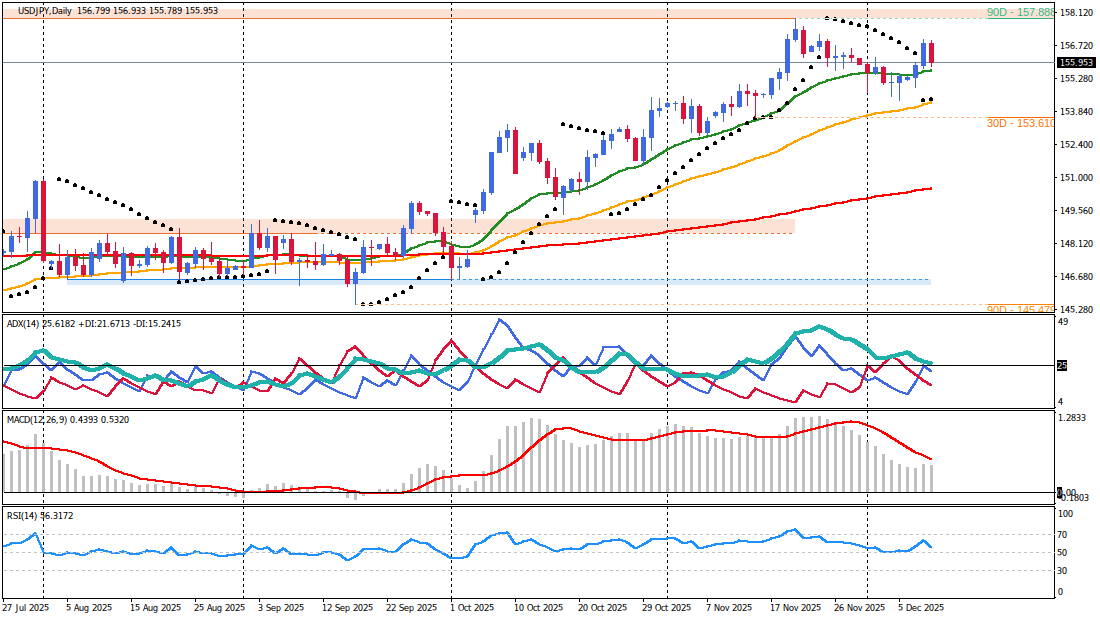
USD/JPY exhibits a clear intraday bearish bias, driven by the Federal Reserve's recent interest rate cut and dovish forward guidance, which has significantly weakened the US Dollar. This immediate selling pressure pushes the pair into oversold territory, directly challenging the underlying bullish structure observed on the daily chart. While the Fed's dovish pivot dominates short-term sentiment, the Bank of Japan's flexible policy stance and Japan's fiscal concerns provide a countervailing fundamental force that caps significant downside for the Yen in the medium term. The market's focus now shifts entirely to the impending FOMC economic projections and press conference, which are poised to dictate the pair's near-term trajectory and test critical technical support levels. The divergence between short-term bearish momentum and longer-term bullish technicals, amplified by high-impact USD events, creates a low-confluence trading environment requiring precise execution and heightened risk management.
Technical Analysis
Multi-Timeframe Market Structure
The multi-timeframe analysis for USD/JPY presents a divergent picture. The daily chart maintains a robust bullish structure, with price closing at 156.800, comfortably above the EMA20 (155.607), EMA50 (154.213), and EMA200 (150.525). The aligned moving averages and positive, rising MACD unequivocally support the long-term bullish bias. This longer-term bullishness reflects the historical policy divergence between the Fed and BoJ, which has favored USD strength.Conversely, the short-term intraday perspective (H1/M30) demonstrates strong bearish momentum. Price trades significantly below all key moving averages on these timeframes, with MACD deeply negative and declining. RSI is oversold on both H1 (27.82) and M30 (27.03), signaling an intense recent sell-off. H1 ADX (41.56) confirms a very strong downtrend. This immediate bearish pressure aligns directly with the fundamental impact of the Fed's rate cut, which has triggered broad USD weakness. The H4 timeframe shows a mixed picture from its last completed candle, but current live price action indicates a shift towards bearishness, consistent with the immediate fundamental drivers. The short-term bearish impulse is currently overriding the established daily uptrend, creating a pivotal moment for the pair.
Critical Price Levels & Momentum Assessment
Current price action is characterized by a sharp intraday decline, testing short-term support levels. The market is experiencing significant volatility, with H1 ATR at 0.218.- Resistance:
- 155.800: Intraday resistance, a confluence of previous M30 support and a psychological level. A failure to reclaim this level reinforces bearish sentiment following the dovish Fed.
- 156.050: H1 EMA20 and intraday swing high. A sustained break above this level would signal a potential short-term bullish correction, possibly on a surprise hawkish tone from the FOMC.
- 156.280: H1 EMA50 and H4 EMA20 confluence. Reclaiming this level would indicate a stronger bullish reversal, potentially if the FOMC's forward guidance is less dovish than anticipated.
- Support:
- 155.600: D1 EMA20 and current intraday lows, a critical short-term structural level. A decisive break below this level, particularly post-FOMC, would threaten the daily bullish structure.
- 155.000: Strong psychological level. This acts as a key downside target for a bearish continuation driven by sustained USD weakness.
- 154.770: H4 EMA200, a key medium-term support. A breach here would signal a significant shift in the medium-term trend, aligning with a more aggressive dovish Fed outlook.
The trend consensus is highly divergent, with a dominant daily bullish trend conflicting with strong intraday bearish momentum. Short-term momentum quality is strong bearish, while higher timeframe momentum, although technically bullish on D1, shows signs of weakening as price approaches key daily support. This transitional phase is highly susceptible to the upcoming high-impact economic events, which will determine if the short-term bearish pressure can invalidate the longer-term bullish structure.
Fundamental Market Drivers
Central Bank Policy & Economic Outlook
The primary fundamental driver for USD/JPY is the recent shift in Federal Reserve policy. The FOMC voted 9-3 to cut the benchmark federal funds rate by 25 basis points to a range of 3.5%-3.75%, a move that immediately weakened the US Dollar across the board. Fed Chair Jerome Powell's subsequent comments, stating the central bank is "well positioned to wait and see how the economy evolves," reinforce a dovish stance, suggesting further rate cuts are probable. The CME FedWatch tool indicates a more than 77% probability of two additional rate cuts next year. This dovish pivot by the Fed directly contradicts the previous hawkish narrative and is the fundamental catalyst behind the current bearish pressure on USD/JPY. The US labor market data, specifically the recent JOLTS Job Openings showing multi-year lows, further supports the dovish Fed odds, highlighting easing labor market conditions.In Japan, the Bank of Japan's policy remains largely accommodative, even after ending its yield curve control program in March 2024. BoJ Governor Ueda's recent speech offered mixed messages, signaling flexibility by stating the BoJ may ramp up government bond buying if long-term JGB yields rise rapidly. This indicates a willingness to tweak policy but not necessarily a firm commitment to aggressive tightening, thereby limiting significant Yen appreciation. Furthermore, concerns about expansionary fiscal measures under Prime Minister Sanae Takaichi's pro-growth agenda introduce potential fiscal stimulus and looser financial conditions, which exert selling pressure on the JPY. This policy divergence, with the Fed cutting rates and the BoJ maintaining flexibility with a potential for looser fiscal conditions, supports a narrowing of the interest rate differential, but the immediate impact is on USD weakness from the Fed's dovish shift.
Market Sentiment & Risk Environment
Global market sentiment is currently dominated by uncertainty surrounding the Federal Reserve's monetary policy path for 2026 and beyond. The news of President Biden preparing interviews for potential Fed Chair candidates, with Kevin Warsh viewed as more hawkish, adds another layer of political uncertainty that could alter expectations for Fed policy. This uncertainty contributes to softened global risk sentiment, which typically favors the safe-haven Japanese Yen. However, the JPY's safe-haven appeal is currently being overshadowed by domestic fiscal concerns and the BoJ's flexible stance, which caps its upside potential despite the risk-off mood. The overall market is positioned for significant volatility, with traders awaiting clear guidance from the FOMC's economic projections and press conference to assess the trajectory of US monetary policy. The immediate reaction to the Fed's rate cut confirms a shift in sentiment towards USD bearishness, aligning with the intraday technical breakdown.Integrated Trading Execution
Primary Trading Scenario
- Bias: Bearish - The immediate dovish shift from the Federal Reserve, evidenced by the rate cut and Powell's forward guidance, provides strong fundamental backing for the current intraday bearish momentum. This scenario capitalizes on sustained USD weakness.
- Trigger/Entry: Short entry on a pullback to 155.800 (retest of previous intraday support/M30 EMA20 area). This level represents a key technical resistance point, and a rejection here, especially if accompanied by further dovish signals from the FOMC, confirms the bearish continuation.
- Stop-Loss: Place stop above 156.050 (above H1 EMA20 and intraday resistance). This stop-loss is strategically placed above a confluence of short-term technical resistance, providing protection against a sharp, event-driven reversal.
- Profit Targets:
- Target 1: 155.300 (intraday support). This target aligns with immediate structural support, likely to be tested as USD weakness persists.
- Target 2: 154.800 (near H4 EMA200). This target approaches a key medium-term moving average, where a strong bearish drive, potentially fueled by a more aggressively dovish FOMC, would find significant structural support.
- Session Context: This scenario is optimal for execution during the London session if momentum persists, or as a fade of any Asian session bounce. Avoid initiating trades close to the FOMC event releases due to extreme volatility risk.
Alternative Market Scenario
- Invalidation: The primary bearish scenario is invalidated if price breaks and holds decisively above 156.050. This would suggest that either the Fed's dovishness is already priced in, or that JPY-specific weaknesses (fiscal concerns, BoJ flexibility) are gaining traction, allowing for USD recovery.
- Bias: Bullish - A shift to bullish bias would indicate that the market has either overreacted to the Fed's dovishness or that underlying JPY weakness is reasserting itself.
- Trigger/Entry: Long entry on a clear break and sustained hold above 156.050 (above H1 EMA20 and prior intraday resistance). This technical breakout would need to be supported by either less dovish FOMC guidance than expected or a strong surge in risk-on sentiment.
- Stop-Loss: Place stop below 155.800 (below key intraday support).
- Profit Targets:
- Target 1: 156.300 (confluence of H1 EMAs).
- Target 2: 156.500 (H4 previous low).
- Session Context: This scenario is highly speculative before the FOMC events and could occur as a relief bounce from oversold conditions, potentially during the London/NY overlap if USD data surprises to the downside or if the FOMC statement is unexpectedly less dovish.
Risk Management & Catalyst Analysis
Trade Risk Assessment
The current market environment for USD/JPY carries a significantly elevated risk profile. The confluence quality is low due to the sharp divergence between the daily bullish trend and the strong intraday bearish momentum. This technical conflict, coupled with the immediate proximity of multiple high-impact USD events, makes technical signals highly susceptible to sudden invalidation. Intraday-specific risks include lower liquidity during the Asian session, which can exaggerate price moves, and deeply oversold conditions on H1/M30 charts, increasing the risk of sharp counter-trend bounces. Most importantly, the impending FOMC decisions today introduce extreme event risk. Position sizing should be drastically reduced, with traders considering suspending USD/JPY trading entirely until after the FOMC Press Conference concludes. For any intraday trades taken, a stop-loss based on 1.25x the H1 ATR (0.218) is recommended, but traders must acknowledge that event risk may render even these stops vulnerable to gaps or extreme spikes.Economic Calendar & Event Impact
The upcoming economic calendar features several high-impact events that will significantly influence USD/JPY:- US Employment Cost Index q/q (Today, 13:30 UTC): Forecast 0.9%, Previous 0.9% - This is a critical indicator for inflation expectations and labor cost pressures. A higher-than-forecast reading could temporarily temper dovish Fed expectations, while a lower reading would reinforce them, impacting USD.
- US Federal Funds Rate (Today, 19:00 UTC): Forecast 3.75%, Previous 4.00% - While a 25bps cut is already priced in, any deviation or subtle phrasing in the accompanying statement will be crucial for USD direction.
- US FOMC Economic Projections (Today, 19:00 UTC): High impact - The "dot plot" for future interest rates will be paramount. A more aggressive projection for future rate cuts will severely pressure the USD, while a more cautious outlook could trigger a bounce.
- US FOMC Statement (Today, 19:00 UTC): High impact - The language used regarding economic outlook, inflation, and future policy guidance will be scrutinized for clues on the Fed's dovishness.
- US FOMC Press Conference (Today, 19:30 UTC): High impact - Fed Chair Powell's commentary and answers to questions will provide critical context to the FOMC decisions, driving significant volatility and potentially setting the near-term trend for USD/JPY.
- US Unemployment Claims (Tomorrow, 13:30 UTC): Forecast 220K, Previous 191K - A key labor market indicator. A significant increase in claims would further support the Fed's dovish stance, while a decrease could offer temporary USD relief.
Synthesized Market Outlook
USD/JPY is at a critical juncture, with immediate bearish momentum driven by the Federal Reserve's dovish pivot clashing with a robust longer-term bullish technical structure. The Fed's rate cut and forward guidance have fundamentally weakened the USD, aligning with the strong intraday sell-off. However, the Bank of Japan's flexible policy and Japan's domestic fiscal concerns temper the Yen's appreciation potential, suggesting that the longer-term bullish trend on the daily chart remains vulnerable but not yet invalidated.The market now hinges entirely on the upcoming FOMC economic projections and Chair Powell's press conference. A more aggressively dovish outlook from the Fed, especially if future rate cuts are signaled more strongly, supports a continuation of the intraday bearish trend, targeting 155.00 and potentially 154.770 (H4 EMA200). Conversely, if the FOMC's forward guidance is less dovish than anticipated, or if JPY-specific weaknesses reassert themselves, a bounce towards 156.050 and 156.280 could materialize. Traders must closely monitor the 155.600 (D1 EMA20) support level for signs of a deeper breakdown and the 156.050 resistance level for any potential bullish invalidation. Extreme caution and reduced position sizing are imperative during this period of heightened event risk.


