
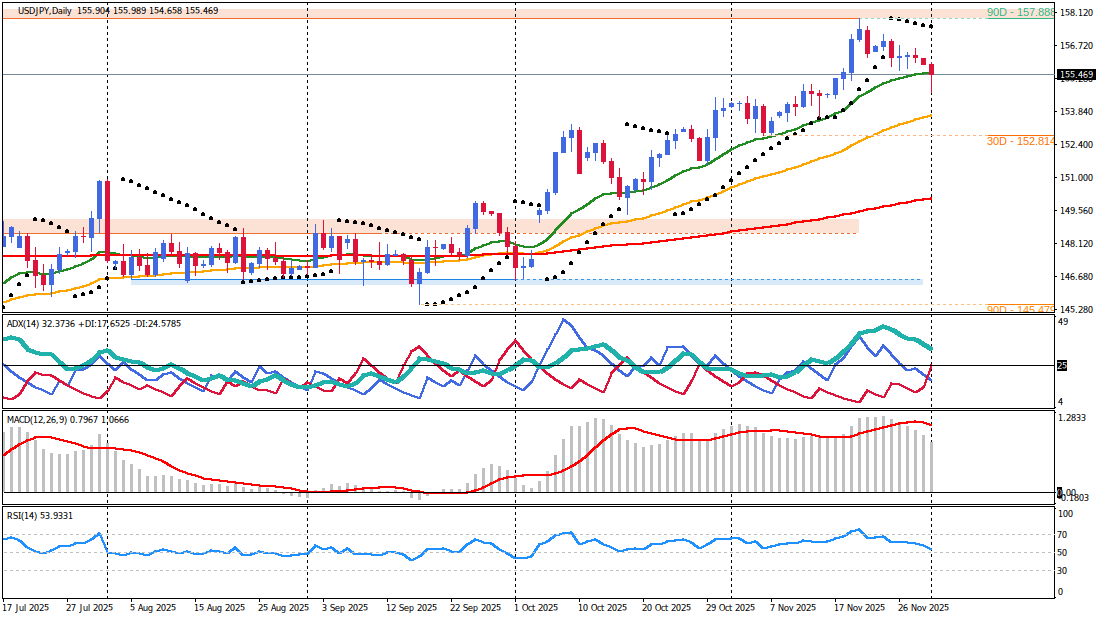
USD/JPY trades in a complex, neutral to ranging environment, with long-term bullish technical structures facing significant headwinds from a hawkish Bank of Japan and increased expectations for a dovish Federal Reserve. While intraday momentum shows a strong bullish push, this rally struggles against medium-term bearish pressure and established resistance levels, with short-term indicators suggesting overbought conditions. The immediate market is highly sensitive to the upcoming Fed Chair Powell speech, which carries substantial event risk and is poised to dictate the pair's short-term direction, potentially overriding current technical setups. The fundamental narrative of narrowing rate differentials, driven by BoJ's signals of a December rate hike and the Fed's anticipated rate cut, creates a strong bias for Yen strength, challenging the Dollar's broader uptrend.
Technical Analysis
Multi-Timeframe Market Structure
The daily timeframe for USD/JPY maintains a dominant long-term bullish trend, with price trading above the EMA20, EMA50, and EMA200. This underlying strength is supported by a positive MACD and a neutral RSI at 54.51, while ADX at 32.37 confirms a strong trend. However, the previous session closed lower, and the SAR is positioned above price at 157.515, signaling a potential top or a deep correction that is fundamentally supported by the Bank of Japan's increasingly hawkish stance. Conversely, the medium-term framework on the H4 chart presents a clear bearish momentum, with price trading below the EMA20 and EMA50, both of which are sloping downwards. This suggests a significant pullback within the broader daily uptrend. MACD is negative, RSI is bearish at 40.73, and the SAR at 156.119 reinforces this bearish bias, with a strong ADX at 44.89 validating the trend's strength. This medium-term bearishness aligns with the market's pricing in of a December Fed rate cut. Short-term intraday action on the H1 chart shows price just above its EMA20 but below EMA50 and EMA200, indicating a struggle against resistance. The M30 timeframe, however, exhibits strong intraday bullish momentum, with price above rising EMA20 and EMA50, positive MACD, and bullish RSI at 61.11. This intraday bullish push, while strong, appears to be a counter-trend rally against the H4 bearish pressure. Overbought Stochastic conditions on both M30 (87.49) and H1 (93.16) suggest that this short-term rally may be nearing exhaustion, especially as it approaches critical higher timeframe resistance, a scenario exacerbated by the low confluence quality across timeframes ahead of major event risk.Critical Price Levels & Momentum Assessment
USD/JPY exhibits mixed momentum, with a long-term bullish trend on the daily chart but a clear medium-term bearish bias on the H4, challenged by a strong short-term bullish counter-trend rally. The conflicting signals across timeframes contribute to a low confluence quality, indicating a transitional phase in the market. Intraday momentum is strong and bullish, but overbought conditions on M30/M15/M5 suggest potential exhaustion, particularly as price approaches key H4 resistance levels. The ATR on H1 is 0.175, indicating moderate intraday volatility, which is expected to surge dramatically with the imminent Fed Chair Powell speech.- Resistance:
- 155.83 (H4 EMA20, immediate strong resistance) - A break above this level would challenge the medium-term bearish outlook.
- 155.90 (D1 previous close, psychological level) - This level represents a key point for intraday sentiment.
- 156.12 (H4 SAR, structural resistance) - Sustained price action below here reinforces the H4 bearish bias.
- Support:
- 155.40 (H1 EMA20, M30 SAR, critical intraday support) - A break below this level would invalidate the current intraday bullish momentum.
- 155.00 (Psychological round number) - This level provides a significant psychological floor.
- 154.26 (H4 EMA200, strong structural support) - A break below here would signal a deeper correction within the broader daily uptrend.
Fundamental Market Drivers
Central Bank Policy & Economic Outlook
The fundamental backdrop for USD/JPY is characterized by a significant divergence in central bank policy expectations. The Bank of Japan (BoJ) Governor Kazuo Ueda's recent hawkish rhetoric has significantly boosted the Japanese Yen. Ueda explicitly hinted at the possibility of a December rate hike, stating that delaying an increase for too long could lead to sharp inflation and necessitate rapid policy adjustments. This has led traders to price in approximately a 76-80% probability of a BoJ rate hike this month, a sharp increase from previous expectations. The BoJ's shift away from its ultra-loose monetary policy, driven by rising inflation and the prospect of increasing salaries, provides strong fundamental support for JPY strength. This policy adjustment narrows the interest rate differential that has long favored the US Dollar against the Yen, thereby challenging the long-term bullish trend in USD/JPY. Japan's 10-year government bond yield surged above 1.85% following Ueda's comments, reflecting increased tightening expectations.Conversely, the US Dollar faces selling pressure due to mounting expectations for a Federal Reserve rate cut in December. Recent US economic data, specifically the ISM Manufacturing PMI, which fell to 48.2 in November (weaker than the 48.6 forecast and 48.7 previous), signals a contraction for the ninth consecutive month. This downbeat data reinforces the market's conviction that the Fed will deliver a rate cut at its December 9-10 meeting, with implied probabilities around 87%. The broader outlook for the Greenback remains tilted to the downside as markets lean dovish. This anticipated policy divergence, with the BoJ tightening and the Fed easing, fundamentally supports a bearish outlook for USD/JPY, as the yield differential, a key driver for the pair, continues to narrow.
Market Sentiment & Risk Environment
Market sentiment for USD/JPY is currently shaky, primarily driven by the Bank of Japan's hawkish signals. Governor Ueda's clear hints at a December rate hike have triggered significant position unwinding in USD/JPY, causing the Yen to surge against the Dollar and outperform all G10 currencies. This Japan-led risk aversion has carried through into global sessions, with US equity futures dipping slightly. The Yen's traditional role as a safe-haven asset amplifies its strength during periods of market stress or uncertainty, which is currently being compounded by the shift in BoJ policy expectations. Investors are reassessing the possibility of a more sustained tightening cycle in Japan, given that real rates remain deeply negative even with an increase, implying that the BoJ could deliver further hikes without entering restrictive territory. This fundamental reassessment of policy trajectory, coupled with the immediate event risk from Fed Chair Powell's speech and a packed US economic calendar, creates an environment of elevated volatility and uncertainty for USD/JPY.Integrated Trading Execution
Primary Trading Scenario
- Bias: Bearish - The significant hawkish shift from the BoJ, coupled with growing expectations for a dovish Fed, provides strong fundamental justification for a pullback. Technical resistance in the 155.83-156.12 zone is expected to hold.
- Trigger/Entry: A confirmed M30 candle close below 155.60, signaling failure to sustain intraday bullish momentum, especially if Fed Chair Powell's commentary does not provide strong bullish impetus for the USD. Sell at 155.55 (±3 pips).
- Stop-Loss: 155.75 - Placed above immediate technical resistance and the anticipated intraday rejection zone, allowing for minor whipsaws around event risk.
- Profit Targets:
- Target 1: 155.20 - This level aligns with intraday support and a potential retest zone after a bearish move.
- Target 2: 155.00 - A significant psychological round number and a key area of short-term structural support, further reinforced by the fundamental drive for Yen strength.
- Session Context: This scenario is optimal for the early London session, trading the immediate reaction to Fed Chair Powell's speech and subsequent consolidation.
Alternative Market Scenario
- Invalidation: The primary scenario is invalidated if price closes above 155.85 (H4 EMA20) after Powell's speech, or if Powell delivers unexpectedly hawkish commentary.
- Bias: Bullish - A strong, hawkish catalyst from Fed Chair Powell could override current Yen strength and drive a breakout.
- Trigger/Entry: A confirmed M30 candle close above the 155.85 H4 EMA20 zone, indicating a decisive break of medium-term resistance, triggered by hawkish Fed commentary. Buy at 155.90 (±3 pips).
- Stop-Loss: 155.65 - Placed below the breakout level, managing risk effectively.
- Profit Targets:
- Target 1: 156.10 - Targeting the H4 SAR and structural resistance.
- Target 2: 156.30 - A continuation target towards higher resistance, contingent on sustained USD strength.
- Session Context: This setup is highly event-dependent and suitable for an aggressive London session trade if a clear and sustained bullish catalyst emerges from Powell's remarks.
Risk Management & Catalyst Analysis
Trade Risk Assessment
The current market environment for USD/JPY is characterized by low confluence quality across timeframes, with a long-term bullish trend conflicting with medium-term bearish momentum and a strong, but potentially exhausted, intraday bullish rally. This technical ambiguity is significantly amplified by the immediate high-impact event risk from Fed Chair Powell's speech. Technical signals are highly susceptible to sudden invalidation by fundamental drivers, leading to potential whipsaws and extreme volatility, especially around 01:00 UTC. Liquidity may also be thin during the Asian-London session overlap, exacerbating price movements. Given these factors, a significant reduction in position size (at least 50%) is strongly recommended for any trades initiated within the next few hours. For stop-loss calculations, while the H1 ATR(14) is 0.175, it is advisable to widen stops to 1.5x-2x ATR or wait for initial event volatility to subside before entering trades, as precise technical levels may be violated during the event's immediate impact.Economic Calendar & Event Impact
The upcoming economic calendar is heavily front-loaded with high-impact US events that will significantly influence USD/JPY direction. The immediate focus is on Fed Chair Powell's speech, which could provide the necessary catalyst to either confirm a deeper pullback or trigger a bullish breakout. Subsequent US data will then provide further clarity on the Federal Reserve's policy trajectory, directly impacting the Dollar's strength against the Yen.- US Fed Chair Powell Speaks (Today, 01:00 UTC): Impact: Medium - This is an immediate, high-impact event for USD direction. Any hawkish or dovish signals will drive substantial volatility and dictate short-term USD/JPY price action, potentially overriding current technical levels.
- US ADP Non-Farm Employment Change (Tomorrow, 13:15 UTC): Forecast 7K, Previous 42K - High-impact labor market indicator. A weaker-than-expected print reinforces dovish Fed expectations, supporting JPY strength.
- US ISM Services PMI (Tomorrow, 15:00 UTC): Forecast 52.0, Previous 52.4 - High-impact indicator for the services sector. A print below forecast would signal further economic slowdown, increasing Fed rate cut probabilities and weighing on USD/JPY.
- US Challenger Job Cuts y/y (December 4, 12:30 UTC): Previous 175.3% - Medium-impact labor market indicator. An increase in job cuts would support a dovish Fed outlook.
- US Unemployment Claims (December 4, 13:30 UTC): Forecast 220K, Previous 216K - High-impact weekly labor market data. A higher-than-forecast reading would signal weakening labor conditions, boosting Fed dovishness and JPY strength.
- US Core PCE Price Index m/m (December 5, 15:00 UTC): Forecast 0.2%, Previous 0.2% - High-impact inflation gauge, the Fed's preferred measure. A reading below forecast would solidify expectations for a December rate cut, exerting strong downward pressure on USD/JPY.
- US Prelim UoM Consumer Sentiment (December 5, 15:00 UTC): Forecast 52.0, Previous 50.3 - High-impact sentiment indicator. A weak reading would align with broader economic concerns, supporting a dovish Fed.
- US Prelim UoM Inflation Expectations (December 5, 15:00 UTC): Previous 4.7% - High-impact inflation expectation data. A decrease would reduce inflation concerns, further supporting Fed rate cut expectations.


