
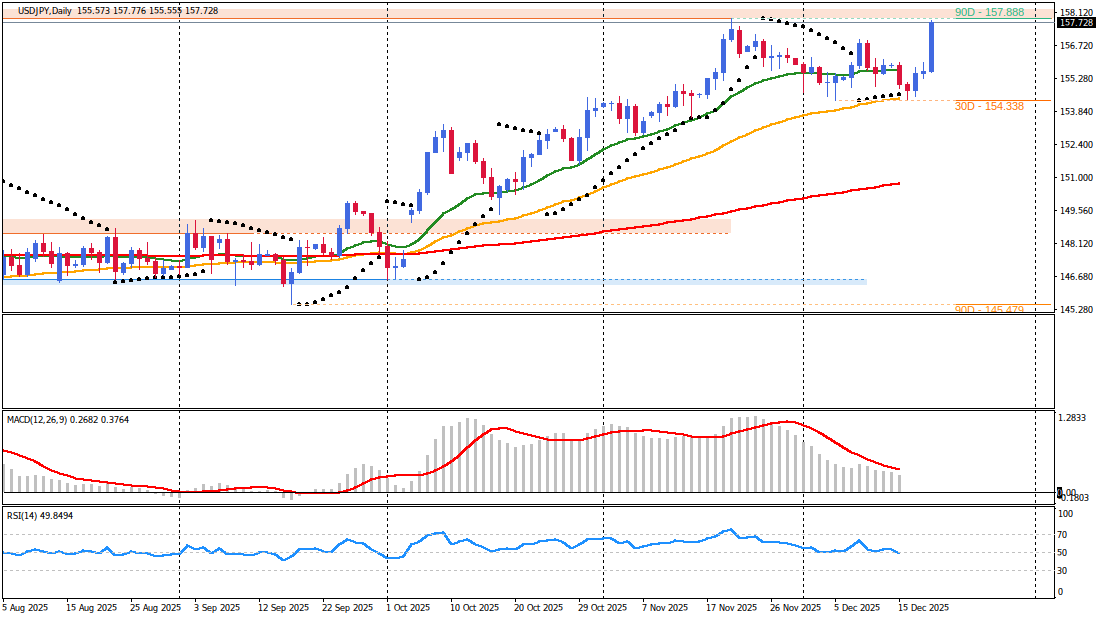
USD/JPY exhibits an extreme bullish bias across all timeframes, driven by persistent US economic strength and a widening policy divergence with the Bank of Japan, which recently raised rates but maintained an accommodative stance. Despite this robust uptrend, the pair is encountering significant headwinds from extreme overbought technical conditions and heightened Japanese verbal intervention, signaling readiness to stabilize the Yen. Upcoming high-impact US economic data, including Prelim GDP and Unemployment Claims, are critical catalysts that will test current market positioning and dictate whether the rally extends or triggers a significant correction, especially given the current low-liquidity trading environment. The BoJ's cautious stance on further tightening, coupled with the Fed's dovish expectations for 2026, creates a complex fundamental backdrop for a technically extended market.
Technical Analysis
Multi-Timeframe Market Structure
The dominant structure for USD/JPY remains strongly bullish across all timeframes. On the daily chart, price trades significantly above the EMA20 (155.723), EMA50 (154.636), and EMA200 (150.925), underscoring a robust long-term uptrend. The MACD is positive and showing upward momentum, while the RSI (65.53) is firm, indicating strong buying interest that aligns with persistent US economic resilience despite some moderation. The ADX (21.53) suggests a developing trend, confirming underlying strength, while the SAR (154.392) remains well below price, maintaining the bullish signal. This bullish conviction is fundamentally supported by the Fed's cautious stance on rapid rate cuts, contrasting with the BoJ's gradual normalization.The medium-term framework on the H4 chart also maintains a strong bullish trajectory, with price trading above the EMA20 (156.249), EMA50 (155.865), and EMA200 (155.096). MACD (0.521) shows aggressive positive momentum, reflecting the market's response to the recent BoJ rate hike being largely priced in and the subsequent dovish tone. However, the RSI (78.02) and Stochastic (97.07) are both deep in extreme overbought regions, signaling that the rally is extended and vulnerable to a correction. The ADX (45.11) indicates a very strong trend, underscoring the current momentum but also the potential for exhaustion, especially in the face of Japanese verbal intervention.
In the short-term intraday charts (H1/M30), intense bullish pressure is evident. On H1, price is well above EMA20 (157.068), with MACD (0.468) showing strong upward thrust. RSI (85.46) and Stochastic (95.75) are extremely overbought, indicating an unsustainable pace. ADX (58.77) reflects exceptional trend strength. M30 mirrors this, with price above EMA20 (157.412), positive MACD (0.255), and overbought RSI (76.83) and Stochastic (96.17). This extreme overbought condition across intraday oscillators suggests that while the immediate trading bias is bullish, the risk of a sharp pullback is high. A minor retracement to key intraday support levels would offer a more favorable entry, especially as the current low-liquidity session tends to amplify consolidations or mild retracements before resuming the dominant trend.
Critical Price Levels & Momentum Assessment
The market's current momentum is decisively bullish, but the extreme overbought readings on various oscillators introduce a high degree of caution for chasing further upside. Key resistance levels include the psychological 158.000 mark, which may attract profit-taking, and a potential extension target at 158.400, which would signify a strong continuation of the current upswing. These levels are critical for determining the sustainability of the bullish trend, especially considering the looming threat of Japanese intervention if the Yen weakens further.On the support side, immediate technical levels include 157.412, representing a confluence of the M30 EMA20 and M30 SAR. This level is crucial for maintaining intraday bullish integrity. A deeper support lies at 157.068 (H1 EMA20), while 156.396 (H4 SAR) and 155.723 (D1 EMA20) represent stronger structural supports. A break below these levels, particularly the daily EMA20, would signal a significant shift in momentum, likely triggered by stronger-than-expected dovish signals from the Fed or aggressive Japanese intervention. The strength of these support zones will be tested by upcoming US economic data, which could either reinforce USD strength or trigger a deeper correction.
Fundamental Market Drivers
Central Bank Policy & Economic Outlook
The monetary policy divergence between the US Federal Reserve and the Bank of Japan remains a primary driver for USD/JPY. The Bank of Japan recently raised its policy rate to 0.75%, the highest level in several decades, marking a gradual unwinding of its ultra-loose policy. However, policymakers stressed that real interest rates are expected to remain significantly negative, and accommodative financial conditions will continue to support economic activity. BoJ Governor Ueda maintains a deliberately cautious, data-dependent approach, suggesting further rate increases are expected but not in the near term, potentially extending into 2026. This gradual approach, coupled with the perception that the rate hike was largely priced in, prevents a substantial strengthening of the Yen and provides fundamental support for the pair's bullish technical structure.In contrast, the US Federal Reserve's policy outlook is characterized by dovish expectations for 2026. Financial markets are pricing in nearly a 21.0% chance of a Fed rate cut in January, following three quarter-point reductions. While policymakers remain divided, some Fed Governors like Stephen Miran advocate for further easing due to softer inflation and a slight rise in the Unemployment Rate. Cleveland Fed President Beth Hammack, however, downplays the urgency for rate adjustments, citing persistent inflation risks and suggesting rates could remain steady into spring. This mixed but generally dovish leaning for the Fed, compared to the BoJ's cautiously hawkish but still accommodative stance, favors a wider interest rate differential that underpins USD/JPY's upward trajectory. US Q3 GDP growth is expected to moderate to 3.2% from 3.8%, but a stronger-than-expected outcome would further lift the Greenback, aligning with the bullish technical bias.
Market Sentiment & Risk Environment
Market sentiment for USD/JPY is heavily influenced by Japanese verbal intervention and broader risk appetite. Japanese officials, including top foreign exchange official Atsushi Mimura and Finance Minister Satsuki Katayama, have consistently warned against "one-sided and sharp" currency moves, expressing deep concern over the Yen's weakness and signaling readiness to take "appropriate action." This verbal intervention, while providing some temporary support to the JPY and causing mild retracements, has largely been viewed by traders as rhetorical rather than imminent, failing to reverse the dominant bullish trend. The effectiveness of these warnings will be tested if USD/JPY approaches the 160 area.Furthermore, the Yen retains its safe-haven appeal amid persistent geopolitical tensions and concerns surrounding global fiscal conditions. However, in the current environment, this safe-haven demand is not overriding the yield differential favoring the USD. The surge in precious metals like Gold and Silver to new record highs, driven by geopolitical risk (US-Venezuela tensions, Ukraine war uncertainty), reflects a broader defensive demand amplified by year-end low-liquidity conditions. This risk-off sentiment could theoretically benefit the JPY, but the strong US economic data and Fed-BoJ policy divergence continue to dominate, mitigating the Yen's safe-haven gains against the Dollar. The low-liquidity trading environment around the holidays also means that any significant news or intervention could trigger exaggerated moves, increasing the risk for technical scenarios.
Integrated Trading Execution
Primary Trading Scenario
- Bias: Bullish - The strong underlying technical uptrend, combined with the US-Japan interest rate differential and the BoJ's gradual normalization, supports a continuation of the bullish trajectory after a brief respite.
- Trigger/Entry: An optimal entry emerges on a dip towards the 157.400-157.420 zone, aligning with the M30 EMA20 and SAR. This pullback allows oscillators to reset slightly, providing a more robust entry point. A strong US Prelim GDP report or hawkish Fed commentary would serve as a fundamental catalyst for renewed buying.
- Stop-Loss: Place a stop-loss below 157.100, just beneath the H1 EMA20, providing a buffer against volatility and protecting against deeper corrections. This level also sits below a key psychological support zone.
- Profit Targets:
- Target 1: 158.000 (Psychological Level) - This target anticipates profit-taking around a significant round number, particularly if Japanese verbal intervention intensifies.
- Target 2: 158.400 (Potential Extension Target) - This target is justified by strong underlying bullish momentum and the likelihood of continued USD strength, especially if US economic data exceeds expectations.
- Session Context: This scenario is best executed during the London or early New York session, allowing for better liquidity, but prior to the major US data releases on December 23rd, which could introduce significant volatility.
Alternative Market Scenario
- Invalidation: The primary bullish scenario is invalidated if price fails to hold above 157.400 and registers a clear M30 candle close below this level, accompanied by a shift in intraday momentum (e.g., RSI dropping below 70). Aggressive profit-taking or unexpectedly weak US economic data (e.g., lower GDP, higher unemployment) could trigger this breakdown.
- Bias: Bearish Pullback - The extreme overbought conditions across multiple timeframes, coupled with the potential for intensified Japanese intervention or weaker-than-expected US data, suggest a significant corrective pullback is possible.
- Trigger/Entry: A clear M30 candle close below 157.400, indicating a loss of immediate support and a shift in intraday momentum, would trigger this setup.
- Stop-Loss: Place a stop-loss above 157.700, just above recent intraday highs, to manage risk effectively in a volatile environment.
- Profit Targets:
- Target 1: 157.000 (Psychological Level near H1 EMA20) - This target accounts for a retest of a key psychological and technical support zone.
- Target 2: 156.400 (H4 SAR) - A deeper correction would likely find support at this significant medium-term level, reflecting substantial profit-taking.
- Session Context: This scenario could unfold during the London or early New York session, particularly if pre-event positioning leads to significant profit-taking or if strong negative US economic data accelerates the move, or if BoJ Gov Ueda's speech is unexpectedly hawkish on December 25th.
Risk Management & Catalyst Analysis
Trade Risk Assessment
The confluence quality for current technical setups is medium. While the bullish trend is clearly dominant across all timeframes, the extreme overbought conditions on oscillators (H4, H1, M30 RSI and Stochastic) introduce significant risk of a sharp correction. H4 signals require fresh validation given the elapsed time since the last completed candle. The anticipation of high-impact US economic data and continued Japanese verbal intervention adds a layer of uncertainty and potential for heightened volatility. Given the high event risk and extreme overbought conditions, position size should be reduced by at least 50% for any trades taken before the US GDP and Unemployment Claims releases. Employ a minimum 1.25x H1 ATR (approximately 0.26 pips) for intraday stops. Due to the high event risk, consider widening stops to 1.5x ATR or more, or reducing position size further. Technical setups are highly susceptible to invalidation by the US GDP release on December 23rd. Traders should exercise extreme caution or consider remaining on the sidelines until after these events.Economic Calendar & Event Impact
The upcoming economic calendar features several high-impact events that will significantly influence USD/JPY:- US ADP Weekly Employment Change (Today, 13:20 UTC): Previous 16.3K - A significant deviation from the previous figure could hint at the broader health of the US labor market, impacting Fed rate cut expectations and USD strength.
- US Prelim GDP q/q (Today, 13:30 UTC): Forecast 3.3%, Previous 3.8% - This is a high-impact event for USD direction. A stronger-than-forecast GDP reading would reinforce US economic resilience, supporting USD/JPY's bullish trend. A weaker reading could trigger profit-taking and a deeper pullback.
- US Core Durable Goods Orders m/m (Today, 13:30 UTC): Forecast 0.3%, Previous 0.6% - This medium-impact data provides insight into business investment and manufacturing activity, influencing the overall US economic outlook.
- US Durable Goods Orders m/m (Today, 13:30 UTC): Forecast -1.5%, Previous 0.5% - A sharper decline than expected could signal cooling economic activity, potentially weighing on the USD.
- US Prelim GDP Price Index q/q (Today, 13:30 UTC): Forecast 2.7%, Previous 2.1% - An increase in this inflation gauge could reinforce a hawkish Fed bias, even amid rate cut expectations, supporting the USD.
- US CB Consumer Confidence (Today, 15:00 UTC): Forecast 91.7, Previous 88.7 - Stronger consumer confidence supports the idea of continued consumer spending, a key component of US GDP, and could bolster the USD.
- US Richmond Manufacturing Index (Today, 15:00 UTC): Forecast -8, Previous -15 - An improvement in regional manufacturing sentiment could offer mild support for the USD.
- US Unemployment Claims (Tomorrow, 13:30 UTC): Forecast 223K, Previous 224K - A key labor market indicator. A higher-than-expected claims figure could fuel Fed dovish expectations, weakening the USD.
- JN BOJ Gov Ueda Speaks (December 25, 04:59 UTC): High-impact event for JPY direction - Any deviation from his cautiously accommodative tone towards a more hawkish stance on future rate hikes or intervention could provide significant support for the Yen and challenge the USD/JPY rally.
Synthesized Market Outlook
USD/JPY's extreme bullish technical setup, characterized by strong trends across all timeframes, aligns with fundamental drivers stemming from the persistent US-Japan interest rate differential. The Fed's dovish pivot, with rate cuts already initiated, is slower than the market's initial pricing, while the BoJ's recent rate hike maintains a significantly accommodative stance, preventing a substantial JPY appreciation. This policy divergence provides the fundamental undercurrent for the technical strength. However, the pair is at a critical juncture, facing extreme overbought conditions on oscillators and heightened verbal intervention from Japanese officials, which adds a significant layer of risk.The upcoming US Prelim GDP and Unemployment Claims data are pivotal. A robust GDP outcome or lower unemployment claims will likely reinforce USD strength, providing the fundamental catalyst for the technical bullish continuation scenario, potentially pushing the pair towards 158.000 and 158.400 after a shallow pullback. Conversely, weaker US data or unexpectedly hawkish commentary from BoJ Governor Ueda could trigger the alternative bearish pullback scenario, validating the overbought technical signals and driving profit-taking towards 157.000 and 156.400. Traders must monitor the 157.400 level closely as a key intraday pivot and be prepared for increased volatility around the high-impact US economic releases and BoJ commentary, especially given the current low-liquidity holiday trading conditions. The ongoing threat of Japanese intervention also places a soft ceiling on the upside, making any push towards 160.000 a high-risk proposition.


