
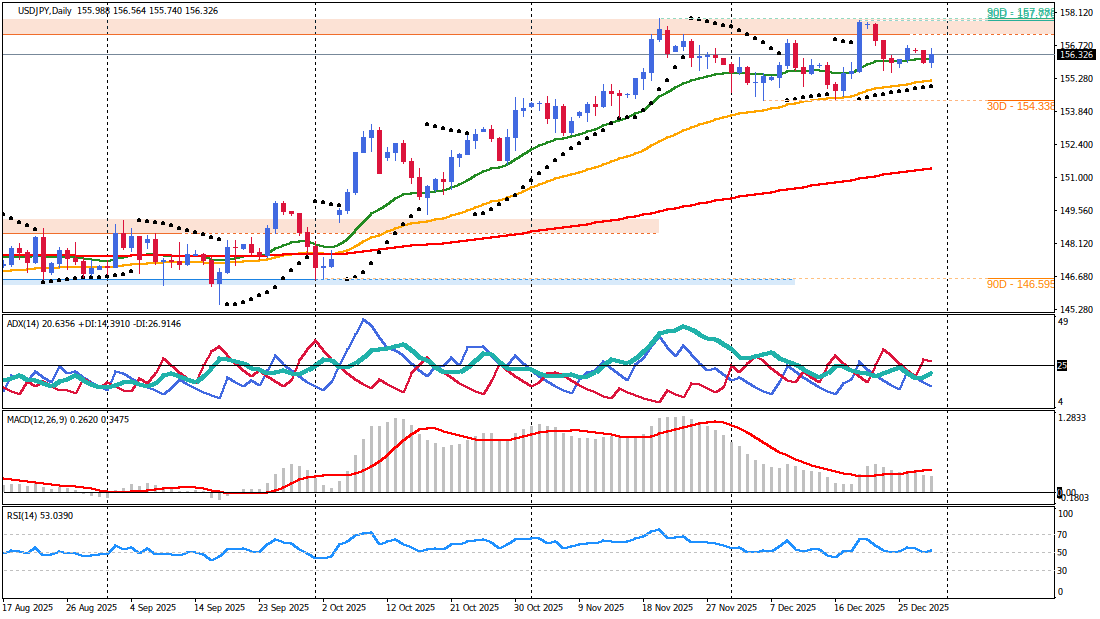
USD/JPY currently exhibits a strong bullish intraday bias, firmly positioned above key moving averages, yet faces immediate technical resistance at 156.56. This upward momentum is challenged by broader market dynamics characterized by persistent structural Yen weakness, despite the Bank of Japan's recent rate hike to 0.75%. The Federal Reserve's latest FOMC minutes indicate a cautious dovish tilt, contingent on easing inflation, which could narrow yield differentials and further influence USD/JPY. Elevated "Yentervention" risk looms as the pair trades near previous intervention levels, while robust carry trade dynamics, fueled by a strong Nikkei, continue to exert downward pressure on the Yen. The upcoming US Unemployment Claims today at 13:30 UTC represents a critical catalyst, capable of overriding current technical setups and dictating near-term direction.
Technical Analysis
Multi-Timeframe Market Structure
The USD/JPY pair displays a nuanced market structure across timeframes. On the daily (D1) chart, the price closed below the 20-period EMA (156.131) but remains comfortably above the 50-period (155.183) and 200-period (151.402) EMAs, indicating a resilient underlying long-term bullish trend despite recent consolidation. The MACD is positive at 0.269, supporting this bullish outlook, while the RSI is neutral at 53.68. The ADX at 20.64 suggests a developing, rather than strong, trend, implying that the long-term bullishness, while present, lacks aggressive conviction. The SAR at 154.955 confirms the bullish trend remains intact below current price. This underlying long-term bullishness is fundamentally supported by the persistent policy divergence between the BoJ and other major central banks, even with the BoJ's recent rate hike, as the carry trade continues to favor the USD.In the medium-term (H4) framework, the pair trades above the 20-period EMA (156.240), 50-period EMA (156.196), and 200-period EMA (155.492), reinforcing a bullish bias. However, the MACD near zero (-0.003) signals flat momentum, while the RSI is neutral at 53.48 and the Stochastic is in the overbought zone at 70.86. The ADX at 18.42 suggests a ranging market, which conflicts with the bullish EMA alignment and indicates a pause in medium-term directional strength. The SAR at 156.564 acts as immediate resistance above the current price. This medium-term consolidation reflects market participants grappling with the BoJ's recent policy shift and the Fed's cautious dovishness, creating uncertainty about the sustainability of the current rally.
The short-term intraday (H1/M30) charts present a strong bullish picture. On the H1 chart, price trades above all key EMAs (EMA20 at 156.268, EMA50 at 156.226, EMA200 at 156.170). MACD is positive at 0.078, RSI is bullish at 59.25, and Stochastic is firmly in the overbought region at 80.34. The ADX at 30.26 indicates a strong trend. The M30 timeframe similarly reinforces this bullish bias, with price above its EMAs (EMA20 at 156.342), positive MACD, bullish RSI (58.23), and strong ADX (31.15). The immediate trading bias is bullish, but the overbought conditions on H1 Stochastic suggest caution for new long entries without a prior pullback. The H1 SAR at 156.081 provides a clear short-term bullish invalidation level. This short-term strength is likely driven by short-term carry interest and the general USD demand ahead of key US economic data.
Critical Price Levels & Momentum Assessment
Resistance:- 156.56 (H4 SAR, previous H4 high of 156.518, and M30 SAR 156.542) - This is a critical confluence zone for immediate upside, representing a technical barrier that, if broken, signals renewed bullish conviction, especially given the persistent Yen weakness.
- 157.00 (Psychological level) - A break above 156.56 with strong momentum targets this key psychological level, which may attract fresh buying interest as fundamental factors continue to weigh on the Yen.
- 156.34 (M30 EMA20) - Immediate intraday support, a break below which suggests a temporary loss of short-term bullish control.
- 156.27 (H1 EMA20) - Stronger intraday support, aligning with H4 EMA20, crucial for maintaining the immediate bullish structure.
- 156.08 (H1 SAR) - This is the key short-term bullish invalidation level. A decisive break below this point, particularly if accompanied by a strong USD pullback on softer US data, would shift the intraday bias to bearish.
Momentum Indicator Synthesis: The short-term trend shows Strong momentum, with H1/M30 MACD and ADX confirming the bullish bias. Medium-term momentum is Moderate, as H4 ADX is low and MACD is flat, indicating a period of consolidation. D1 momentum is also Moderate, pointing to a developing trend. Overall, the market presents a mixed picture, with shorter timeframes driving current action while higher timeframes suggest underlying consolidation, a dynamic heavily influenced by the conflicting signals from central bank policies and economic data.
Market Phase Classification: The market is currently in a Moderate Trend phase for the short-term, transitioning towards a Ranging/Consolidation phase on the medium-term, as indicated by the conflicting ADX readings. Intraday momentum supports a bullish bias, but this strength faces a significant test from structural resistance and upcoming high-impact US economic data.
Fundamental Market Drivers
Central Bank Policy & Economic Outlook
The Bank of Japan (BoJ) delivered another quarter-point interest rate hike on December 19, pushing its cash rate to a three-decade peak of 0.75%. Despite this move, which broke the BoJ away from the pack as the only central bank raising rates into year-end, the Japanese Yen (JPY) has been unable to find meaningful strength. This highlights the persistent structural weakness of the Yen, driven by factors beyond mere interest rate differentials. The BoJ's continued role as a massive buyer of government bonds in gross terms effectively caps long-term yields, preventing them from rising naturally in response to Japan's expansive budget stance. This artificial suppression of yields means that risks, particularly fiscal sustainability concerns, are instead priced into the Yen, leaving it vulnerable to further depreciation. Even potential direct government intervention, if it extends beyond verbal warnings, is unlikely to offer lasting relief against these entrenched bearish forces.Conversely, the Federal Reserve's (Fed) latest FOMC Meeting Minutes reveal a cautious dovish tilt among policymakers, with a majority expecting further rate cuts in the future. However, the pace and timing of these cuts remain strictly contingent on US inflation metrics continuing to ease lower. A significant concern for both investors and central bankers is the quality of American inflation data. Despite a steep cooling in headline Consumer Price Index (CPI) inflation data, the underlying components are noted to be missing several key parts, with a high degree of assumptions and carry-forward estimates due to missing price information. This lack of accurate measurement will keep both FOMC votes and trader expectations on the back foot, limiting the Fed's ability to commit to aggressive rate cuts. The narrowing of the differential between US and Japanese bond yields, supported by the BoJ's gradual unwinding of ultra-loose policy and potential Fed cuts, is a key dynamic, but the Yen's structural weakness limits its ability to capitalize on this convergence.
Market Sentiment & Risk Environment
Market sentiment towards the Japanese Yen remains largely negative, with the currency battling headwinds on multiple fronts. The Yen's inability to stage a meaningful rebound, even after the BoJ's rate hike, underscores the deeply entrenched bearish forces. Carry trade dynamics are central to this sentiment. The Nikkei has enjoyed a powerful uptrend throughout the year, surging to fresh record highs above 50,000 by early November. This optimism, fueled by Prime Minister Sanae Takaichi’s new administration and enthusiasm for AI- and tech-linked stocks, encourages investors to borrow in low-yielding Yen to invest in higher-yielding assets, thus maintaining downward pressure on the Yen. The consolidation of the Nikkei around 50,000 suggests underlying momentum remains intact, leaving scope for another leg higher early next year, which would continue to support the carry trade.Furthermore, "Yentervention" risk remains elevated as USD/JPY drifts towards previous intervention levels. While the BoJ has intervened in currency markets previously, often to lower the Yen's value, the effectiveness of such interventions for lasting relief is questionable given the structural issues. The Yen is traditionally viewed as a safe-haven investment during times of market stress. However, its current weakness suggests that broader risk sentiment is not currently prioritizing its safe-haven appeal over carry trade opportunities and fundamental policy divergence. This environment of persistent Yen weakness, coupled with a cautiously dovish Fed and strong equity market performance, creates a challenging fundamental backdrop for any sustained Yen appreciation.
Integrated Trading Execution
Primary Trading Scenario
- Bias: Bullish - The strong intraday technical momentum, combined with persistent structural Yen weakness and ongoing carry trade dynamics, supports a bullish continuation.
- Trigger/Entry: Buy on a confirmed break and retest of 156.56, or a clear M30 candle close above this level during the London or early NY session. This break would signal a renewed conviction in USD strength, further supported by the current fundamental backdrop. Entry zone: 156.56-156.59.
- Stop-Loss: Place below 156.34 (M30 EMA20), with a buffer (e.g., 1.25x H1 ATR) for a stop at 156.15. This placement provides protection against a false breakout while respecting short-term technical support, aligning with the low conviction for Yen strength.
- Profit Targets:
- Target 1: 157.00 (Psychological level) - This target aligns with the next significant psychological barrier, likely to be tested if the bullish momentum sustains, driven by continued dollar strength.
- Target 2: 157.40 (Extension beyond current structural highs) - An extension target, supported by the broader bullish trend and the expectation that fundamental Yen headwinds will persist.
- Session Context: Optimal for London or early NY session when liquidity increases, providing better confirmation for breakout attempts. The outcome of today's US Unemployment Claims will be crucial for sustaining this momentum.
Alternative Market Scenario
- Invalidation: A sustained break above 156.56 invalidates this scenario.
- Bias: Bearish Pullback - The pair fails to break above 156.56 resistance, potentially forming a double top or bearish divergence on shorter timeframes. This scenario gains traction if today's US Unemployment Claims data is significantly weaker than expected, or if BoJ intervention fears escalate.
- Trigger/Entry: Sell on an M30 candle close below 156.27 (H1 EMA20). This break signals a loss of short-term bullish control, potentially triggered by a dovish shift in USD sentiment or increased Yen buying on intervention fears. Entry zone: 156.27-156.24.
- Stop-Loss: Place above 156.56 (H4 SAR), with a buffer for a stop at 156.65. This stop provides protection against a re-test of resistance and aligns with the technical invalidation point for the bearish setup.
- Profit Targets:
- Target 1: 156.08 (H1 SAR) - The initial target, representing the key short-term bullish invalidation level, where initial profit-taking is advised.
- Target 2: 155.80 (Previous D1 low zone) - A deeper pullback target, aligning with previous daily structural support, indicating a more significant shift in short-term sentiment.
- Session Context: Could develop during Asian consolidation if bullish momentum stalls, or if the London session fails to push higher. This scenario could accelerate if today's US Unemployment Claims are weaker than expected, prompting USD selling.
Risk Management & Catalyst Analysis
Trade Risk Assessment
The confluence quality for USD/JPY is Medium. While short-term timeframes (H1/M30) show strong bullish alignment, the medium-term (H4) and primary (D1) timeframes exhibit conflicting signals, indicating potential for consolidation or a reversal. This reduces overall confidence in a sustained strong trend. Intraday-specific risks include the current low-liquidity Asian session, which can lead to false breakouts or choppy price action. Session transitions, particularly from Asian to London, are prone to increased volatility and can invalidate early signals. The upcoming US Unemployment Claims release today poses significant event risk, capable of overriding all technical levels and introducing substantial volatility. Furthermore, the persistent "Yentervention" risk from the BoJ adds another layer of uncertainty, as direct action could abruptly shift market dynamics. The quality of US inflation data, identified as a concern by the Fed, introduces fundamental uncertainty regarding future Fed policy, increasing the sensitivity of USD to upcoming economic releases.Economic Calendar & Event Impact
The upcoming economic calendar features a high-impact event that will significantly influence USD/JPY:- US Unemployment Claims (Today, 13:30 UTC): Forecast 219K, Previous 214K - This is a high-impact labor market indicator for the US. A reading significantly different from the forecast could trigger substantial USD volatility. Stronger (lower) claims would support USD, reinforcing the primary bullish scenario, while weaker (higher) claims would weigh on the USD, potentially triggering the alternative bearish scenario.
Synthesized Market Outlook
USD/JPY maintains a prevailing bullish bias on shorter timeframes, driven by current market flows and sustained Yen weakness. The technical structure above key EMAs supports further upside, targeting 156.56 initially, with a break opening the path to 157.00. This technical outlook is fundamentally underpinned by the persistent structural weakness of the Yen, which continues to be influenced by carry trade dynamics and the BoJ's bond-buying program, effectively capping yields despite its recent rate hike. The Federal Reserve's cautious dovish tilt, contingent on inflation data, also plays a role, though concerns about data quality limit immediate aggressive policy shifts.However, the medium and longer-term technical pictures show some consolidation, indicating waning momentum, which aligns with the elevated "Yentervention" risk as the pair approaches previous intervention levels. The critical catalyst for the near-term direction is the US Unemployment Claims data scheduled for today, 13:30 UTC. A stronger-than-expected claims report will likely reinforce USD strength and support the bullish technical breakout, while a weaker report could trigger a bearish pullback towards 156.08 and 155.80. Traders are monitoring the 156.56 resistance for a confirmed bullish break and the 156.08 support as the key intraday bullish invalidation level, with heightened caution warranted around the upcoming US data release due to its potential to override existing technical setups.


