
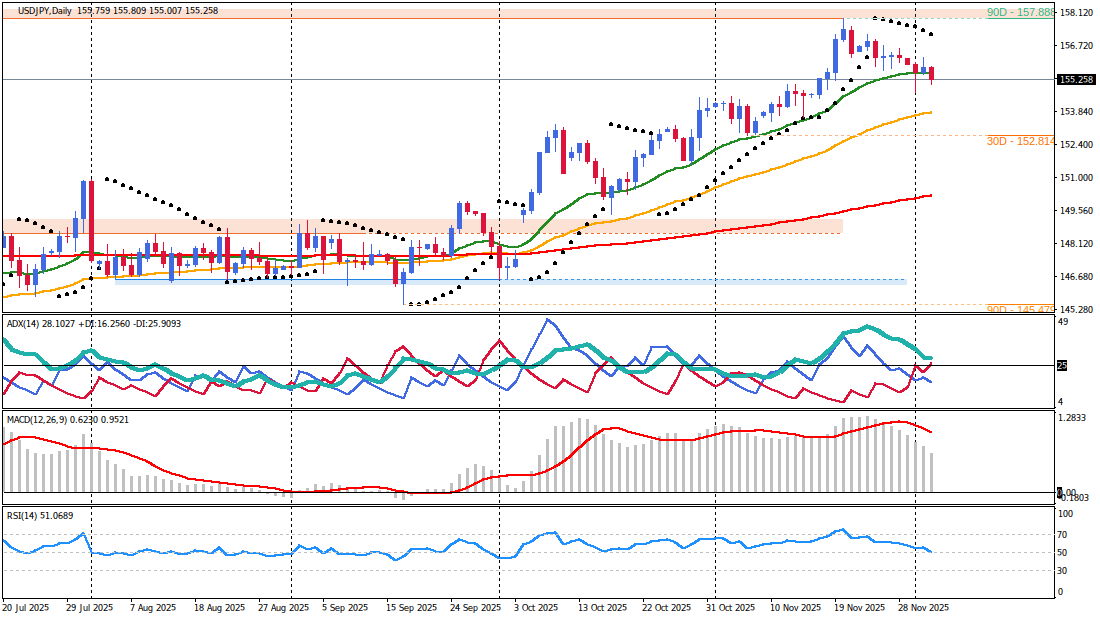
USD/JPY exhibits a pronounced bearish bias across medium and short-term timeframes, driven by a confluence of weakening US economic data and escalating Bank of Japan (BoJ) rate hike expectations. The pair is currently testing the critical psychological support at 155.000, with underlying technical momentum indicators reinforcing the downside pressure. Fundamentally, an unexpected decline in US ADP private payrolls has fueled market expectations for an imminent Federal Reserve rate cut, weakening the Dollar. Concurrently, hawkish remarks from BoJ Governor Ueda are solidifying bets for a December or January rate hike, narrowing yield differentials significantly. This policy divergence is the primary fundamental catalyst supporting the technical breakdown, although the daily chart retains a longer-term bullish structure. Upcoming high-impact US data, particularly Unemployment Claims, poses significant volatility risks for the pair's immediate trajectory.
Technical Analysis
Multi-Timeframe Market Structure
The USD/JPY pair demonstrates a clear conflict between its longer-term structural bullishness and immediate bearish momentum. The Daily (D1) chart maintains an underlying bullish structure, with price closing at 155.760 above the EMA20 (155.483), EMA50 (153.804), and EMA200 (150.205), all in bullish alignment. This D1 bullish alignment reflects the broader trend fueled by past US-Japan yield differentials. However, the Parabolic SAR is positioned above price at 157.182, signaling a potential top or reversal, while RSI is neutral at 49.91 and Stochastic is near oversold at 28.80, hinting at a possible turn.In contrast, the H4 and H1 timeframes are dominated by strong bearish momentum. The H4 chart shows price trading at 155.145, below EMA20 (155.600) and EMA50 (155.808), with a bearish MACD and a strong ADX at 32.65. This medium-term bearishness aligns with the recent fundamental shift towards a more dovish Federal Reserve and a more hawkish Bank of Japan. The H1 chart reinforces this, with price at 155.195 trading below all EMAs, a negative MACD, and a very strong ADX at 43.91, indicating robust intraday bearish pressure. While M30 RSI (35.63) and Stochastic (38.71) show signs of moving out of oversold territory, suggesting a potential short-term bounce, this is likely a temporary retracement within the dominant H1 downtrend. The overarching technical theme is immediate bearish pressure challenging longer-term bullish structural support.
Critical Price Levels & Momentum Assessment
Key technical levels provide clear markers for potential price action. Immediate resistance is identified at 155.325-155.350, a confluence of M30 SAR and H1 EMA20. A reclaim of this zone would suggest a temporary relief rally within the downtrend, potentially driven by minor USD strength or JPY profit-taking. Further resistance lies at 155.455 (previous D1 Low / D1 EMA20 area) and 155.600 (H4 EMA20). These levels represent significant barriers, and fundamental catalysts favoring the USD would be required for a sustained break above them.On the support side, the psychological level of 155.000 is critical. A decisive break below this level, particularly if reinforced by further dovish Fed messaging or stronger BoJ hawkishness, would confirm the bearish continuation. The next significant structural support is the H4 EMA200 at 154.414, which represents a crucial long-term technical anchor. The strong bearish momentum observed across H4 and H1, evidenced by negative MACD readings and high ADX values, indicates that price action aligns with fundamental drivers for further downside pressure.
Fundamental Market Drivers
Central Bank Policy & Economic Outlook
The primary driver of USD/JPY's recent decline is the widening policy divergence between the US Federal Reserve and the Bank of Japan. Recent US economic data points to a weakening labor market, with the Automatic Data Processing (ADP) reporting an unexpected decline of 32,000 private payrolls in November, significantly below the forecasted 5,000 growth. This marks the largest monthly decline since early 2023 and has intensified market expectations for a more dovish Fed. Interest rate futures traders are now pricing in a nearly 89% chance of a 25 basis point Fed rate cut next week, to 3.50%-3.75%, a substantial increase from 63% a month ago. This aggressive repricing of Fed policy is exerting considerable downward pressure on the US Dollar.Conversely, the Bank of Japan is signaling a clear shift towards policy normalization. BoJ Governor Kazuo Ueda's recent comments indicate the central bank will consider the "pros and cons" of raising interest rates at its upcoming policy meeting. Ueda also stated that the likelihood of the BoJ’s baseline scenario for growth and inflation being realized is gradually increasing, reinforcing market bets for a rate hike in December or January. Markets are currently pricing in 20 basis points of tightening for December and a full 25 basis point hike by March. This hawkish pivot by the BoJ, coupled with the dovish shift by the Fed, is rapidly narrowing the differential between US and Japanese bond yields to levels last seen in 2022, providing robust fundamental support for JPY strength against the USD.
Japan's economic outlook is also improving, driven by the new 'Sanaenomics' measures, a stimulus package valued at approximately ¥21.3 trillion. This initiative aims to stabilize inflation and boost growth, with expectations of a meaningful recovery in 2026. Solid wage growth, with Rengo targeting at least 5% raises, is projected to turn real wages positive and stimulate private spending. While the BoJ's normalization process is slow, with real interest rates remaining negative, improving growth conditions and core inflation projected to stay above 2% in 2026 justify further rate hikes. This domestic economic strength, combined with the BoJ's hawkish stance, provides a strong fundamental tailwind for the Japanese Yen.
Market Sentiment & Risk Environment
Market sentiment is firmly aligned against the US Dollar in the wake of weaker US jobs data, driving expectations for an accelerated Fed easing cycle. The USD/JPY pair's decline below 155.50 reflects this sentiment. A significant underlying factor impacting both currencies is the unwinding of the yen carry trade. As Japanese interest rates have risen significantly over the last 18 months, investors who borrowed yen to invest in higher-yielding USD assets are now unwinding these positions. This necessitates selling US dollar assets to repay yen loans, which produces downward pressure on US asset prices, upward pressure on US interest rates, and downward pressure on the value of the dollar. This dynamic contributes to the JPY's strength and could potentially influence US inflation dynamics.While 'Sanaenomics' is generally positive for growth, concerns about fiscal sustainability could emerge due to aggressive fiscal spending combined with the BoJ's quantitative tightening. This could potentially boost JGB yields and, paradoxically, weaken the JPY if market confidence in Japan's fiscal health wavers. Additionally, the strengthening of Japan's defense and diplomatic capabilities under Sanaenomics could lead to increased regional tensions, particularly with China, which carries economic risks for Japan, such as reduced tourism. For now, the dominant sentiment is driven by monetary policy divergence, with risk-off flows not currently a primary driver for JPY, given its strengthening primarily from yield differentials rather than safe-haven demand.
Integrated Trading Execution
Primary Trading Scenario
- Bias: Bearish - The strong bearish momentum on H4 and H1 charts, combined with increasing dovishness from the Fed and hawkish signals from the BoJ, provides a compelling case for continued downside.
- Trigger/Entry: A confirmed M30 candle close below 154.997. This break of the psychological 155.000 level would be fundamentally reinforced by sustained USD weakness from upcoming US data and solidifying BoJ rate hike expectations.
- Stop-Loss: 155.325, placed above the confluence of M30 SAR and H1 EMA20, with a 1.25x H1 ATR buffer. This stop-loss is strategically placed above a key technical resistance zone that would indicate a failure of bearish momentum.
- Profit Targets:
- Target 1: 154.800 - A near-term support level, likely to be tested quickly if bearish momentum persists, driven by ongoing policy divergence.
- Target 2: 154.414 (H4 EMA200) - This significant structural support level represents a key target for the current bearish trend, where the confluence of dovish Fed and hawkish BoJ narratives could drive price.
- Session Context: This scenario is best executed during the London or early New York sessions, which typically offer higher liquidity and clearer directional moves. However, extreme vigilance is required ahead of today's US Unemployment Claims release due to its high impact potential.
Alternative Market Scenario
- Invalidation: The primary bearish scenario invalidates if price holds above 155.000 and reclaims the 155.200 (M30 EMA20). This could be triggered by stronger-than-expected US labor market data, temporary profit-taking on JPY longs, or unexpected market sentiment shifts.
- Bias: Short-term Bullish Retracement - A temporary bounce or consolidation against the dominant H1/H4 bearish trend, driven by short-term technical adjustments from oversold conditions.
- Trigger/Entry: A confirmed M30 close above 155.203. This indicates a temporary shift in short-term momentum.
- Stop-Loss: 154.900, placed just below 155.000 with a 1.25x M30 ATR buffer. This protects against a swift return to the dominant bearish trend.
- Profit Targets:
- Target 1: 155.350 (H1 EMA20 / M30 SAR zone) - A key resistance area for a retracement.
- Target 2: 155.500 (psychological / H1 SAR) - A higher resistance level, representing a significant temporary rebound within the bearish context.
- Session Context: This scenario carries lower probability and is best suited for the Asian session, aiming to capture a temporary retracement from oversold conditions before the larger fundamental drivers reassert themselves.
Risk Management & Catalyst Analysis
Trade Risk Assessment
The confluence quality for USD/JPY is currently medium. While the H4, H1, and M30 timeframes show strong bearish alignment, the D1 timeframe maintains an underlying bullish structural bias, creating a conflict in the longer-term perspective. This divergence implies that while immediate bearish trades are favored, any significant retracement or reversal on the daily chart would necessitate a re-evaluation of the overall bias. Intraday signals on M30 suggest a potential for short-term retracement from oversold conditions, which could temporarily interrupt the bearish flow, requiring traders to be nimble.Intraday-specific risks are significant. The current Asian session typically exhibits lower liquidity, which can lead to choppy price action and potentially exaggerated moves on smaller volumes. More critically, today's high-impact US Unemployment Claims event introduces substantial event risk, with the potential for sudden and sharp price movements that could swiftly invalidate existing technical setups. Position sizing must be adjusted to account for this increased volatility, especially within four hours of the event's release. Using an H1 ATR of 0.163143 (approximately 16 pips) for stop-loss calculations, a 1.25x ATR is advised for intraday precision. However, within four hours of today's Unemployment Claims release, position size should be reduced by 50% to mitigate exposure to potential whipsaws.
Economic Calendar & Event Impact
The upcoming economic calendar features several high-impact US events that will significantly influence USD/JPY direction:- US Challenger Job Cuts y/y (Today, 12:30 UTC): Previous 175.3% - This labor market indicator provides further insight into the health of the US employment sector, potentially reinforcing the dovish Fed narrative if the figure shows a significant increase.
- US Unemployment Claims (Today, 13:30 UTC): Forecast 219K, Previous 216K - This is a high-impact event for USD pairs. A higher-than-forecast number would reinforce the narrative of a weakening US labor market, bolstering Fed rate cut expectations and driving USD/JPY lower. Conversely, a stronger-than-expected outcome could provide temporary support for the USD.
- US Core PCE Price Index m/m (Tomorrow, 15:00 UTC): Forecast 0.2%, Previous 0.2% - As the Fed's preferred inflation gauge, this report is critical. A print below expectations would strengthen the dovish Fed case, while an inline or higher reading might temper rate cut expectations, leading to USD strength.
- US Prelim UoM Consumer Sentiment (Tomorrow, 15:00 UTC): Forecast 52.0, Previous 50.3 - Consumer sentiment can influence spending and economic activity. A weaker reading would support the dovish Fed outlook.
- US Prelim UoM Inflation Expectations (Tomorrow, 15:00 UTC): Previous 4.7% - This component is vital for Fed policy. A decline in inflation expectations would give the Fed more room for rate cuts, weighing on USD/JPY.
Synthesized Market Outlook
The USD/JPY pair is poised for further downside, with the prevailing bearish technical momentum across H4 and H1 timeframes strongly supported by fundamental developments. The significant policy divergence between a dovish Federal Reserve, driven by weakening US labor market data, and an increasingly hawkish Bank of Japan, signaling imminent rate hikes, is narrowing yield spreads and exerting sustained downward pressure on the pair. While the daily chart retains a longer-term bullish structure, immediate market sentiment and central bank rhetoric overwhelmingly favor JPY strength.Traders should closely monitor the 155.000 psychological support level, as a decisive break confirms the bearish continuation towards 154.414. Conversely, a sustained hold above 155.000, potentially triggered by stronger US data, could lead to a temporary retracement towards 155.350. The upcoming high-impact US Unemployment Claims data today and Core PCE Price Index tomorrow are critical catalysts that will dictate short-term volatility and validate or challenge the current bearish bias. Position sizing must be adjusted to account for event risk, maintaining a disciplined approach to trade execution within this fundamentally driven, technically bearish environment.


