
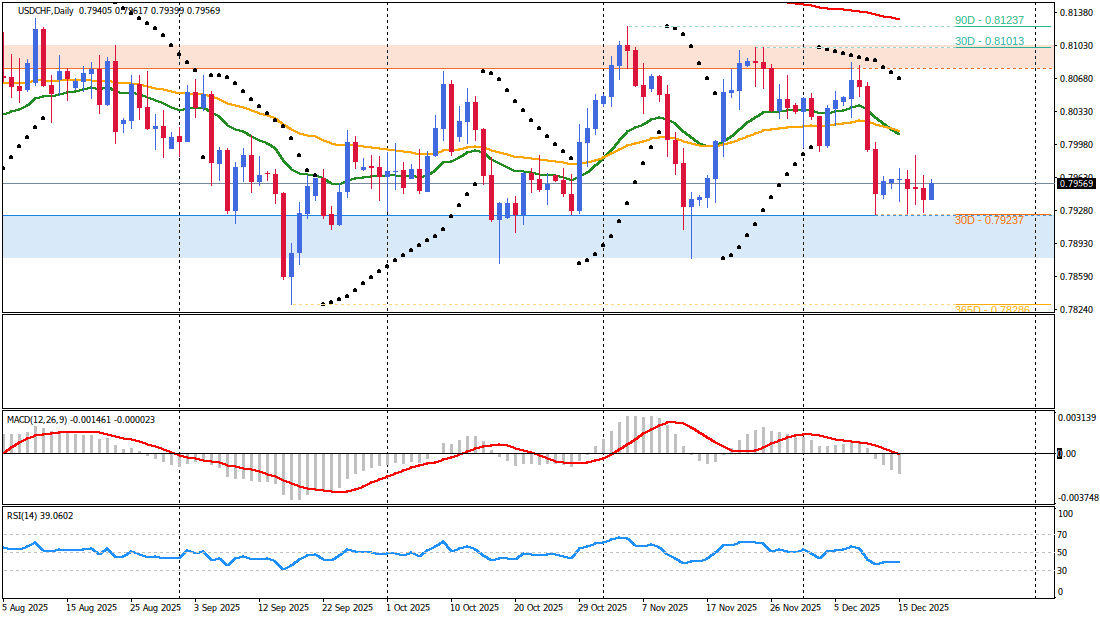
USD/CHF is navigating a complex environment characterized by a strong daily bearish trend and a short-term intraday bullish correction. The pair’s overall bias remains neutral to ranging as it consolidates below critical higher timeframe resistance levels. Fundamentally, the US Dollar faces significant headwinds from growing expectations of two Federal Reserve rate cuts in 2026, reinforced by comments from Fed officials hinting at the need for policy easing to avert recession risks. Despite strong US Prelim GDP data, underlying concerns about the economy’s health and weakening consumer confidence persist. Conversely, the Swiss Franc finds support from an optimistic long-term growth outlook in Switzerland and its inherent safe-haven appeal, further contributing to the dominant bearish pressure on USD/CHF. Upcoming high-impact US economic data, particularly Unemployment Claims, will act as a critical catalyst, either validating the short-term bounce or reinforcing the broader downtrend.
Technical Analysis
Multi-Timeframe Market Structure
The daily chart for USD/CHF maintains a strong bearish bias, trading significantly below the EMA20 (0.79899), EMA50 (0.80035), and EMA200 (0.81235). This bearish alignment of moving averages, coupled with a deeply negative MACD (-0.002099) and a bearish RSI (41.05), confirms the persistent downtrend. The ADX reading of 35.56, with the -DI above the +DI, further reinforces the strong bearish momentum, which aligns with the fundamental narrative of sustained US Dollar weakness driven by dovish Federal Reserve expectations. The SAR (0.80462) remains well above price, providing a formidable overhead barrier.On the H4 timeframe, price trades below the EMA20 (0.79539), EMA50 (0.79698), and EMA200 (0.80016), consistent with the higher timeframe bearish trend. However, momentum indicators on this timeframe show signs of a pause in the bearish impulse. The MACD is negative but flattening, the RSI is neutral at 49.98, and the ADX is low at 13.10, indicating a ranging or transitional market phase. The H4 SAR (0.79779) acts as significant resistance. This consolidation phase on the H4 chart reflects the current market uncertainty ahead of key US economic data, where short-term counter-trend movements are possible within the dominant bearish framework.
The short-term intraday charts (H1/M30) reveal a bullish shift in immediate momentum. On the H1 chart, price trades above the EMA20 (0.79513) and EMA50 (0.79512), which have crossed bullishly. The MACD is positive (0.000115), and the RSI is bullish at 56.01. The H1 SAR (0.79416) is now below price, supporting a short-term upward move. The M30 chart confirms this intraday bullish bias, with price also above its EMA20 (0.79516) and EMA50 (0.79506). M30 MACD is positive (0.000058), and RSI is bullish at 56.94. The M30 EMA200 at 0.79558 and the H1 EMA200 at 0.79704 are acting as immediate and stronger resistance levels, respectively. The intraday action indicates a corrective bounce, but the low ADX on both H1 (12.08) and M30 (18.66) suggests this bounce lacks strong directional conviction, making it vulnerable to fundamental shifts or a resumption of the dominant daily downtrend.
Critical Price Levels & Momentum Assessment
Key resistance levels for USD/CHF include 0.79558 (M30 EMA200), which acts as immediate intraday resistance, and 0.79704 (H1 EMA200), a more significant intraday hurdle with confluence from H4 resistance. The H4 SAR at 0.79779 provides strong medium-term resistance, marking the upper boundary of recent consolidation and reinforcing the bearish higher timeframe structure.Immediate intraday support is found within the 0.79510-0.79516 zone, representing a cluster of H1/M30 EMAs. Further support exists at 0.79445 (M30 SAR), a key intraday level, and 0.79404 (D1 Close), which offers minor structural support. The ability of these support levels to hold will be critical for the continuation of any intraday counter-trend bounce, particularly given the underlying fundamental bias for CHF strength and USD weakness. A sustained break below these supports would signal a resumption of the dominant daily downtrend, aligning with the broader fundamental outlook.
Fundamental Market Drivers
Central Bank Policy & Economic Outlook
The US Dollar faces significant challenges due to the market pricing in growing expectations of two Federal Reserve rate cuts in 2026. This dovish sentiment is reinforced by statements from White House Adviser Kevin Hassett, who suggests the Fed is not cutting rates quickly enough, and Fed Governor Stephen Miran, who warns that failing to ease policy would raise recession risks. While the preliminary US Gross Domestic Product (GDP) Annualized expanded by a stronger-than-expected 4.3% in the July–September period, analysts caution that this headline strength overstates underlying economic health. Growth is primarily driven by healthcare spending and inventory drawdowns, alongside evidence of a softening labor market and weaker US consumer confidence in December. This nuanced economic picture provides fundamental support for the technical bearish structure on USD/CHF, as a dovish Fed outlook typically weighs on the Greenback.Conversely, the Swiss Franc continues to demonstrate resilience. UBS analysts have become more optimistic about Switzerland’s long-term growth prospects, with the five-year growth forecast climbing to its highest level since late 2024. Although the Swiss ZEW Survey – Expectations index fell in December, the Current Conditions index surged significantly, pointing to robust economic activity. The survey also indicates continued Swiss Franc strength, which is consistent with its role as a safe-haven currency, particularly during periods of global economic uncertainty or when other major central banks are perceived to be easing monetary policy. The Swiss National Bank (SNB) aims for an annual inflation rate of less than 2%, and while no immediate policy changes are expected, the strong growth outlook provides a fundamental underpinning for CHF strength.
Market Sentiment & Risk Environment
Market sentiment is currently characterized by a risk-off tilt for the US Dollar, driven by the increasing certainty of Federal Reserve rate cuts in 2026. This dovish shift in Fed expectations diminishes the attractiveness of the Greenback for carry trades and as a safe-haven alternative. The caution regarding the true health of the US economy, despite recent GDP figures, further dampens USD sentiment.In contrast, the Swiss Franc benefits significantly from its long-standing status as a safe-haven asset. In times of market stress or perceived global economic instability, investors tend to flock to the CHF due to Switzerland's stable economy, strong export sector, substantial central bank reserves, and political neutrality. The current environment of expected Fed easing and underlying US economic concerns increases the probability of the bearish technical scenario playing out for USD/CHF, as capital flows favor the more stable and potentially appreciating Franc. Additionally, thin trading volumes are anticipated due to holiday-shortened trading, which can lead to exaggerated price movements and increased volatility around key data releases. The high correlation between the Euro and the Swiss Franc (over 90%) means that any weakness in the Eurozone could also indirectly support the CHF as a regional safe-haven, although the immediate focus is on USD-specific factors.
Integrated Trading Execution
Primary Trading Scenario
- Bias: Bullish (Intraday Counter-Trend)
- Trigger/Entry: Buy on M30 close above 0.79560, capitalizing on the short-term bullish momentum within the current consolidation. This move is supported by the temporary pause in bearish sentiment, but remains highly vulnerable to US data.
- Stop-Loss: 0.79430. This level is strategically placed below the H1/M30 EMA cluster and M30 SAR, approximately 1.25x H1 ATR, providing a tight risk parameter in recognition of the dominant bearish trend.
- Profit Targets:
- Target 1: 0.79700 (Near H1 EMA200). This target aligns with a key intraday resistance level, where the short-term bounce is likely to face significant selling pressure.
- Target 2: 0.79770 (Near H4 SAR). This represents a stronger medium-term resistance, where a more significant rejection of the counter-trend move is anticipated given the dominant daily bearish bias and ongoing USD weakness.
- Session Context: Best executed during early London or late Asian session for potential follow-through before US event risk.
Alternative Market Scenario
- Invalidation: M30 close above 0.79600. This level would suggest stronger bullish conviction than anticipated, invalidating the immediate bearish setup.
- Bias: Bearish (Downtrend Resumption)
- Trigger/Entry: Sell on M30 close below 0.79500. This trigger signifies a failure of the intraday bounce to sustain, aligning with the dominant daily bearish trend and the fundamental backdrop of sustained USD weakness and CHF strength. A bearish US economic data print would strongly support this entry.
- Stop-Loss: 0.79630. This stop is positioned above the M30 EMA200 and recent intraday highs, approximately 1.25x H1 ATR, providing protection against a false breakdown.
- Profit Targets:
- Target 1: 0.79400 (Previous D1 close/low). This target aligns with a recent structural low, representing the immediate bearish objective.
- Target 2: 0.79300 (Intraday structural low). This level indicates a deeper extension of the bearish move, consistent with the broader downtrend.
- Session Context: Optimal during London or early NY session, especially if US data disappoints or reinforces the dovish Fed narrative.
Risk Management & Catalyst Analysis
Trade Risk Assessment
The confluence quality for USD/CHF is currently medium. While intraday timeframes show a bullish bounce, this contradicts the strong bearish bias from the daily chart. The medium-term (H4) is ranging but with a bearish lean. This divergence reduces overall confidence in sustained directional moves without external catalysts. The upcoming high-impact US economic events on December 24th pose significant event risk, potentially causing sharp, unpredictable price movements and invalidating technical levels. Low liquidity during holiday-shortened trading can also lead to exaggerated moves or false breakouts. Traders must consider reducing position size by 50% within 4 hours of high-impact events due to elevated risk. Stop-losses should be implemented at 1.25x ATR for intraday precision, expanding to 1.5x ATR during periods of higher expected volatility or around event releases.Economic Calendar & Event Impact
The upcoming economic calendar features several high-impact US events that will significantly influence USD/CHF, particularly given the market's focus on Federal Reserve policy and US economic health:- US Unemployment Claims (Today, 13:30 UTC): Forecast 224K, Previous 224K - This high-impact labor market indicator is critical for assessing the health of the US economy and will directly influence Federal Reserve rate cut expectations. A significant deviation from the forecast could trigger substantial USD volatility.
The following events, though scheduled for yesterday, are referenced in the provided text and technical analysis as having significant recent impact:
- US Prelim GDP q/q (December 23, 13:30 UTC): Forecast 3.3%, Previous 3.8% - While the actual print of 4.3% already occurred, its implications for underlying economic health are still being debated, providing a fundamental backdrop for USD weakness if the strength is deemed unsustainable.
- US Core Durable Goods Orders m/m (December 23, 13:30 UTC): Forecast 0.3%, Previous 0.6% - This medium-impact manufacturing data provides insight into business investment and economic activity. Weaker-than-expected data would reinforce the dovish Fed narrative.
- US Durable Goods Orders m/m (December 23, 13:30 UTC): Forecast -1.5%, Previous 0.5% - A negative forecast suggests a potential contraction in orders, which would be bearish for the USD and support the USD/CHF downtrend.
- US Prelim GDP Price Index q/q (December 23, 13:30 UTC): Forecast 2.7%, Previous 2.1% - An inflation gauge tied to GDP, this data point helps shape inflation expectations and, consequently, Fed policy outlook.
- US CB Consumer Confidence (December 23, 15:00 UTC): Forecast 91.7, Previous 88.7 - Consumer confidence is a key sentiment indicator. While a forecast increase is positive, the text notes weaker consumer confidence in December, suggesting a potential for downside surprise or cautious market reaction.
- US Richmond Manufacturing Index (December 23, 15:00 UTC): Forecast -8, Previous -15 - Regional manufacturing surveys offer real-time insights into economic conditions. A rebound from previous lows would be mildly positive for the USD.
Synthesized Market Outlook
USD/CHF currently presents a market torn between a powerful dominant daily bearish trend and an intraday counter-trend bullish bounce. The overarching technical structure aligns strongly with the fundamental narrative of a weakening US Dollar, driven by aggressive Federal Reserve rate cut expectations for 2026 and concerns about the underlying health of the US economy despite robust headline GDP figures. The Swiss Franc, underpinned by an optimistic long-term growth outlook and its entrenched safe-haven status, is poised for continued strength against the Greenback.The current intraday bounce, while technically valid on shorter timeframes, appears to be a corrective move within a larger downtrend. Its sustainability is highly questionable, particularly with the critical US Unemployment Claims data due today. A weaker-than-expected jobs report would provide a strong fundamental catalyst for the resumption of the bearish trend, potentially driving USD/CHF towards new lows as the market reinforces its dovish Fed bets. Conversely, a surprisingly strong jobs report could provide a temporary reprieve for the USD, allowing the intraday bounce to extend towards higher resistance levels before likely encountering renewed selling pressure. Traders must monitor the 0.79558 (M30 EMA200) and 0.79704 (H1 EMA200) resistance levels for signs of a sustained bullish failure, and the 0.79510-0.79516 support zone for a breakdown confirming the resumption of the primary bearish trend. The combination of holiday-thinned liquidity and high-impact US data mandates a disciplined approach to risk management.


