
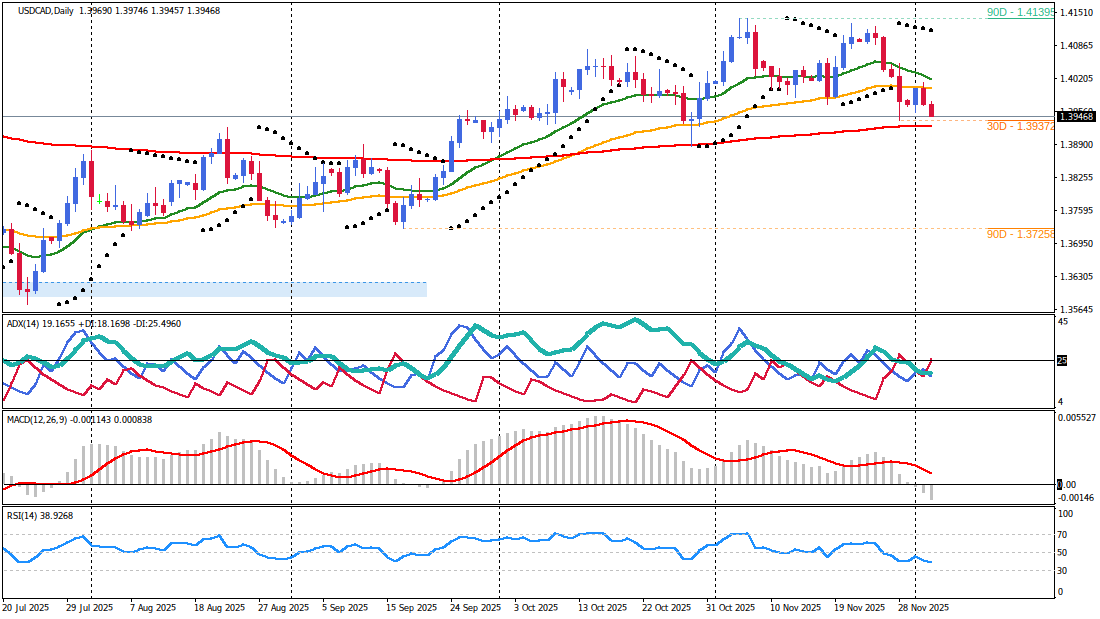
USD/CAD exhibits strong bearish momentum across short-to-medium timeframes, with price action consistently trading below key moving averages, signaling a dominant downtrend. However, deeply oversold conditions on intraday charts suggest a potential for a temporary corrective bounce or consolidation before further declines. The immediate direction is heavily influenced by a series of high-impact US economic events today, including the ADP Non-Farm Employment Change and ISM Services PMI, followed by crucial Canadian labor market data tomorrow. While the technical structure strongly favors continued bearish pressure, the oversold state and upcoming fundamental catalysts introduce significant volatility risk and potential for short-term reversals within the broader bearish trend.
Technical Analysis
Multi-Timeframe Market Structure
The USD/CAD pair is under significant bearish pressure across multiple timeframes. On the daily chart (D1), price trades below the EMA20 and EMA50, confirming a bearish immediate outlook, despite remaining above the EMA200, which indicates a longer-term uptrend. This suggests the current bearish leg is a significant correction within a broader uptrend. The MACD shows declining negative momentum, and the RSI sits in bearish territory at 38.50. The ADX is below 20, indicating a lack of strong trend conviction on this timeframe, which aligns with the view of a corrective phase rather than a new sustained downtrend. This longer-term perspective from the D1 chart, suggesting a correction within an uptrend, introduces nuance to the strong short-term bearish signals.
On the H4 timeframe, a strong bearish bias prevails, with price trading below the EMA20, EMA50, and EMA200. The MACD confirms robust bearish momentum with a large negative value that continues to decline. The RSI at 32.78 and Stochastic at 16.92 are in bearish and deeply oversold territory, respectively. The ADX at 17.14 suggests a ranging or weak trend despite the strong momentum indicators, implying that while the bearish impulse is powerful, it may be nearing exhaustion or facing consolidation, especially given the oversold oscillators.
The short-term intraday charts (H1/M30) confirm strong bearish momentum, with price well below all key EMAs, which are aligned in a bearish configuration. MACD histograms are deeply negative and declining, reinforcing the downtrend. RSI on H1 (24.78) and M30 (24.69) are deeply oversold, as are Stochastic readings (H1: 9.73, M30: 12.21). ADX on both timeframes is above 38, signaling a strong and robust bearish trend. Despite the deeply oversold conditions, the immediate bias remains bearish, although a short-term corrective bounce is a strong possibility before further declines. Execution timing must consider potential pullbacks for optimal entry within the dominant downtrend, especially with the immediate impact of high-profile US economic data.
Critical Price Levels & Momentum Assessment
Key technical levels define the current trading range and potential inflection points for USD/CAD. Resistance levels are critical for confirming bearish continuation:
- 1.3967-1.3972: This zone represents a confluence of the H1 EMA20 and previous H1 resistance, acting as a dynamic barrier.
- 1.3980-1.3987: A stronger resistance zone formed by the H1 EMA50 and H4 EMA20, indicating a more significant structural barrier.
- 1.4013-1.4018: This area incorporates the H4 SAR and D1 EMA20, representing a substantial structural barrier that, if broken, would significantly challenge the immediate bearish bias.
Support levels outline potential downside targets and areas for consolidation:
- 1.3939: The recent H1 low serves as immediate intraday support.
- 1.3900: This is a key psychological level that is expected to attract significant trading interest and potential buying pressure.
- 1.3850: A potential extension target for a sustained bearish continuation, representing a deeper structural support.
The overall trend consensus is strongly bearish, confirmed by MACD and EMA alignments across all timeframes. Momentum quality is strong on H1/M30, with ADX values above 38, indicating a robust downtrend. On D1 and H4, ADX suggests a developing or ranging trend, which slightly diverges from the strong bearish momentum indicated by other oscillators and price action, hinting at potential for consolidation or a snap-back from oversold levels. RSI and Stochastic are deeply oversold on H1, M30, and H4, strongly suggesting that while the trend is down, a short-term correction or consolidation is possible. Volatility, as measured by D1 ATR (0.005064), is high, while H1 ATR (0.000711) indicates moderate intraday volatility. The market is in a strong bearish trend phase on short timeframes, transitioning from a more ranging phase on longer timeframes, setting up a dynamic environment where fundamental catalysts can significantly impact technical levels.
Fundamental Market Drivers
Central Bank Policy & Economic Outlook
The fundamental landscape for USD/CAD is primarily driven by divergent economic outlooks and central bank policy expectations for the US Federal Reserve and the Bank of Canada (BoC). For the US Dollar, a series of high-impact economic data releases today and tomorrow are crucial. The US ADP Non-Farm Employment Change and ISM Services PMI today will provide immediate insights into the health of the US labor market and service sector. Stronger-than-expected data reinforces the Federal Reserve's capacity to maintain a restrictive monetary policy stance for longer, thereby supporting the USD. Conversely, weaker data would fuel expectations of earlier rate cuts, weighing on the dollar. The upcoming US Unemployment Claims and Core PCE Price Index later this week are equally significant for inflation and labor market assessments, directly influencing Fed policy expectations.
For the Canadian Dollar, the domestic economic outlook is a key determinant. The upcoming CA Ivey PMI tomorrow offers a gauge of business activity, while the CA Employment Change and Unemployment Rate on December 5 are critical for assessing the health of Canada's labor market. Forecasts for a contraction in employment (-1.5K) and an increase in the unemployment rate (to 7.0%) suggest a weakening labor market. Such data would likely increase pressure on the Bank of Canada to consider a more dovish stance, potentially leading to CAD weakness. This aligns with the bearish technical structure on USD/CAD, as a weaker CAD would contribute to the pair's downside. However, the broader market narrative from some analysts suggests that USD/CAD may be undergoing a correction within a larger uptrend, with a "neutral intraday bias" and "range trading" expected for the medium term, implying that strong CAD weakness might be contained within existing ranges.
Market Sentiment & Risk Environment
Current market sentiment appears to favor the US Dollar, with the USD index showing early strength. This broader USD strength acts as a fundamental tailwind for USD/CAD, even if the pair is technically bearish. Risk sentiment is highly sensitive to the upcoming economic data and any commentary from US President Trump, whose speeches can introduce geopolitical or trade-related uncertainties, influencing broader market risk appetite. A "risk-off" environment generally supports the safe-haven USD, while "risk-on" typically benefits riskier assets and commodity-linked currencies like the CAD, provided that Canadian economic fundamentals are robust. The corporate news regarding CI Financial Corp.'s debenture offering is company-specific and does not present a broad market sentiment driver for the Canadian Dollar at this time. The confluence of high-impact US economic data and Canadian labor market figures creates a volatile environment where shifts in sentiment can quickly impact technical levels, making precise positioning challenging.
Integrated Trading Execution
Primary Trading Scenario
- Bias: Bearish - The strong multi-timeframe bearish alignment, reinforced by potential Canadian labor market weakness and ongoing USD strength, supports continued downside.
- Trigger/Entry: A short entry near 1.3965-1.3970 (H1 EMA20 / previous resistance) is viable if price shows clear rejection following the release of US ADP Non-Farm Employment Change and ISM Services PMI, especially if US data is robust or Canadian data is weak.
- Stop-Loss: Place a stop-loss above 1.3980 (H1 EMA50 and previous resistance, ~1.5x H1 ATR buffer). A break above this level, particularly on strong US data disappointment or unexpected Canadian strength, would invalidate the immediate bearish setup.
- Profit Targets:
- Target 1: 1.3900 (key psychological support). This target becomes highly probable with sustained bearish momentum, especially if Canadian employment data disappoints.
- Target 2: 1.3850 (potential extension target). Achievement of this target requires significant and sustained CAD weakness or overwhelming USD strength from economic data.
- Session Context: This scenario is best executed during the London/New York overlap, anticipating increased volatility from today's high-impact USD economic events (ADP Non-Farm Employment Change at 13:15 UTC and ISM Services PMI at 15:00 UTC).
Alternative Market Scenario
- Invalidation: The primary bearish scenario is invalidated if price closes above 1.3980, especially if driven by weaker-than-expected US economic data or stronger Canadian economic prints.
- Bias: Short-Term Bullish (Correction) - Due to deeply oversold conditions on H1, M30, and H4, a short-term bounce or consolidation is possible, particularly if US data disappoints or CAD data surprises positively.
- Trigger/Entry: A long entry could be considered if price consolidates near 1.3940 and shows bullish momentum confirmation, or breaks above 1.3950, ideally supported by weaker US economic reports or stronger Canadian figures.
- Stop-Loss: Place a stop-loss below 1.3930 (recent low with buffer).
- Profit Targets:
- Target 1: 1.3970 (H1 EMA20).
- Target 2: 1.4000 (psychological resistance / H4 EMA20).
- Session Context: This scenario is more speculative and carries higher risk due to the dominant bearish trend. It may occur during early New York session profit-taking or if immediate US economic data surprises to the downside.
Risk Management & Catalyst Analysis
Trade Risk Assessment
The confluence quality for the bearish direction remains high, with strong alignment across D1, H4, H1, and M30 for trend and momentum. However, the deeply oversold conditions on shorter timeframes introduce a significant risk of a short-term corrective bounce, slightly reducing confidence in immediate bearish continuation without a pullback. The ADX readings on D1 and H4 indicate a weaker trend than H1/M30, suggesting a potential for ranging on longer timeframes, which increases the likelihood of a consolidation phase. The most significant risk arises from the proximity of high-impact USD economic events today (US ADP Non-Farm Employment Change at 13:15 UTC and US ISM Services PMI at 15:00 UTC), as well as upcoming Canadian labor data. These events have the potential to override technical levels and introduce extreme volatility, making precise level reliance challenging. The London/New York session overlap also contributes to higher volatility, necessitating a reduction in position size to mitigate event-driven risk.
Economic Calendar & Event Impact
The upcoming economic calendar features several high-impact events that will significantly influence USD/CAD direction:
- US ADP Non-Farm Employment Change (Today, 13:15 UTC): Forecast 5K, Previous 42K - A key gauge of US private sector employment. A significant deviation from the forecast will heavily impact USD sentiment and Federal Reserve rate expectations.
- US ISM Services PMI (Today, 15:00 UTC): Forecast 52.0, Previous 52.4 - A critical indicator of US service sector health. A strong reading supports the USD, while a weak reading could trigger a USD sell-off.
- US President Trump Speaks (Today, 19:30 UTC): Medium-impact event - Any comments on trade, economic policy, or geopolitical issues could introduce unexpected volatility for the USD.
- US Challenger Job Cuts y/y (Tomorrow, 12:30 UTC): Previous 175.3% - Provides insights into corporate layoff trends, a medium-impact indicator for the US labor market.
- US Unemployment Claims (Tomorrow, 13:30 UTC): Forecast 219K, Previous 216K - A high-impact weekly labor market indicator. Higher claims suggest a weakening labor market, typically bearish for USD.
- CA Ivey PMI (Tomorrow, 15:00 UTC): Forecast 53.6, Previous 52.4 - A medium-impact indicator for Canadian economic activity. A strong reading supports the CAD.
- CA Employment Change (December 5, 13:30 UTC): Forecast -1.5K, Previous 66.6K - A high-impact Canadian labor market report. A negative change would be significantly bearish for the CAD, reinforcing the USD/CAD upside.
- CA Unemployment Rate (December 5, 13:30 UTC): Forecast 7.0%, Previous 6.9% - A high-impact Canadian labor market report. An increase in unemployment rate would be bearish for the CAD.
- US Core PCE Price Index m/m (December 5, 15:00 UTC): Forecast 0.2%, Previous 0.2% - The Federal Reserve's preferred inflation gauge. Any surprises will heavily influence Fed policy expectations and USD valuation.
- US Prelim UoM Consumer Sentiment (December 5, 15:00 UTC): Forecast 52.0, Previous 50.3 - High-impact consumer confidence survey, providing insights into consumer spending outlook.
- US Prelim UoM Inflation Expectations (December 5, 15:00 UTC): Previous 4.7% - High-impact inflation expectation component from the UoM survey, directly influencing Fed policy outlook.
These events collectively shape Federal Reserve and Bank of Canada policy expectations and will determine near-term USD/CAD direction, with particular focus on today's US data and Thursday's Canadian labor market figures.
Synthesized Market Outlook
The USD/CAD pair is currently navigating a strong bearish technical trend on short-to-medium timeframes, driven by recent market flows and potentially underlying USD strength. However, this immediate bearishness is set against a backdrop of deeply oversold technical conditions, particularly on intraday charts, which points to a high probability of a short-term corrective bounce or consolidation. The daily timeframe's position above the EMA200 also suggests that the current decline is a correction within a broader, longer-term uptrend, reinforcing the potential for range-bound activity in the medium term.
Fundamentally, the pair's direction will be dictated by a barrage of high-impact US economic data today and tomorrow, including key employment and services sector metrics, which will heavily influence Federal Reserve policy expectations. Concurrently, critical Canadian labor market data later this week presents a significant catalyst for CAD. Weak Canadian employment figures, as forecast, would fundamentally support the continuation of the USD/CAD downtrend, aligning with the primary bearish technical scenario. Conversely, any significant downside surprises in US data or unexpected strength in Canadian data could trigger the alternative short-term bullish scenario, pushing the pair towards higher resistance levels.
Traders should closely monitor the price action around the 1.3965-1.3970 resistance zone for bearish continuation entries, with 1.3900 and 1.3850 as key downside targets. Invalidation of this primary bias occurs above 1.3980. The deeply oversold conditions, coupled with the high event risk, warrant cautious position sizing and strict adherence to stop-loss levels. The market remains highly sensitive to economic surprises, particularly from the US ADP and ISM Services PMI today, and Canadian employment data on December 5.


