
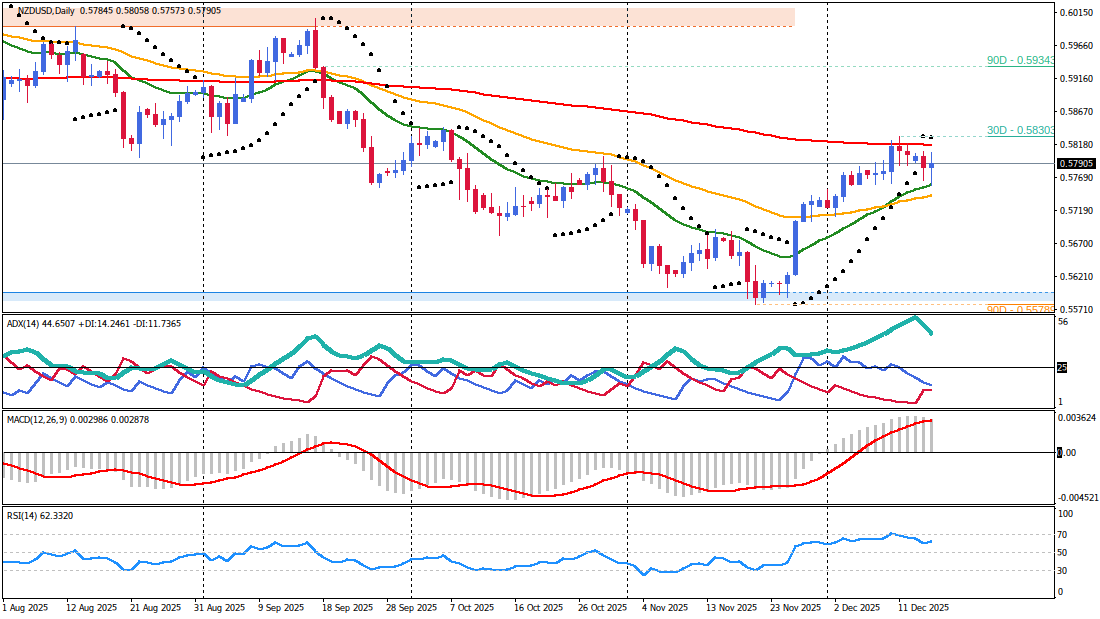
NZD/USD is currently undergoing a short-term bearish pullback, consolidating after a significant daily bullish impulse. This immediate downside pressure aligns with a series of recent disappointing New Zealand economic indicators, including a lower-than-expected Current Account (QoQ) and a dipped GDT Price Index, alongside a gloomy economic outlook from the New Zealand Treasury. Despite some recent USD weakness stemming from softer US employment and retail sales data, the kiwi faces internal fundamental headwinds. The overall technical bias remains neutral due to the divergence between the strong daily bullish trend and the intraday bearish correction. Critical high-impact events, particularly today's NZ GDP and tomorrow's US CPI, are poised to be the decisive catalysts for the pair's next major directional move, potentially overriding current technical structures.
Technical Analysis
Multi-Timeframe Market Structure
The daily timeframe for NZD/USD establishes a bullish short-to-medium term trend, with price trading firmly above the EMA20 and EMA50. Positive and strong MACD, along with bullish RSI and Stochastic, reinforce this upward momentum. The ADX at 44.65 confirms a robust trend. However, the price's closure below the daily SAR and its position below the EMA200 introduce a cautious note for the dominant long-term trend, suggesting that while recent strength is notable, the broader macro environment may still limit sustained upside. The previous session's strong rejection from the 0.58075 high indicates significant overhead resistance, aligning with the recent string of negative New Zealand fundamental data that dampens bullish conviction.On the H4 chart, the pair is clearly in a pullback phase, trading below the EMA20 but maintaining its position above the EMA50 and EMA200. MACD is negative, while RSI and Stochastic are neutral to slightly bearish, reflecting weakening bullish conviction. The low ADX at 15.86 indicates a lack of strong trend, pointing to consolidation or ranging conditions, which is consistent with market participants awaiting major fundamental catalysts. The short-term intraday perspective on both H1 and M30 charts confirms a bearish bias. Price trades below the EMA20 and EMA50 on H1, and below all key EMAs on M30, underscoring immediate downside pressure. Negative MACD and bearish RSI/Stochastic on these timeframes, combined with developing short-term bearish trends indicated by ADX (H1: 24.68, M30: 21.51), suggest a continuation of the H4 pullback. This aligns with the recent weak NZ fundamental data potentially weighing on the kiwi in the immediate term.
Critical Price Levels & Momentum Assessment
Key technical resistance levels include 0.57890, representing a confluence of the H4 EMA20 and H1 EMA50, which provides immediate overhead pressure. The psychological level of 0.58000 stands near the daily previous high rejection, while 0.58075 marks strong structural resistance at the daily previous high. These resistance levels are reinforced by the recent negative New Zealand economic reports, which make a sustained break higher fundamentally challenging without a significant positive catalyst.On the support side, 0.57797 acts as immediate intraday support at the H1 EMA200. Below this, 0.57716 represents structural support from a previous H4 low. The strongest structural support is identified at 0.57644, a critical daily previous low. A break below these levels would further confirm the bearish technical momentum, especially if accompanied by continued weak NZ data or a stronger USD narrative.
Fundamental Market Drivers
Central Bank Policy & Economic Outlook
The Reserve Bank of New Zealand (RBNZ) faces a challenging economic landscape, which provides a significant fundamental backdrop for NZD/USD. Recent data indicates a deteriorating economic outlook for New Zealand. The Current Account (QoQ) registered at $-8.37B, falling below expectations of $-8.1B in 3Q, signaling a larger deficit than anticipated. Although the Current Account - GDP Ratio improved slightly from -3.7% to -3.5%, the overall picture remains one of external imbalance. Furthermore, the GDT Price Index dipped from -4.3% to -4.4%, a negative development for New Zealand's critical dairy export sector, directly undermining the resilience of the New Zealand dollar. The New Zealand Treasury's Half Year Economic and Fiscal Update delivered a gloomy outlook, projecting a stalling economic recovery and a potential rise in unemployment to 5.5%. This comprehensive set of negative economic data points to a constrained RBNZ policy environment, where any hawkish pivots become increasingly difficult to justify. The upcoming NZ GDP q/q data, with a forecast of 0.9% after a previous -0.9%, is a crucial event. A positive surprise could offer some relief, but the broader fundamental context suggests that sustained economic recovery remains elusive, limiting NZD's upside potential against a potentially strengthening USD.In contrast, the US Dollar has experienced some recent weakness following mixed economic signals. The latest employment report showed Nonfarm Payrolls declining by 105,000 in October before rising by 64,000 in November, while the Unemployment Rate climbed to 4.6% in November. Retail Sales in the United States were virtually unchanged, below market expectations. PMI data also revealed a loss of growth momentum in the private sector. This softer US data has contributed to a temporary weakening of the USD, providing some counter-balance to NZD's own fundamental challenges. However, the market is now keenly focused on tomorrow's US CPI y/y, which is forecast to rise to 3.1% from 3.0%. A hotter inflation print would reinforce the Federal Reserve's need to maintain a restrictive stance or even signal potential tightening, which would fundamentally support USD strength and exert renewed downward pressure on NZD/USD.
Market Sentiment & Risk Environment
Market sentiment is currently characterized by caution, driven by the divergence in global economic performance and the upcoming high-impact economic data. The recent softening of US economic data, particularly in employment and retail sales, has injected a degree of uncertainty regarding the Federal Reserve's policy path, leading to some USD weakness. This has provided a temporary reprieve for risk-sensitive currencies like the NZD, despite New Zealand's own economic headwinds. However, the broader risk environment for the NZD remains challenging due to the deteriorating domestic economic outlook and falling commodity prices, notably dairy. The upcoming NZ GDP data carries significant weight; a print below expectations would amplify existing concerns about New Zealand's economic recovery and reinforce bearish sentiment towards the kiwi. Conversely, a stronger-than-expected US CPI print would quickly shift sentiment back towards USD strength, as it would likely solidify expectations for the Federal Reserve to maintain a higher-for-longer interest rate policy or even consider further tightening. This dynamic interplay of domestic economic woes for New Zealand and potential hawkish shifts for the US creates a volatile backdrop, where market positioning is likely to remain cautious ahead of these key catalysts. The current intraday bearish technical structure aligns with the prevailing weak NZ fundamental backdrop, suggesting that traders are sensitive to negative news flow from New Zealand and are positioning for potential USD strength if US inflation proves persistent.Integrated Trading Execution
Primary Trading Scenario
- Bias: Bearish - The immediate intraday bias is bearish, aligning with the H4 pullback and short-term indicator signals, which find fundamental reinforcement from the recent disappointing New Zealand economic data and the gloomy Treasury outlook.
- Trigger/Entry: Sell on a confirmed break and hold below 0.57797 (H1 EMA200). Target entry around 0.57795 (±3 pip tolerance). This trigger capitalizes on the existing short-term bearish momentum and positions the trade below a significant intraday support level, anticipating further downside driven by continued weak NZ fundamentals or a stronger USD.
- Stop-Loss: Place above 0.57850 (just above H1 EMA20, providing a 5.5 pip buffer). This stop-loss level provides protection above immediate resistance and serves as an invalidation point for the short-term bearish structure.
- Profit Targets:
- Target 1: 0.57720 (near H4 previous low, R:R ~1.36). This target aims for the next significant structural support, aligning with the extended H4 pullback.
- Target 2: 0.57650 (near D1 previous low, R:R ~2.63). This target eyes a stronger daily structural support level, a move that would be fundamentally justified by persistently weak NZ data or a hawkish surprise from upcoming US CPI.
- Session Context: Asian/London session. This timing is optimal for capturing the continuation of the current intraday bearish momentum before the full impact of major US and NZ data releases.
Alternative Market Scenario
- Invalidation: Primary scenario invalidates if price closes above 0.57850 on the H1 chart. This would signal a reclaiming of immediate resistance, potentially driven by a stronger-than-expected NZ GDP print or further significant USD weakness.
- Bias: Bullish - Should the intraday bearish pressure fail to sustain, and price reclaims higher levels, the underlying D1 bullish momentum could reassert itself, supported by an unexpected positive NZ GDP outcome or a dovish shift in US sentiment.
- Trigger/Entry: Buy on a confirmed break and hold above 0.57890 (H4 EMA20). Target entry around 0.57895 (±3 pip tolerance). This entry targets a break above a key medium-term resistance level, indicating a shift back to bullish control.
- Stop-Loss: Place below 0.57820 (just below H1 EMA200, providing a 7.5 pip buffer).
- Profit Targets:
- Target 1: 0.57980 (H4 previous high, R:R ~1.13).
- Target 2: 0.58070 (near D1 previous high, R:R ~2.33).
- Session Context: London/NY session, requires strong momentum. This scenario is more likely to develop with higher liquidity and requires strong positive catalysts to overcome the prevailing event risk.
Risk Management & Catalyst Analysis
Trade Risk Assessment
The confluence quality for NZD/USD is currently medium, reflecting a divergence between the strong daily bullish momentum and the consolidating/bearish signals on the H4, H1, and M30 timeframes. This mixed signal environment reduces overall conviction, indicating a period of uncertainty or correction before the next major move. Fundamentally, the New Zealand dollar is under pressure from recent disappointing Current Account and GDT Price Index data, coupled with a gloomy economic outlook from the Treasury. While the US dollar has shown some recent weakness due to mixed employment and retail sales figures, upcoming high-impact US CPI data poses a significant fundamental risk. This creates a high event risk environment, significantly increasing the potential for volatility and unexpected moves that could rapidly invalidate intraday technical levels. The looming NZ GDP q/q report adds another layer of domestic event risk for the kiwi. Due to this heightened uncertainty and potential for sharp swings, reducing position size by 50% is a prudent risk management approach to mitigate exposure to potential volatility spikes around these critical data releases.Economic Calendar & Event Impact
The upcoming economic calendar features several high-impact events that will significantly influence NZD/USD:- US FOMC Member Waller Speaks (Today, 13:15 UTC): Medium-impact event for USD direction - Any commentary on inflation or monetary policy outlook will be closely scrutinized for shifts in Fed expectations.
- NZ GDP q/q (Today, 21:45 UTC): Forecast 0.9%, Previous -0.9% - This is a high-impact event for NZD. A stronger-than-forecast reading would provide a much-needed boost to the kiwi, potentially challenging the current bearish pullback. A weaker reading would reinforce the gloomy economic outlook and extend NZD weakness.
- US President Trump Speaks (Tomorrow, 02:00 UTC): Medium-impact event - Geopolitical or economic policy statements could introduce volatility for the USD.
- US CPI y/y (Tomorrow, 13:30 UTC): Forecast 3.1%, Previous 3.0% - This is a high-impact event for USD. A hotter-than-expected inflation print would likely strengthen the USD as it reinforces a hawkish Federal Reserve stance. A weaker print could lead to further USD selling.
- US Unemployment Claims (Tomorrow, 13:30 UTC): Forecast 224K, Previous 236K - High-impact labor market indicator. A significant deviation from forecast impacts Fed policy expectations and USD direction.
- US Philly Fed Manufacturing Index (Tomorrow, 13:30 UTC): Forecast 2.5, Previous -1.7 - Medium-impact indicator for manufacturing health.
- US Existing Home Sales (December 19, 15:00 UTC): Forecast 4.15M, Previous 4.10M - Medium-impact housing market data.
- US Revised UoM Consumer Sentiment (December 19, 15:00 UTC): Forecast 53.5, Previous 53.3 - Medium-impact sentiment indicator.


