
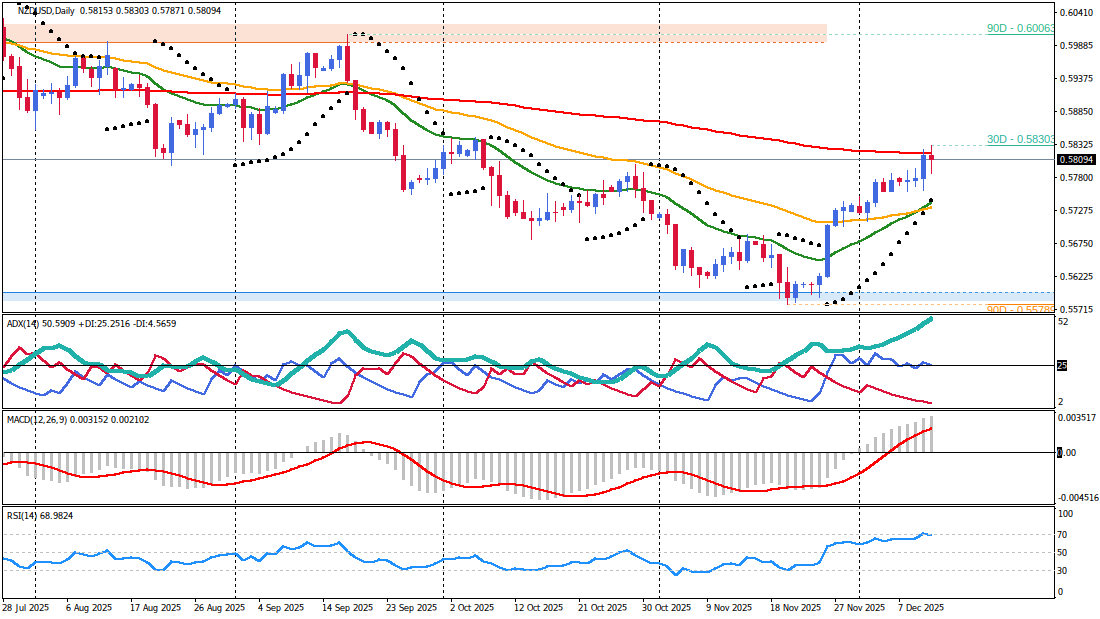
NZD/USD maintains a robust bullish bias on higher timeframes, driven by significant policy divergence between the dovish US Federal Reserve and the increasingly hawkish Reserve Bank of New Zealand. This fundamental backdrop provides strong support for the Kiwi, despite a current intraday pullback from recent highs. The pair approaches critical structural resistance at 0.58181 (D1 EMA200), a level that ongoing USD weakness and positive New Zealand economic data are poised to challenge. Traders are keenly observing the 0.58000-0.57934 support zone for potential bullish re-entry opportunities, particularly as the market digests remarks from US President Trump and aligns short-term momentum with the dominant uptrend.
Technical Analysis
Multi-Timeframe Market Structure
The NZD/USD pair exhibits a strong bullish trend on the daily (D1) timeframe, with price trading well above its EMA20 (0.57401) and EMA50 (0.57322). The daily MACD is firmly positive and advancing, while the RSI (68.70) reflects robust buying pressure. Although the Stochastic (92.64) is in overbought territory, suggesting a near-term pause, the ADX (50.59) confirms the very strong trend. This sustained D1 bullishness is fundamentally supported by the RBNZ's hawkish stance and broad US Dollar weakness. The H4 chart reinforces this bullish momentum, with price holding above its EMA20 (0.57934), EMA50 (0.57694), and EMA200 (0.57262). The H4 MACD remains positive and rising, while the RSI (58.64) indicates healthy momentum. The H4 Stochastic (74.27) is approaching overbought conditions, and ADX (24.09) points to a developing trend.In contrast, short-term intraday charts (H1/M30) reveal a temporary pullback. The H1 chart trades just below its EMA20 (0.58085) but remains above the EMA50 (0.58000) and EMA200 (0.57684). H1 MACD is positive but shows weakening histogram bars, and Stochastic (29.70) is nearing oversold levels. On the M30 timeframe, price is below EMA20 (0.58107) and EMA50 (0.58072), with MACD turning negative and Stochastic (16.79) firmly in oversold territory. This short-term corrective phase within the broader bullish trend provides a tactical opportunity for entry, pending confirmation of renewed upward momentum.
Critical Price Levels & Momentum Assessment
NZD/USD faces significant resistance at 0.58181, which is the D1 EMA200 and a key structural hurdle. A break above this level is crucial for the continuation of the multi-month rally and would indicate strong fundamental conviction in NZD strength against USD weakness. The previous H4 high at 0.58230 acts as immediate overhead resistance. On the downside, immediate support is found at 0.58000 (H1 EMA50 and a psychological level), followed by 0.57934 (H4 EMA20). The H4 SAR at 0.57775 provides a deeper support level.Momentum indicators across D1 and H4 timeframes confirm a strong bullish trend, indicating the dominant market direction. However, the weakening momentum on H1 and M30 charts signals a temporary intraday correction or consolidation. This divergence requires careful timing for trade execution, favoring entries on a retest of support zones. The ATR (H1: 0.000788, H4: 0.001729) indicates moderate intraday volatility, suitable for structured trades. The market's overall strong trend phase on the daily chart, combined with the RBNZ's hawkish stance and the Fed's dovish pivot, underpins the significance of these technical levels for potential trend continuation or deeper correction.
Fundamental Market Drivers
Central Bank Policy & Economic Outlook
The primary fundamental driver for NZD/USD’s current bullish trajectory is the stark policy divergence between the Reserve Bank of New Zealand (RBNZ) and the US Federal Reserve (Fed). The RBNZ has adopted a more hawkish tone in recent weeks, signaling that its easing cycle is likely nearing its end, despite having lowered its policy rate in November to a three-year low. This stance contrasts sharply with the Federal Reserve's increasingly dovish pivot. The Fed recently cut its policy rate by 25 basis points to a target range of 3.50–3.75% and signaled a possible pause in January, fueling expectations of further rate cuts in 2026. Federal Reserve Chair Jerome Powell's comments, emphasizing downside risks to employment and the institution's desire not to further weaken job creation, reinforced these dovish expectations, weighing heavily on the US Dollar. Moreover, speculation surrounding a potentially more dovish successor to Powell, such as Kevin Hassett, adds further pressure on the USD.Economic data from New Zealand provides additional support for the Kiwi. New Zealand Electronic Card Retail Sales (MoM) rose significantly from 0.2% to 1.2% in November, with the YoY figure increasing from 0.8% to 1.6%. The Business NZ Performance of Manufacturing Index (PMI) for November registered 51.4, indicating an expansion in economic activity. These positive domestic indicators bolster the RBNZ's hawkish outlook and provide a solid fundamental foundation for the NZD's strength. In the United States, recent labor market data confirmed a cooling trend, with Initial Unemployment Claims jumping to 236,000 for the week ending December 6, higher than the 220,000 expected. This weakening employment landscape aligns with the Fed’s assessment and reinforces the narrative of an accommodative monetary policy, contributing to broad US Dollar weakness.
Market Sentiment & Risk Environment
A generally positive risk environment further strengthens demand for risk-sensitive currencies like the New Zealand Dollar. The broad US Dollar weakness, stemming from the Federal Reserve's dovish monetary policy and softer economic data, has intensified selling pressure on the Greenback. The US Dollar Index (DXY) is slipping towards its lowest level since mid-October, reflecting this sentiment. This environment creates a tailwind for NZD/USD, as investors seek higher yields and growth opportunities outside of the softening US economy. The RBNZ's hawkish stance, contrasting with the Fed's dovish pivot, enhances the carry appeal of the NZD, attracting capital flows. Market participants remain sensitive to any shifts in central bank rhetoric or economic data, particularly from the US, which could impact the current risk appetite and USD trajectory.Integrated Trading Execution
Primary Trading Scenario
- Bias: Bullish - The strong higher-timeframe technical structure, combined with the significant policy divergence favoring the NZD and positive domestic economic data, supports a bullish continuation.
- Trigger/Entry: Entry around 0.58005 (±3 pips) upon confirmation of bullish momentum (e.g., M30 MACD cross positive, Stochastic exiting oversold) following a bounce from the 0.58000 (H1 EMA50 / psychological level) to 0.57934 (H4 EMA20) support zone. This entry aligns with the underlying fundamental strength of the NZD.
- Stop-Loss: 0.57900, placed below the H1 EMA50 and accounting for 1.25x H1 ATR, providing protection if the key support fails under unexpected USD strength.
- Profit Targets:
- Target 1: 0.58180 (D1 EMA200) - This is a significant structural resistance that the strong fundamental tailwinds for NZD are expected to challenge.
- Target 2: 0.58280 (extension beyond previous H4 high) - A break above the D1 EMA200, driven by continued USD weakness and RBNZ hawkishness, would open the path to this higher extension.
- Session Context: This scenario is optimal for execution during the London session, after any immediate volatility from the US President's speech subsides, or if the Asian session shows clear support holding, confirming the intraday pullback has concluded.
Alternative Market Scenario
- Invalidation: A sustained M30 close below 0.57900, which would indicate a failure to hold the key H4 EMA20 support, invalidates the immediate bullish continuation and suggests a deeper correction. This could be triggered by an unexpectedly hawkish tone from US President Trump or a significant shift in risk sentiment.
- Bias: Bearish - A deeper bearish pullback would ensue if fundamental drivers shift or if technical support fails decisively.
- Trigger/Entry: Entry around 0.57895 (±3 pips) on confirmation of bearish momentum following a break and sustained M30 close below 0.57900.
- Stop-Loss: 0.58000, placed above the broken H4 EMA20, providing a clear invalidation point for the bearish move.
- Profit Targets:
- Target 1: 0.57775 (H4 SAR)
- Target 2: 0.57650
- Session Context: This alternative scenario gains traction if US President Trump's speech creates significant and unexpected USD strength, or if the current intraday pullback accelerates during the Asian session without finding support.
Risk Management & Catalyst Analysis
Trade Risk Assessment
The confluence quality for NZD/USD is currently medium. While higher timeframes (D1, H4) exhibit strong bullish alignment, short-term (H1, M30) indicators are conflicting, signaling a corrective phase. This divergence reduces immediate confidence in direct continuation, necessitating patience for bullish confirmation before entry. Intraday-specific risks are elevated due to potential volatility from US President Trump's speech scheduled for Today, 01:15 UTC, which occurs during the Asian session. Traders must account for potential spikes and whipsaws around this event. Conservative position sizing is paramount, utilizing 1.25x the H1 ATR (approximately 10 pips) for stop-loss placement on intraday trades. Position size should be reduced by 50% when trading within four hours of this high-impact event to mitigate event risk. The overall market environment, characterized by a dovish Fed and hawkish RBNZ, provides a strong fundamental undercurrent, but short-term price action requires careful navigation.Economic Calendar & Event Impact
The upcoming economic calendar features a high-impact event that will significantly influence USD/JPY:- US President Trump Speaks (Today, 01:15 UTC): Impact: Medium - This event carries significant weight for USD direction. Any hawkish or dovish signals from President Trump regarding economic policy, trade, or geopolitical matters will drive substantial volatility and could either reinforce or challenge the current USD weakness, directly impacting NZD/USD.
Synthesized Market Outlook
The NZD/USD pair presents a compelling bullish outlook, underpinned by a clear policy divergence where the Reserve Bank of New Zealand maintains a hawkish stance while the US Federal Reserve has adopted a dovish pivot. This fundamental strength for the Kiwi is further supported by improving New Zealand retail sales and manufacturing data, contrasting with a cooling US labor market. Technically, the daily and H4 charts exhibit strong bullish trends, but an intraday pullback is currently underway, providing a potential tactical entry point.Traders should closely monitor the 0.58000-0.57934 support zone for signs of bullish reversal and confirmation before initiating long positions. The D1 EMA200 at 0.58181 stands as a critical resistance level; a decisive break above this point would signal robust continuation of the uptrend. The immediate market focus is on US President Trump's speech scheduled for Today, 01:15 UTC, which carries the potential for significant, albeit temporary, volatility. A surprisingly hawkish tone could provide temporary respite for the USD, potentially extending the current NZD/USD pullback, while a neutral or dovish tone would likely reinforce the existing fundamental drivers for NZD strength. Position sizing must remain conservative, especially around high-impact events, to manage event-driven risks effectively.


