
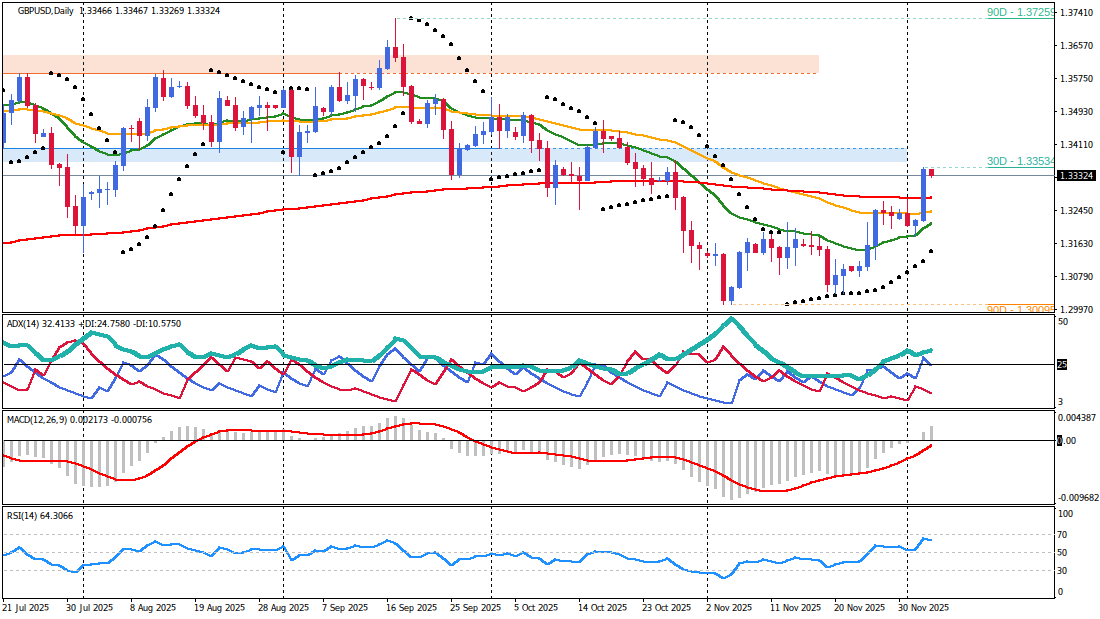
GBP/USD maintains a strong bullish bias across higher timeframes, currently experiencing short-term consolidation in the Asian session as the pair retreats from a two-month high. This technical strength is fundamentally underpinned by increasing market expectations for a Federal Reserve rate cut as early as next week, driven by recent weaker-than-expected US economic data. While the Bank of England is also priced for a December rate cut, the relative dovish shift from the Fed, combined with specific UK tailwinds like a new trade deal, provides a supportive backdrop for Sterling. However, significant event risk looms with high-impact US Unemployment Claims due today and critical inflation data (Core PCE) tomorrow, which will determine if the current pullback extends or if the prevailing bullish trend resumes with renewed conviction.
Technical Analysis
Multi-Timeframe Market Structure
GBP/USD exhibits a robust bullish structure across the daily (D1) and four-hour (H4) timeframes. On the D1 chart, price trades firmly above its 20, 50, and 200-period Exponential Moving Averages (EMAs), signaling a well-established uptrend. The Moving Average Convergence Divergence (MACD) is positive and expanding, with the Relative Strength Index (RSI) at 64.59 confirming strong bullish momentum without being excessively overbought. Stochastic is in the overbought region at 90.67, and the Average Directional Index (ADX) at 32.41 reinforces the presence of a strong trend. This daily structure remains decisively bullish, suggesting that fundamental factors driving US Dollar weakness are effectively translating into sustained upward pressure for Cable.
The H4 chart mirrors this strong bullish momentum, with price comfortably above its 20, 50, and 200-period EMAs, which are all correctly aligned for an uptrend. MACD is positive and rising, while RSI at 69.24 approaches overbought territory, indicating strong buying pressure. Stochastic is deeply overbought at 90.94, and ADX at 39.74 confirms a robust trend. This medium-term framework strongly aligns with the daily bullish bias, suggesting that the fundamental narrative of diverging central bank policies continues to fuel this uptrend.
In contrast, the short-term intraday charts (H1/M30) reveal a temporary consolidation phase. On H1, price trades above its EMAs, but the Stop and Reverse (SAR) indicator is above price at 1.33458, hinting at a potential short-term reversal or consolidation. MACD is positive but shows declining momentum, and Stochastic pulls back from overbought levels. M30 price action consolidates around its 20-period EMA, with MACD also showing declining positive momentum and Stochastic falling. This short-term easing, typical during Asian session consolidation, provides potential re-entry opportunities on dips within the broader uptrend, especially if upcoming US economic data reinforces the dovish Fed narrative.
Critical Price Levels & Momentum Assessment
The market is currently navigating key technical levels as it consolidates. Immediate intraday resistance is found between 1.33460-1.33480, coinciding with the H1 SAR and recent M5/M15 highs. A breach of this zone would open the path towards 1.33530, which represents the previous D1 High and a significant structural resistance, further reinforced by the psychological level of 1.33600. These levels will be critical tests for bullish continuation, particularly if US data provides a catalyst for USD weakness.
On the support side, the immediate intraday support zone is identified between 1.33300-1.33320, encompassing the previous H4 Low and M30 EMA20. A more significant intraday support lies at 1.33230 (H1 EMA20), which aligns with the strong bullish trend on higher timeframes. Deeper intraday support is found at 1.33140 (M30 EMA50). The ability of these support levels to hold during the current consolidation will be crucial for the continuation of the broader uptrend, especially given the market's sensitivity to upcoming US economic releases that could either confirm or challenge the current fundamental lean.
The overall trend consensus is strongly bullish on the D1 and H4 timeframes, with price consistently above key moving averages and momentum indicators confirming strength. Momentum quality is strong on higher timeframes but shows signs of weakening and consolidation on H1 and M30, indicating a temporary pullback. ATR (H1) is 0.000801, suggesting moderate intraday volatility. The market is in a strong trend phase overall, but short-term intraday momentum is easing, which is typical during Asian session consolidation before the London open. This short-term easing contradicts the higher timeframe strength, suggesting a potential re-accumulation phase before a likely continuation of the bullish move if fundamental drivers persist.
Fundamental Market Drivers
Central Bank Policy & Economic Outlook
The primary fundamental driver for GBP/USD's recent ascent is the significant shift in US Federal Reserve monetary policy expectations. Weaker US economic data, specifically the unexpected contraction in ADP Non-Farm Employment Change and the subdued employment sub-component of the ISM Services PMI, has cemented market bets for a Fed rate cut at next week's December 10th FOMC meeting. Traders are now pricing in an 89% probability of a quarter-point rate cut and further easing into 2026. This dovish sentiment is exacerbated by rumors that Kevin Hassett, a known advocate for quicker and deeper interest rate reductions, could succeed Jerome Powell as Fed Chair. This prospect of a more accommodative Fed significantly weakens the US Dollar, providing a strong fundamental tailwind for GBP/USD, aligning with the technical bullish momentum.
Concurrently, the Bank of England (BoE) is also expected to cut rates. The UK Autumn November budget has reinforced market expectations for a December 18th BoE rate cut, with a majority of analysts anticipating a reduction to 3.75% and markets pricing in a 90% chance. UK Prime Minister Keir Starmer's emphasis on lowering inflation and interest rates to boost business investment further supports this dovish outlook. While a BoE rate cut would typically weigh on Sterling, the key differentiator is that BoE rates are still priced to remain the highest among OECD nations due to stickier inflation. This relative rate differential, combined with the more aggressive dovish repricing for the Fed, helps to cushion the Pound's downside and maintains the overall bullish bias for GBP/USD. The recently announced US-UK trade deal, exempting UK pharmaceutical exports from tariffs, also provides a specific tailwind for the Pound, boosting confidence and supporting its valuation.
Market Sentiment & Risk Environment
Market sentiment is currently characterized by a renewed demand for the US Dollar in Asian trading hours, causing GBP/USD to retreat from its recent highs. This short-term USD recovery, however, is likely to be challenged by the prevailing dovish expectations surrounding the Federal Reserve. The broad market consensus for a Fed rate cut has generally fostered a risk-on environment that tends to favor non-USD assets, including the Pound. The potential succession of Kevin Hassett as Fed Chair, signaling a more growth-oriented monetary policy, further reinforces this sentiment, reducing demand for the safe-haven US Dollar over the medium term.
Geopolitical factors are currently less prominent in driving GBP/USD, with the focus squarely on central bank policy divergence and economic data releases. The positive US-UK trade deal on pharmaceuticals contributes to a constructive sentiment for Sterling, providing a specific fundamental uplift that supports its resilience against the US Dollar. The overall risk environment suggests that while short-term profit-taking or minor USD strength may occur, the fundamental backdrop of a dovish Fed and relatively higher BoE rates supports the ongoing bullish technical structure for GBP/USD.
Integrated Trading Execution
Primary Trading Scenario
- Bias: Bullish - The strong higher-timeframe technical uptrend, combined with the increasing fundamental probability of a Federal Reserve rate cut next week and continued US Dollar weakness, supports bullish continuation.
- Trigger/Entry: Look for price to find support at 1.33230 (H1 EMA20) or 1.33140 (M30 EMA50). An entry trigger requires an M30 candle close above 1.33280, accompanied by renewed M30 MACD bullish momentum and Stochastic turning higher from oversold/neutral levels. This entry aligns with the expectation of a London session re-accumulation and subsequent push higher, especially if US data today does not significantly strengthen the USD.
- Stop-Loss: Place stop-loss below 1.33080, which is 1.25x H1 ATR below the M30 EMA50, protecting against a deeper technical pullback or unexpected strong US data.
- Profit Targets:
- Target 1: 1.33530 (Previous D1 High) - This target is significant as a structural resistance, with a break confirming renewed bullish strength towards higher levels, potentially fueled by dovish Fed rhetoric.
- Target 2: 1.33700 (R:R > 1:2) - This target represents a conservative extension beyond the previous daily high, supported by the strong underlying bullish momentum and the potential for a sustained US Dollar depreciation.
- Session Context: This scenario is optimal during the London session, anticipating increased liquidity and directional clarity following the Asian consolidation, and assuming US data later today does not significantly alter the dovish Fed outlook.
Alternative Market Scenario
- Invalidation: The primary bullish scenario invalidates if price breaks and closes below 1.33100 on the H1 chart, signaling a deeper intraday correction. This invalidation would likely be triggered by significantly stronger-than-expected US Unemployment Claims data, challenging the current dovish Fed narrative.
- Bias: Bearish Intraday Reversal - A break below key support levels would shift the short-term bias to bearish, driven by a potential re-evaluation of Fed policy if US data surprises to the upside.
- Trigger/Entry: An H1 close below 1.33100, with M30 confirming bearish momentum (MACD negative, Stochastic falling). This entry would capitalize on a fundamental shift or a strong technical breakdown.
- Stop-Loss: Place stop-loss above 1.33250 (1.25x H1 ATR above the breakdown level), managing risk effectively for the alternative scenario.
- Profit Targets:
- Target 1: 1.32850 (H1 EMA50)
- Target 2: 1.32700 (H4 EMA20)
- Session Context: This scenario is more likely to unfold post-US data releases, particularly if the figures show unexpected strength, leading to a temporary repricing of Fed rate cut probabilities and a rebound in the US Dollar.
Risk Management & Catalyst Analysis
Trade Risk Assessment
The current confluence quality is Medium. While the D1 and H4 timeframes display strong bullish alignment, the H1 and M30 timeframes indicate short-term consolidation or a pullback, creating a temporary divergence in momentum. This reduces immediate intraday confidence. Furthermore, high-impact US Unemployment Claims data is scheduled for today, approximately 6.5 hours from the current time. Tomorrow brings a cluster of high-impact US data, including the Core PCE Price Index and UoM Consumer Sentiment, which are critical for inflation and consumer confidence. This significantly elevates event risk, requiring traders to exercise extreme caution and potentially reduce position sizing. The transition from the lower-liquidity Asian session into the higher-volatility London session also presents intraday-specific risks, as news spikes from upcoming US data pose a significant risk of sudden, unpredictable price movements that could override technical levels.
Economic Calendar & Event Impact
The upcoming economic calendar features several high-impact events that will significantly influence USD/JPY:
- US Challenger Job Cuts y/y (Today, 12:30 UTC): Previous 175.3% - This labor market indicator provides insight into corporate layoff trends, which could influence overall employment sentiment ahead of the NFP report and further cement dovish Fed bets if job cuts remain elevated.
- US Unemployment Claims (Today, 13:30 UTC): Forecast 219K, Previous 216K - This is a high-impact event for USD direction. A higher-than-forecast reading would reinforce the narrative of a weakening labor market, strengthening the case for a Fed rate cut and likely weighing heavily on the US Dollar. Conversely, a lower reading could trigger a short-term USD rebound.
- US Core PCE Price Index m/m (Tomorrow, 15:00 UTC): Forecast 0.2%, Previous 0.2% - As the Fed's preferred inflation gauge, this report is critical. A reading below forecast would intensify rate cut expectations, driving USD weakness, while a higher reading could temper dovish bets and support the Dollar.
- US Prelim UoM Consumer Sentiment (Tomorrow, 15:00 UTC): Forecast 52.0, Previous 50.3 - This indicator provides insight into consumer confidence and spending intentions. A weaker reading could signal economic slowdown concerns, bolstering the dovish Fed outlook and USD weakness.
- US Prelim UoM Inflation Expectations (Tomorrow, 15:00 UTC): Previous 4.7% - Consumer inflation expectations are closely watched by the Fed. A decline in expectations would support the Fed's disinflation narrative, reinforcing rate cut probabilities and contributing to USD depreciation.
Synthesized Market Outlook
GBP/USD maintains a strong bullish outlook, underpinned by robust higher-timeframe technical structures and a compelling fundamental narrative of aggressive Federal Reserve dovishness. The market is increasingly pricing in a Fed rate cut next week, driven by recent weaker US economic data and speculation regarding a more dovish Fed Chair. This fundamental backdrop provides significant tailwinds for Sterling, despite the Bank of England also being expected to cut rates. The short-term intraday consolidation presents potential re-entry opportunities for bullish positions, aligning with the broader uptrend.
However, traders must remain highly vigilant as significant event risk from today's US Unemployment Claims and tomorrow's US Core PCE and UoM data could introduce substantial volatility. A continuation of the bullish trend relies on US economic data confirming the dovish Fed expectations. Key monitoring levels include the immediate intraday support zone of 1.33230-1.33140 for re-entry points and the critical resistance at 1.33530 for bullish continuation. Conversely, a decisive H1 close below 1.33100 would signal a deeper correction, particularly if US data surprises with unexpected strength, challenging the prevailing fundamental bias.


