
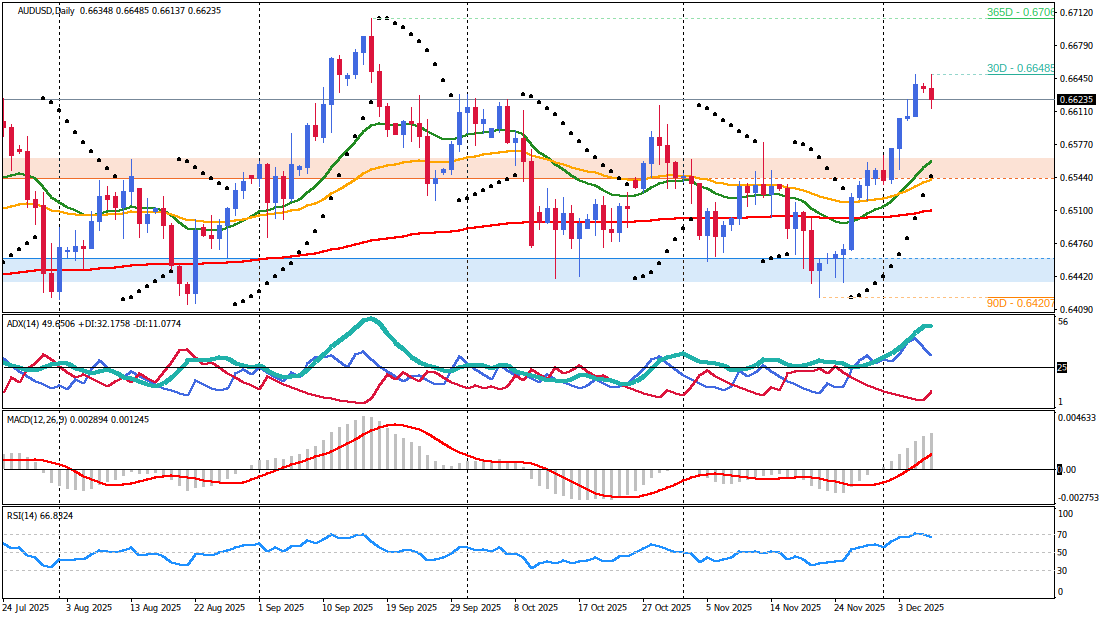
AUD/USD is consolidating in a tight range, reflecting market anticipation ahead of pivotal central bank decisions. While the daily chart maintains a strong bullish trend, shorter timeframes indicate a neutral to ranging bias as traders await catalysts. The Reserve Bank of Australia (RBA) is widely expected to keep its cash rate at 3.60% today, but recent upbeat inflation and GDP data strongly suggest a hawkish tilt in its forward guidance, potentially signaling an end to the easing cycle and opening the door for 2026 rate hikes. Conversely, the Federal Open Market Committee (FOMC) is poised to deliver a 25-basis point rate cut tomorrow, weakening the US Dollar. This significant divergence in monetary policy outlook, coupled with supportive Chinese trade data, provides a robust fundamental backdrop that aligns with the primary bullish technical scenario, despite short-term consolidation.
Technical Analysis
Multi-Timeframe Market Structure
The AUD/USD pair maintains a strong bullish posture on the daily (D1) chart, trading significantly above its EMA20 (0.65600), EMA50 (0.65417), and EMA200 (0.65095). These moving averages are fanned out in a clear uptrending alignment, with MACD (0.002892) positive and ADX (49.65) indicating robust trend strength. RSI (66.77) is firm, though Stochastic (92.79) suggests overbought conditions, hinting at a potential pullback or consolidation before further upside. This daily bullish structure is fundamentally supported by the RBA's recent hawkish shift in rhetoric and better-than-expected economic data, reinforcing the sustainability of the uptrend.In the medium-term, the H4 chart shows price trading near the EMA20 (0.66183) after a recent push higher. While MACD (0.001448) is positive, its momentum is waning. RSI (58.08) is neutral, and ADX (35.41) still signals a strong trend, but the SAR (0.66458) has flipped above price, indicating a medium-term pause or short-term correction within the broader D1 uptrend. This H4 consolidation reflects the market's cautious stance ahead of the high-impact RBA and FOMC decisions, which introduce significant uncertainty into the immediate directional bias.
The short-term intraday perspective on the H1 chart exhibits a bearish bias, with price trading below the EMA20 (0.66285) and EMA50 (0.66263). MACD (-0.000303) is negative, and RSI (43.39) is weak. SAR (0.66266) confirms this short-term bearishness. Conversely, the M30 chart shows price below its EMAs, but its SAR (0.66137) has just flipped bullish, and Stochastic (60.39) is rising from oversold territory, suggesting a potential intraday bounce. This creates a mixed immediate trading bias, with a slight bearish tilt on H1 but signs of consolidation or a bounce on M30 within a tight range, directly attributable to the market's holding pattern before today's RBA announcements and tomorrow's FOMC decision.
Critical Price Levels & Momentum Assessment
Key technical resistance levels include 0.6640, representing a previous D1 high and the H4 SAR, and 0.6630, a psychological level coinciding with an H1 EMA20/50 cluster. These levels act as immediate barriers, and a decisive break above them, especially post-RBA, would confirm renewed bullish momentum.Crucial support levels are identified at 0.6618 (H4 EMA20), which serves as a potential intraday bounce area, 0.6614 (previous H4 low), and the psychological 0.6600 level, reinforced by the M30 SAR. The 0.6600 mark is particularly significant as it represents a clean break point that, if sustained, reinforces the bullish tone and keeps the door open for higher targets.
Momentum indicators synthesize a D1 strong bullish trend, an H4 pause or minor correction, and conflicting/ranging signals on H1/M30. The overall market phase is a D1 uptrend undergoing a short-term ranging/correction phase, heavily influenced by the upcoming central bank events. ATR (H1) is 0.000719, indicating relatively subdued intraday volatility, but this is expected to expand significantly around the RBA and FOMC announcements.
Fundamental Market Drivers
Central Bank Policy & Economic Outlook
The Reserve Bank of Australia (RBA) is positioned to be a key driver for AUD/USD today. The RBA is widely expected to keep its Official Cash Rate (OCR) unchanged at 3.60% at its December meeting. However, the critical focus is on the RBA's Monetary Policy Statement (MPS) and Governor Michele Bullock’s press conference. Recent Australian economic data has surprised to the upside, with real Gross Domestic Product (GDP) climbing 2.1% year-on-year in the third quarter, surpassing the RBA's trend growth estimate. Monthly Consumer Price Index (CPI) in October rose at an annual rate of 3.8%, marking a ten-month high and exceeding market forecasts, with broad-based price pressures, particularly in the services sector. Governor Bullock previously warned that "If inflation proves more persistent, it would have implications for policy." This string of upbeat data, combined with Bullock's vigilance against inflation, prompts money markets to fully price in a rate hike by the end of 2026, a significant shift from earlier expectations of rate cuts. This expectation of a hawkish tilt from the RBA provides fundamental support for the AUD, aligning with the daily technical bullish structure.In contrast, the US Dollar faces significant downside pressure ahead of the Federal Open Market Committee (FOMC) decision tomorrow. Markets assign an 87% chance of a 25-basis point rate cut, which would lower the target range to 3.50%-3.75%. Evidence of a cooling labor market, including recent comments from Fed officials like John Williams, reinforces expectations for further easing. The US Dollar Index (DXY) is trading near a five-week low, reflecting investor caution. This dovish stance by the Fed, compared to a potentially hawkish RBA, creates a substantial monetary policy divergence that favors AUD/USD upside, widening the Australia-US yield spreads. However, a potentially more hawkish tone from Fed Chair Jerome Powell, or an unusually divided committee, could temper USD losses if the Fed signals increased caution about the pace of future rate cuts.
Market Sentiment & Risk Environment
Market sentiment around AUD/USD is cautious but generally constructive, primarily driven by the diverging central bank outlooks. The expectation of a less dovish RBA and a dovish FOMC creates a positive fundamental backdrop for the Aussie. AUD positioning against the US Dollar suggests that buyers are likely to retain control, with option markets indicating steady AUD demand and call-side interest, favoring dip-buying.Further support for the Australian Dollar comes from China, Australia's largest trading partner. China's November trade data delivered a stronger-than-expected rebound, with exports surging 5.9% year-on-year and the USD-denominated trade surplus reaching $111.68 billion. This robust performance in Chinese trade figures reinforces underlying AUD demand, given Australia's heavy reliance on Chinese demand for its exports. While global markets are exhibiting a general holding pattern ahead of the FOMC, the specific drivers for AUD/USD suggest an underlying bullish bias supported by these fundamental factors. Any risk-on sentiment in broader markets would further amplify the AUD's gains, especially if the RBA confirms a hawkish pivot.
Integrated Trading Execution
Primary Trading Scenario
- Bias: Bullish - The daily technical structure remains strongly bullish, aligning with the fundamental expectation of a hawkish RBA pivot and a dovish FOMC, creating significant monetary policy divergence favoring AUD strength.
- Trigger/Entry: A decisive H1 close above 0.6630 following a hawkish RBA outcome (or less dovish than expected) that signals an end to the easing cycle and prospects for future hikes. Optimal entry on a confirmed retest of 0.6630.
- Stop-Loss: Below 0.6618 (1.25x H1 ATR from 0.6630 entry, targeting previous H4 low). This stop-loss is justified by the H4 EMA20 acting as a critical short-term support that should hold if the bullish scenario unfolds.
- Profit Targets:
- Target 1: 0.6640 (Previous D1 high) - This level represents a key technical resistance point that, once cleared, confirms stronger upside momentum.
- Target 2: 0.6660 (Psychological level and three-week highs) - This target is supported by the potential for increased AUD inflows if RBA signals tightening, pushing the pair towards higher multi-week levels.
- Session Context: Best executed during the London or early NY session, post-RBA clarity, and ahead of the FOMC decision which is expected to further weaken the USD.
Alternative Market Scenario
- Invalidation: A sustained break and H1 close below 0.6618 (H4 EMA20) or a more dovish-than-expected RBA outcome that dampens tightening expectations.
- Bias: Bearish - This bias would emerge if the RBA disappoints hawkish expectations or if the FOMC delivers a surprisingly hawkish hold, reducing the policy divergence.
- Trigger/Entry: A sustained break and H1 close below 0.6618 (H4 EMA20) or clear bearish price action after a dovish RBA outcome.
- Stop-Loss: Above 0.6630 (1.25x H1 ATR from 0.6618 entry, targeting H1 resistance).
- Profit Targets:
- Target 1: 0.6600 (Psychological level)
- Target 2: 0.6585 (H4 EMA50)
- Session Context: Could develop during the Asian or London session, post-RBA, especially if negative US labor data or a dovish RBA statement triggers a sell-off.
Risk Management & Catalyst Analysis
Trade Risk Assessment
The current market environment for AUD/USD carries extremely high event risk due to the immediate proximity of both the RBA monetary policy decision and the highly anticipated FOMC rate decision. Confluence quality is low in the short term, as the strong D1 bullish trend conflicts with H4 consolidation and mixed H1/M30 signals. This lack of short-term technical alignment, combined with the binary nature of central bank announcements, significantly increases the potential for extreme volatility and whipsaws. Low liquidity during the current Asian session further complicates precise intraday entries. Position sizing must be significantly reduced, by at least 50% within 4 hours of the RBA and FOMC events, to mitigate the substantial risk of potential gaps or slippage around news releases. Adhering to a strict stop-loss protocol, using 1.5x H1 ATR (approximately 11 pips), is essential but traders must be prepared for potential price excursions beyond these levels. Any intraday technical setup before the RBA events carries extremely high risk and has limited validity.Economic Calendar & Event Impact
The upcoming economic calendar features several high-impact events that will significantly influence AUD/USD direction:- AU Cash Rate (Today, 03:30 UTC): Forecast 3.60%, Previous 3.60% - While a hold is expected, any surprise cut or hike would trigger massive AUD volatility.
- AU RBA Rate Statement (Today, 03:30 UTC): Impact: High - The language regarding inflation and future policy guidance is critical; a hawkish tilt supports AUD.
- AU RBA Press Conference (Today, 04:30 UTC): Impact: High - Governor Bullock's commentary on inflation persistence and the easing cycle’s end will dictate AUD's direction.
- US ADP Weekly Employment Change (Today, 13:20 UTC): Previous -13.5K - Key labor market indicator, weakness supports Fed dovishness and USD depreciation.
- US JOLTS Job Openings (Today, 15:00 UTC): Forecast 7.14M, Previous 7.23M - Reflects labor demand; a significant drop reinforces Fed rate cut expectations.
- US Employment Cost Index q/q (Tomorrow, 13:30 UTC): Forecast 0.9%, Previous 0.9% - Inflationary pressure indicator; a lower-than-expected print supports Fed dovishness.
- US Federal Funds Rate (Tomorrow, 19:00 UTC): Forecast 3.75%, Previous 4.00% - A 25bps rate cut is widely expected, which is fundamentally bearish for USD.
- US FOMC Economic Projections (Tomorrow, 19:00 UTC): Impact: High - The "dot plot" and growth/inflation forecasts provide insight into future Fed policy path.
- US FOMC Statement (Tomorrow, 19:00 UTC): Impact: High - The language will be scrutinized for hints on future policy direction and the pace of easing.
- US FOMC Press Conference (Tomorrow, 19:30 UTC): Impact: High - Fed Chair Powell’s tone and responses will be crucial for USD direction and market sentiment.
- AU Employment Change (December 11, 00:30 UTC): Forecast 20.1K, Previous 42.2K - Strong employment data would reinforce RBA's hawkish bias.
- AU Unemployment Rate (December 11, 00:30 UTC): Forecast 4.4%, Previous 4.3% - A lower rate would support AUD, while a significant rise could temper RBA hawkishness.
- US Unemployment Claims (December 11, 13:30 UTC): Forecast 220K, Previous 191K - A higher number indicates labor market weakening, supporting USD downside.
Synthesized Market Outlook
The AUD/USD pair is at a critical juncture, balancing a robust daily bullish trend against short-term consolidation and the overwhelming influence of central bank decisions. The technical structure on the daily timeframe, with price firmly above key moving averages, aligns strongly with the fundamental narrative of a potentially hawkish RBA and a dovish FOMC. This monetary policy divergence is a powerful driver for AUD/USD upside, further bolstered by supportive Chinese trade data.While short-term technical signals are mixed, the overarching fundamental catalysts are expected to provide clear directional impetus. A hawkish RBA, signaling the end of its easing cycle and vigilance against persistent inflation, will provide strong fundamental justification for a bullish breakout above current resistance levels. Conversely, a dovish FOMC, delivering an anticipated rate cut, will exert downward pressure on the USD, amplifying AUD/USD gains. Traders should monitor the RBA's statement and Governor Bullock's press conference today for explicit signals of tightening bias. Tomorrow, the FOMC rate decision and Chair Powell's press conference will be paramount for confirming the anticipated USD weakness. Key monitoring levels include a sustained break above 0.6630 for bullish continuation or a decisive break below 0.6618 that could signal a deeper, albeit temporary, correction. The overall outlook remains firm for AUD/USD, with the technical framework poised for a continuation of the D1 uptrend, contingent on the central bank outcomes.


