
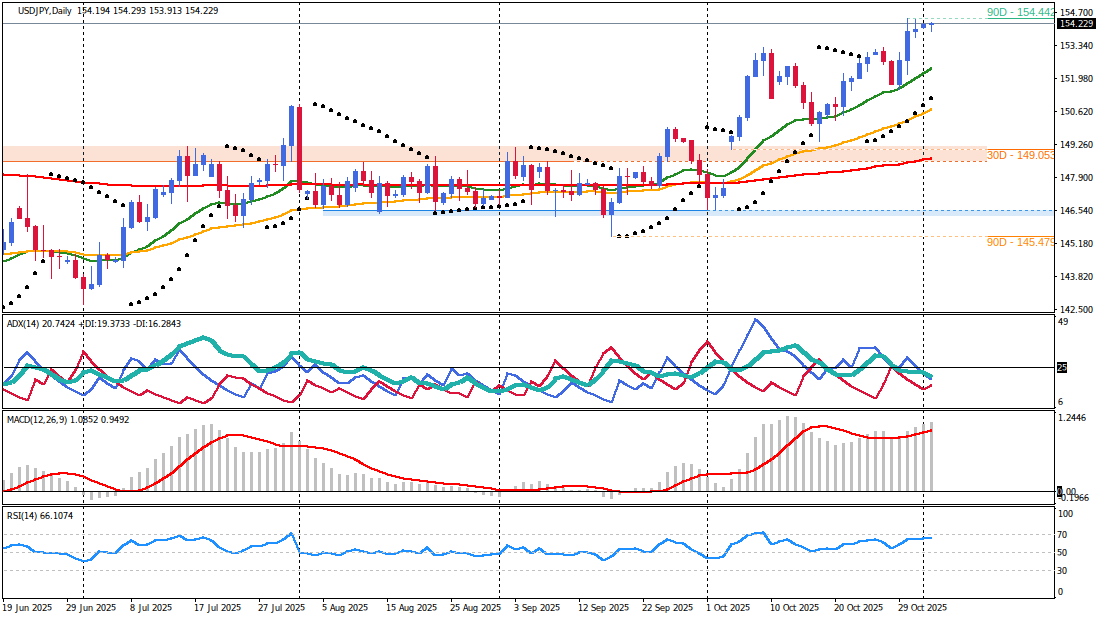
USD/JPY maintains a strong bullish posture across higher timeframes, driven by the Federal Reserve's hawkish tone and the Bank of Japan's continued gradual approach to policy normalization. Price consolidates near the 154.20 level, reflecting a pause in momentum after the recent rally, but the underlying technical structure remains firmly in favor of the upside. The market is pricing in a significantly lower probability of a December Fed rate cut, bolstering the US Dollar. Conversely, the BoJ's cautious stance, despite recent signals of a potential December hike, continues to weigh on the Japanese Yen. Critical US economic events later this week, including ADP Non-Farm Employment Change, ISM Services PMI, and the comprehensive Non-Farm Payrolls report, introduce substantial event risk that will dictate near-term directional conviction. The ongoing US government shutdown presents a fundamental headwind that could cap USD strength, but the policy divergence remains a dominant theme for USD/JPY.
Technical Analysis
Multi-Timeframe Market Structure
The dominant structure for USD/JPY remains strongly bullish on the daily timeframe. Price trades well above the EMA20 (152.385), EMA50 (150.695), and EMA200 (148.683), with all moving averages stacked in a clear uptrend configuration. This robust daily trend is fundamentally supported by the widening policy divergence between the Federal Reserve and the Bank of Japan, as the Fed maintains a hawkish bias while the BoJ proceeds with extreme caution. MACD is significantly positive at 1.084, reinforcing the strong bullish momentum, while RSI at 66.03 indicates strong buying pressure. Stochastic at 93.41 sits in overbought territory, a characteristic frequently observed in strong, sustained trends. ADX at 20.74 suggests a developing trend, with SAR at 151.149 confirming the established uptrend well below current price action.The medium-term framework on the H4 chart supports the bullish bias, with price positioned above the EMA20 (153.825), EMA50 (153.145), and EMA200 (151.134), maintaining a bullish alignment. MACD is positive at 0.371, confirming upward momentum. RSI at 63.92 indicates strength. However, ADX at 14.06 suggests a ranging or weak trend on this timeframe, implying a loss of directional conviction compared to the D1. This indicates that while the broader uptrend is intact, the pair is undergoing a period of consolidation, potentially influenced by market participants awaiting fresh fundamental catalysts from upcoming US economic data. The Parabolic SAR is at 154.421, currently above price, acting as a potential short-term resistance or an early warning of a potential shift in momentum.
The immediate intraday context on the H1/M30 charts shows a bullish bias but with signs of consolidation. On the H1 chart, price holds above the EMA20 (154.155) and EMA50 (153.996), indicating short-term strength. MACD remains positive (0.035), and RSI is at 56.15, suggesting neutral-to-bullish momentum. ADX at 18.19 points to a lack of strong intraday trend. M30 action refines this view, showing price trading near 154.214, slightly above its EMA20 (154.181). M30 Stochastic is in overbought territory at 75.38, while M30 ADX at 21.89 shows a developing trend, slightly stronger than H1. This combined assessment suggests a bullish lean, but execution timing should consider the current low volatility Asian session, favoring entries on pullbacks to support levels or confirmed breakouts above resistance. The intraday consolidation aligns with the market digesting the Fed's hawkish stance while awaiting further clarity from upcoming US labor market and services data.
Critical Price Levels & Momentum Assessment
The market exhibits strong bullish momentum on the daily chart, driven by fundamental policy divergence, but faces consolidation in the short-term. The current price action near 154.20 is a critical juncture, with immediate resistance at 154.250 (previous D1 high) and the H4 Parabolic SAR at 154.420 representing a significant ceiling. These levels are tested as the market assesses the implications of the Fed's hawkish tone against the backdrop of the US government shutdown and mixed US manufacturing data. Key intraday support lies at 154.150 (H1 EMA20) and 153.990 (H1 EMA50), while the H4 EMA20 at 153.825 provides a stronger medium-term dynamic support. A break above 154.250 would confirm renewed bullish conviction, likely fueled by positive US economic data or further hawkish Fed commentary. Conversely, a sustained break below 154.150 could signal a deeper pullback as profit-taking occurs or if upcoming US data disappoints, potentially exacerbated by concerns over the prolonged government shutdown.The trend consensus across D1, H4, H1, and M30 remains qualitatively bullish, but with varying degrees of strength. D1 indicators show strong momentum, while H4 and H1 ADX values suggest a moderate to weak trend development in the short-to-medium term, indicating a period of consolidation. Momentum quality is strong on D1, moderate on H4, and neutral-to-bullish on H1/M30. Current ATR on H1 is 0.1006, indicating moderate intraday volatility suitable for structured trades. The market is in a strong trend phase on D1, transitioning to a more ranging/consolidating phase on H4 and H1. Intraday momentum supports the higher timeframe bias but with less conviction, implying potential for short-term retracements. Signal confluence is moderate, with higher timeframes maintaining a strong bullish outlook, while intraday signals hint at a temporary pause. This suggests that while the long-term direction is clear, traders should be prepared for potential short-term volatility around upcoming economic releases.
Fundamental Market Drivers
Central Bank Policy & Economic Outlook
The primary fundamental driver for USD/JPY remains the significant divergence in monetary policy outlooks between the US Federal Reserve and the Bank of Japan. The Federal Reserve's recent 25 basis point rate cut was widely expected, but Chair Jerome Powell's subsequent hawkish tone, emphasizing risks of further reductions without a more solid economic picture, has significantly shifted market expectations. Traders have notably dialed back bets for further Fed rate cuts, with the CME FedWatch tool now indicating a nearly 70% possibility of a 25 bps cut in December, down sharply from about 94% a week ago. This re-pricing of Fed expectations provides strong fundamental support for the Greenback, reinforcing the bullish technical structure of USD/JPY. The upcoming speech by FOMC Member Waller will be closely watched for further clues on the Fed's stance.In contrast, the Bank of Japan's monetary policy continues to be characterized by a gradual approach, which weighs on the Japanese Yen. Last week, the BoJ left interest rates unchanged at 0.50% for the fifth consecutive meeting. While Governor Kazuo Ueda signaled a rate hike was possible as soon as December, markets remained underwhelmed by the central bank's cautious stance. Ueda reiterated the need for clearer evidence of sustained wage growth and stated the BoJ wants to "take a little longer to see how US tariff impacts would affect the Japanese economy." This contrasts sharply with the Fed's hawkish tilt, further widening the interest rate differential and supporting USD/JPY. Expectations that Japan's new Prime Minister Sanae Takaichi will pursue aggressive fiscal spending plans and resist policy tightening also dampen prospects for a hawkish BoJ shift.
Recent US economic data has presented a mixed picture. The US ISM Manufacturing PMI fell to 48.7 in October, below expectations of 49.5, signaling persistent contraction in factory activity for the eighth straight month. This data contributed to the US Dollar paring some early gains. However, a separate report from S&P Global showed a slightly brighter picture, with the final US Manufacturing PMI improving to 52.5. The ongoing US government shutdown, now in its sixth week and poised to become the longest in US history, introduces considerable uncertainty into the economic picture and could cap the upside for the USD, particularly as official data releases are delayed. This forces market participants to rely on private-sector proxies like the ADP Employment Change and JOLTS Job Openings for labor market insights.
Market Sentiment & Risk Environment
Market sentiment currently reflects a cautious optimism regarding the US economy, tempered by the prolonged government shutdown. The Fed's hawkish tilt has instilled confidence in the US Dollar, as traders reduce their expectations for aggressive rate cuts. This sentiment provides a strong tailwind for USD/JPY, aligning with the pair's bullish technical setup. However, the ongoing US federal government shutdown poses a significant risk to this optimistic outlook. As the shutdown extends, it creates economic uncertainty, with federal workers going unpaid, which could dampen consumer spending and overall economic activity. This situation has the potential to cap the upside for the USD, introducing a fundamental headwind that could contribute to short-term pullbacks, aligning with the alternative technical scenario.The Japanese Yen, traditionally seen as a safe-haven asset, is not currently benefiting from a strong risk-off environment, which would typically strengthen the JPY. Instead, the market's focus remains predominantly on policy divergence, with the BoJ's gradualism preventing any significant JPY appreciation from its safe-haven status. The lack of clear evidence of sustained wage growth in Japan and the potential for aggressive fiscal spending under the new Prime Minister further reinforce the view that the BoJ will remain accommodative for longer, limiting the Yen's appeal despite global uncertainties. Therefore, the current market sentiment largely supports the continuation of the USD/JPY uptrend, with the US government shutdown acting as a potential short-term dampener rather than a trend-reversing factor.
Integrated Trading Execution
Primary Trading Scenario
The technical structure combined with the Federal Reserve's hawkish tone and the Bank of Japan's gradual policy approach supports a bullish continuation in USD/JPY. The ongoing re-pricing of Fed rate cut expectations provides a strong fundamental catalyst for a break above immediate resistance.- Bias: Bullish
- Trigger/Entry: Buy on a confirmed M30 close above 154.253, targeting a breakout fueled by sustained USD strength.
- Stop-Loss: Place at 154.090, protecting against a false breakout and ensuring risk management below key intraday support.
- Profit Targets:
- Target 1: 154.420 (H4 SAR, offering a favorable R:R ~1:2.8, coinciding with a potential medium-term ceiling).
- Target 2: 154.600 (psychological level, R:R ~1:4.8, indicating continued momentum towards higher structural resistance).
- Session Context: Optimal for execution during London/NY session open for increased volatility and liquidity, especially if positive US economic data provides an immediate catalyst.
Alternative Market Scenario
Should USD/JPY fail to clear the 154.250 resistance, and instead sees a confirmed M30 close below the intraday support at 154.150, a deeper pullback is likely. This scenario could be triggered by weaker-than-expected US economic data or increased concerns surrounding the prolonged US government shutdown, leading to profit-taking on USD long positions.- Invalidation: A confirmed M30 close below 154.147 invalidates the primary bullish continuation scenario.
- Bias: Neutral/Short-term Bearish
- Trigger/Entry: Sell on a confirmed M30 close below 154.147, signaling a loss of intraday momentum and a potential retracement.
- Stop-Loss: Place at 154.200, above the immediate resistance, to manage risk effectively.
- Profit Targets:
- Target 1: 153.990 (H1 EMA50, R:R ~1:2.0, representing a significant intraday support base).
- Target 2: 153.825 (H4 EMA20, R:R ~1:3.7, acting as a stronger medium-term dynamic support).
- Session Context: More likely during the Asian session if momentum fades, or during the London session on weak sentiment following US economic releases.
Risk Management & Catalyst Analysis
Trade Risk Assessment
The confluence quality for USD/JPY is currently medium. While higher timeframes exhibit strong bullish confluence, supported by a hawkish Fed and gradual BoJ, the H4 and H1 ADX signals indicate weakening trend strength, suggesting a potential for consolidation or minor retracement. Intraday signals show a bullish bias but with moderate conviction. The current trading environment, transitioning from late NY to early Asian session, typically experiences lower liquidity and tighter ranges, increasing the risk of false breakouts or whipsaws. Session transitions (Asian to London) can introduce sudden volatility. The ongoing US government shutdown adds a layer of fundamental uncertainty that could exacerbate market reactions to economic data or prompt unexpected USD weakness. Position sizing guidance dictates using the H1 ATR (0.1006) for calculating stop-loss distance, with a 1.25x ATR multiplier appropriate for intraday stop-loss placement. For the primary scenario, this equates to approximately 12.5 pips. High-impact US events later this week, including ADP Non-Farm Employment Change, ISM Services PMI, and the comprehensive Non-Farm Payrolls report, pose significant event risk. Traders should reduce position size by 50% for any trades held within 4 hours of these releases. Intraday setups have limited validity given the upcoming economic calendar, requiring close monitoring of price action at the start of the London and New York sessions for confirmation or invalidation.Economic Calendar & Event Impact
The upcoming economic calendar features several high-impact US events that will significantly influence USD/JPY direction:- US ISM Manufacturing PMI (November 3, 15:00 UTC): Forecast 49.4, Previous 49.1 - Already released, showed contraction below expectations, contributed to initial USD pullback.
- US ISM Manufacturing Prices (November 3, 15:00 UTC): Forecast 62.4, Previous 61.9 - Already released, indicated rising prices.
- US ADP Non-Farm Employment Change (Tomorrow, 13:15 UTC): Forecast 31K, Previous -32K - High-impact labor market proxy, crucial for Fed policy expectations given official data delays.
- US ISM Services PMI (Tomorrow, 15:00 UTC): Forecast 50.7, Previous 50.0 - High-impact indicator for the dominant services sector, critical for overall economic health and Fed outlook.
- US FOMC Member Waller Speaks (November 6, 20:30 UTC): Medium-impact event - Any hawkish or dovish signals will influence USD direction.
- US Average Hourly Earnings m/m (November 7, 13:30 UTC): High-impact component of NFP, key for inflation and wage growth outlook.
- US Non-Farm Employment Change (November 7, 13:30 UTC): High-impact labor market report - The most significant US data point, will heavily influence Fed policy expectations.
- US Unemployment Rate (November 7, 13:30 UTC): High-impact labor market report - Crucial alongside NFP for assessing labor market health.
- US Prelim UoM Consumer Sentiment (November 7, 15:00 UTC): Forecast 53.0, Previous 55.0 - Medium-impact, provides insight into consumer confidence and spending outlook.
- US Prelim UoM Inflation Expectations (November 7, 15:00 UTC): Previous 4.6% - Medium-impact, closely watched by the Fed for inflation outlook.


