
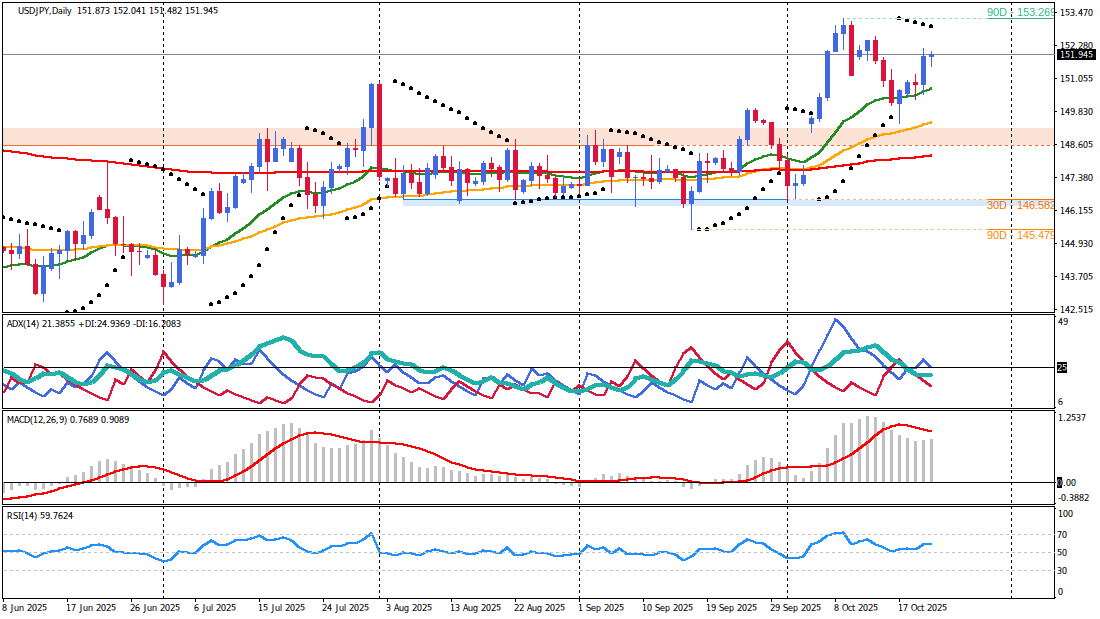
USD/JPY trades in a neutral to ranging bias in the short term, holding near multi-year highs as the market awaits critical US inflation data. While the daily timeframe maintains a robust bullish structure, supported by the ongoing policy divergence favoring the Federal Reserve, the immediate price action reflects caution and low liquidity ahead of tomorrow's high-impact US CPI and PMI releases. Fundamentally, the Bank of Japan's anticipated tightening path, with a Reuters poll showing 60% of economists expecting a rate hike to 0.75% in Q4, provides a counterbalancing force to the dominant USD strength. Japan's new Prime Minister Sanae Takaichi's substantial fiscal stimulus package, designed to ease inflation and boost household spending, further complicates the outlook by potentially alleviating some pressure on the BoJ to tighten aggressively in the near term, although polls suggest it will not delay the central bank's policy normalization. This interplay of US data-driven volatility, diverging central bank policies, and Japan's fiscal measures sets the stage for significant directional shifts following the upcoming catalysts.
Technical Analysis
Multi-Timeframe Market Structure
The dominant trend for USD/JPY on the daily (D1) timeframe remains strongly bullish, a trajectory fundamentally supported by the persistent interest rate differential between the US and Japan. Price trades well above the EMA20 (150.688), EMA50 (149.428), and EMA200 (148.206), with all moving averages aligned in a bullish configuration, signaling sustained upward momentum. The MACD is robustly positive at 0.765, reinforcing the long-term bullish conviction. The ADX at 21.39 indicates a developing trend, while the Parabolic SAR at 152.966 acts as a distant resistance, suggesting further upside potential.On the H4 timeframe, the bullish structure persists, with price above its EMAs. The MACD is positive at 0.255, and RSI is elevated at 61.82, with Stochastic in overbought territory at 84.22. However, the ADX is low at 17.56, indicating that the trend strength is not yet confirmed on this timeframe. This suggests a potential for consolidation or a pullback before the next significant move, aligning with market caution ahead of pivotal US economic data. The Parabolic SAR at 152.155 serves as immediate resistance.
The short-term intraday view (H1/M30) indicates a mixed bias within the broader uptrend, reflecting the current pre-event ranging environment. On H1, price is below the EMA20 (151.824) but above the EMA50 (151.612) and EMA200 (151.221). MACD is positive at 0.064, but Stochastic is overbought at 73.38, and ADX is low at 18.93. The M30 timeframe shows price above its EMAs, suggesting a slight recovery in immediate momentum. This combined view points to a short-term recovery within broader consolidation, lacking strong directional conviction due to overbought oscillators and weak trend strength indicators.
Critical Price Levels & Momentum Assessment
Key technical levels define the current consolidation range while the market absorbs fundamental inputs:- Resistance:
- 152.155 (H4 Parabolic SAR, near recent highs, crucial for a bullish continuation)
- 152.966 (D1 Parabolic SAR, strong long-term resistance that would require a significant fundamental catalyst to break)
- Support:
- 151.612 (H1 EMA50, a key intraday support level that could contain short-term dips)
- 151.221 (H1 EMA200, robust intraday support, a break below which would signal deeper retracement)
- 150.688 (D1 EMA20, strong structural support, holding this level maintains the daily bullish trend)
Momentum indicators across lower timeframes reflect a market in transition. Positive MACD readings suggest underlying bullish sentiment, but overbought Stochastic and relatively neutral RSI levels indicate short-term exhaustion. The ADX readings below 20 on H4 and H1 confirm a lack of strong trend development in the medium-to-short term, aligning with a ranging or transitional market phase. Volatility remains moderate, with H1 ATR at 0.173. This supports the expectation of range-bound movement as traders await the next fundamental impulse from US economic data.
Fundamental Market Drivers
Central Bank Policy & Economic Outlook
The fundamental landscape for USD/JPY is characterized by a significant divergence in central bank policies and economic outlooks. For the Bank of Japan (BoJ), the narrative strongly points towards policy normalization. A recent Reuters poll indicates that 60% of economists anticipate a rate hike to 0.75% in Q4, with 96% expecting this level by the end of Q1 2026. This aggressive tightening schedule reflects the BoJ's focus on exiting decades of ultra-loose monetary policy, providing a fundamental tailwind for the Japanese Yen. Japan's Economics Minister Minoru Kiuchi supports continued economic backing until wage growth strengthens and reiterates coordination with the BoJ to achieve stable inflation near 2%. The upcoming BoJ policy meeting on October 29-30 is a critical event that will likely clarify the central bank's near-term rate path, with any hawkish signals potentially challenging the prevailing USD/JPY uptrend.In contrast, the US Federal Reserve's policy outlook is heavily dependent on incoming economic data, particularly inflation. The delayed US CPI data for September, to be released tomorrow, will significantly influence market expectations for the Fed's monetary policy trajectory. While the US Dollar (USD) currently trades higher amid receding trade frictions between the US and China, the core driver for USD strength against the JPY remains the interest rate differential. The BoJ's gradual abandonment of ultra-loose policy, coupled with potential interest rate cuts in other major central banks, is narrowing this differential, which historically favored the US Dollar. Therefore, strong US inflation data supporting a hawkish Fed stance would reinforce the USD's position, while weaker data could accelerate the narrowing yield gap, providing JPY with fundamental support.
Market Sentiment & Risk Environment
Market sentiment for USD/JPY is currently driven by a confluence of Japanese fiscal policy, global risk dynamics, and the inherent safe-haven appeal of the Yen. Japan's new Prime Minister Sanae Takaichi is preparing a substantial economic stimulus package, reportedly exceeding $92 billion, aimed at easing inflation pressures and boosting household spending through fuel-tax cuts, energy subsidies, and investments in strategic industries. While 65% of economists express concerns over Japan's fiscal health, 67% believe these expansionary policies will not delay the BoJ's rate path, suggesting the central bank's commitment to normalization remains firm. This stimulus could temper some immediate inflationary pressures, potentially giving the BoJ more flexibility, but the long-term impact on the Yen is complex, as Takaichi has also promised looser monetary policy, which generally favors a weaker Yen to boost exporters.The Japanese Yen is often perceived as a safe-haven asset, attracting investor capital during periods of market stress. Recent reports indicate the Yen was lifted by gold-price volatility, igniting a rebalancing across safe-haven assets in its favor. This dynamic suggests that any deterioration in global risk sentiment could provide independent support for the JPY, potentially leading to a retracement in USD/JPY even if the yield differential remains wide. However, the current environment is primarily dominated by central bank policy divergence and the anticipation of high-impact US economic data. Japan's exports grew in September, particularly to Asia, despite US tariffs, indicating resilience in its trade sector. Nonetheless, exports to the US dropped, highlighting the ongoing impact of trade tensions on specific sectors like auto shipments. These factors collectively shape the risk environment, influencing the probability and magnitude of technical breakouts or reversals.
Integrated Trading Execution
Primary Trading Scenario
The prevailing market conditions, characterized by low liquidity and the imminent high-impact US economic events, strongly support a continuation of range-bound price action. This primary scenario involves trading within a tight consolidation range as the market awaits clear directional catalysts.- Bias: Neutral/Ranging - The technical structure, with overbought oscillators and low ADX on lower timeframes, aligns with fundamental caution ahead of US CPI and BoJ policy expectations.
- Trigger/Entry: Fade the extremes of the expected range. Consider selling near 151.900 (±3 pips) or buying near 151.750 (±3 pips). This strategy exploits the pre-event consolidation.
- Stop-Loss: For a sell entry near 151.900, place stop above 152.166. For a buy entry near 151.750, place stop below 151.484. These stops incorporate a buffer based on H1 ATR to manage intraday volatility within the range.
- Profit Targets:
- Target 1 (Sell): 151.750 (opposite end of the range)
- Target 2 (Sell): 151.612 (H1 EMA50, a strong intraday support)
- Target 1 (Buy): 151.900 (opposite end of the range)
- Target 2 (Buy): 152.000 (psychological level)
- Session Context: Best executed during the low-liquidity Asian session, prior to tomorrow's US economic data releases.
- Event Consideration: This scenario is strictly a pre-event trade. All positions must be closed before tomorrow's US CPI data release at 12:30 UTC, as the event has the potential to induce sharp, unpredictable moves.
Alternative Market Scenario
A decisive bullish breakout from the current consolidation could emerge, particularly if tomorrow's US economic data provides a strong bullish catalyst for the USD.- Invalidation: The primary ranging scenario is invalidated if price breaks decisively and closes above 152.000 on the H1 timeframe, indicating a shift in immediate market sentiment and technical momentum.
- Bias: Bullish - A strong US CPI report, reinforcing hawkish Fed expectations, would fundamentally support a move higher, aligning with the daily timeframe's dominant bullish trend.
- Trigger/Entry: A confirmed H1 candle close above 152.000 (±3 pips). This technical signal would require a preceding fundamental catalyst from the US data to gain sustainable traction.
- Stop-Loss: Place stop below the previous resistance turned support at 151.800.
- Profit Targets:
- Target 1: 152.155 (H4 Parabolic SAR, a significant resistance level)
- Target 2: 152.500 (psychological level, hinting at a test of higher structural resistance)
- Session Context: This scenario is highly dependent on the outcome of tomorrow's US economic events and would likely unfold during the London or New York sessions, driven by post-data volatility.
Risk Management & Catalyst Analysis
Trade Risk Assessment
The current market environment presents a medium confluence quality. While the daily timeframe strongly favors a bullish outlook, the shorter timeframes exhibit mixed signals, including overbought oscillators and weakening trend strength (low ADX), suggesting caution. This technical ambiguity is amplified by significant fundamental event risk. The ongoing low liquidity in the late New York/early Asian session increases the risk of exaggerated price movements on low volume or sudden spikes, making range-bound trading challenging. Tomorrow's cluster of high-impact US economic events (CPI, PMIs) poses a substantial event risk, capable of inducing extreme volatility and invalidating technical setups without warning. Any directional bias is highly susceptible to news flow, particularly regarding US inflation and its implications for Federal Reserve policy, as well as any unexpected commentary from the Bank of Japan regarding its tightening path.Position sizing should account for the elevated volatility and event risk. Utilize the H1 ATR (0.173) for precise stop-loss placement, with a 1.25x ATR stop implying a buffer of approximately 0.216 pips from the entry or key level. For any trades initiated within four hours of tomorrow's high-impact US CPI and PMI releases, reduce position size by 50% due to the elevated risk of unpredictable market reactions and potential for wide price swings.
Economic Calendar & Event Impact
The upcoming economic calendar features several high-impact events that will significantly influence USD/JPY, primarily centered on US economic data:- US Existing Home Sales (Today, 14:00 UTC): Forecast 4.06M, Previous 4.00M - Medium impact event, providing insight into the US housing market health, which indirectly influences broader economic sentiment and Fed policy expectations.
- US Core CPI m/m (Tomorrow, 12:30 UTC): Forecast 0.3%, Previous 0.3% - High-impact event. This inflation gauge is critical for Federal Reserve policy. A higher-than-forecast reading would strengthen hawkish Fed expectations, likely boosting the USD.
- US CPI m/m (Tomorrow, 12:30 UTC): Forecast 0.4%, Previous 0.4% - High-impact event. The overall monthly inflation figure, alongside core CPI, will directly influence market pricing of Fed rate hikes or cuts. Stronger data supports USD.
- US CPI y/y (Tomorrow, 12:30 UTC): Forecast 3.1%, Previous 2.9% - High-impact event. The annual inflation rate is a key determinant of the Fed's long-term policy stance. A significant increase would reinforce USD strength and widen yield differentials.
- US Flash Manufacturing PMI (Tomorrow, 13:45 UTC): Forecast 51.9, Previous 52.0 - High-impact event. Manufacturing sector health provides a leading indicator for economic growth. Stronger-than-expected data supports a robust US economy, favoring USD.
- US Flash Services PMI (Tomorrow, 13:45 UTC): Forecast 53.5, Previous 53.9 - High-impact event. The services sector is a major contributor to US GDP. A strong reading would reinforce positive economic sentiment and USD demand.
These events collectively shape Federal Reserve policy expectations and will determine near-term USD/JPY direction. The BoJ's next policy meeting on October 29-30 is also a crucial future catalyst for the JPY, with market participants closely watching for further signals on its tightening trajectory.
Synthesized Market Outlook
USD/JPY remains at a critical juncture, balancing a strong underlying long-term bullish technical trend with immediate short-term consolidation driven by significant fundamental event risk. The daily timeframe's robust bullish structure, supported by the ongoing interest rate differential favoring the US, provides a clear directional bias for long-term traders. However, the market's immediate focus is squarely on tomorrow's cluster of high-impact US inflation and PMI data, which will dictate the Federal Reserve's monetary policy outlook and thus the near-term trajectory of the US Dollar.Concurrently, the Bank of Japan's anticipated shift towards policy tightening, highlighted by a Reuters poll forecasting a rate hike to 0.75% in Q4 2025, introduces a significant counter-force. This expected BoJ hawkishness, combined with Japan's substantial fiscal stimulus package, creates a complex fundamental backdrop for the Yen. While the stimulus aims to mitigate inflation and boost growth, market participants believe it will not deter the BoJ from its normalization path, potentially narrowing the yield differential and offering support to the JPY.
For trading execution, the current low-liquidity environment strongly favors range-bound strategies up until the US CPI release. Traders should monitor the 151.700-151.950 range closely, with strict adherence to risk management and a clear exit strategy before the data. A decisive break above 152.000, particularly if supported by strong US inflation figures, would confirm a bullish continuation towards 152.155 and potentially 152.500. Conversely, a weak US data print could trigger a retracement, testing immediate support at 151.612 and 151.221, as the market recalibrates Fed expectations and potentially amplifies JPY strength from BoJ tightening bets. The integrated market view emphasizes cautious positioning and a readiness to react swiftly to the outcomes of tomorrow's pivotal US economic events.


