
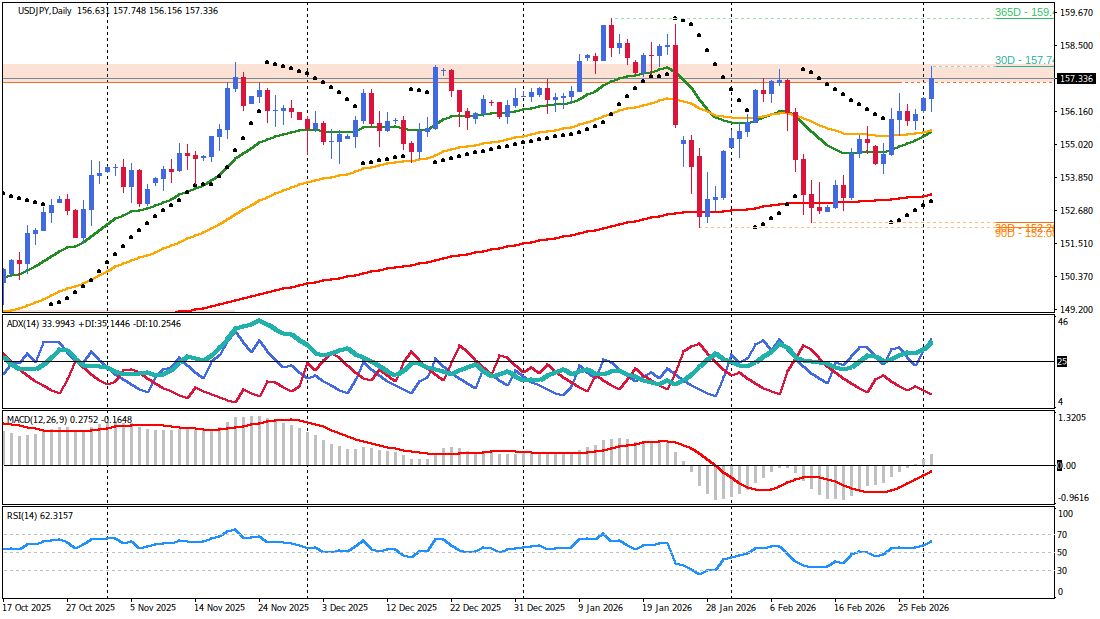
The USD/JPY pair maintains a predominantly bullish technical bias as it navigates a complex intersection of central bank policy shifts and escalating geopolitical risks. While the daily and four-hour timeframes exhibit a clear uptrend supported by strong US manufacturing data, short-term momentum shows signs of exhaustion ahead of critical Japanese policy signals. The fundamental narrative is currently dominated by the high-impact speech from Bank of Japan (BoJ) Governor Ueda, which follows hawkish rhetoric from Deputy Governor Himino regarding the potential for moderate interest rate hikes. Technical structure combined with the resilient US economic backdrop supports a continuation of the primary uptrend, though recent weakness in Japanese labor market data and heightened Middle East tensions introduce significant volatility. Market participants are bracing for a heavy economic calendar, starting with BoJ guidance today and culminating in the US Non-Farm Payrolls report, which will determine if the pair can successfully challenge the 158.000 psychological barrier or if a deeper correction toward structural support is required.
Technical Analysis
Multi-Timeframe Market Structure
The primary trend on the daily (D1) chart remains firmly bullish, characterized by price action sustained well above the key 20-day Exponential Moving Average (EMA) at 155.464 and the 200-day EMA at 153.232. This long-term structure aligns with the fundamental divergence between a resilient Federal Reserve and a BoJ only beginning its tightening cycle. The Daily Relative Strength Index (RSI) at 61.75 and a positive Moving Average Convergence Divergence (MACD) confirm that buyers retain control of the broader trend. However, the four-hour (H4) framework reveals emerging momentum exhaustion. With the H4 RSI at 62.47 and the Stochastic oscillator reaching 82.54, the pair is technically overbought in the medium term. The recent bearish close on the H4 candle after testing 157.747 suggests that sellers are defending recent highs, potentially anticipating a fundamental catalyst from the BoJ.
On the intraday timeframes (H1 and M30), the technical picture is neutral to slightly bearish. The H1 RSI has retreated to 56.42, indicating a loss of upward velocity, while the M30 RSI at 48.22 reflects price consolidation within a narrow range. This intraday indecision aligns with the fundamental backdrop of market participants "waiting for Ueda," as technical levels often lose predictive power immediately preceding high-impact central bank communications. The current consolidation below session highs suggests a lack of conviction to push higher without a fresh fundamental trigger.
Critical Price Levels & Momentum Assessment
Technical resistance is currently concentrated at 157.747, the recent H4 high, which serves as the final gateway to the 158.000 psychological level. A firm break above this zone would signal the resumption of the daily uptrend toward the multi-week high of 159.44. Conversely, immediate support is identified at 157.116, which aligns with the H1 EMA20. A more significant structural floor exists at 156.478, representing the H4 EMA20. Fundamental factors, such as the recent Japanese unemployment rate rising to 2.7% and a lower-than-expected jobs-to-applicants ratio, suggest that while the BoJ may wish to hike rates, the domestic economic data remains fragile, potentially making these support levels susceptible to deep tests if BoJ rhetoric turns unexpectedly dovish.
Fundamental Market Drivers
Central Bank Policy & Economic Outlook
The Bank of Japan is at a critical juncture, with Governor Ueda’s speech today serving as a primary volatility driver. Recent comments from Deputy Governor Himino have set a hawkish tone, suggesting that the central bank should proceed with moderate rate hikes if economic projections are met. This hawkish shift aims to unwind the ultra-loose monetary policy that has historically pressured the Yen. However, the fundamental outlook for Japan is complicated by recent labor market data; the unemployment rate in January rose to 2.7%, exceeding expectations, while the jobs-to-applicants ratio fell to 1.18. These data points suggest that the BoJ’s path toward normalization may be more cautious than the market anticipates.
In contrast, the US Dollar finds support from a resilient economy. The US ISM Manufacturing PMI for February came in at 52.4, exceeding the forecast of 51.8. This upbeat report complicates the Federal Reserve's path toward rate cuts, as strong manufacturing activity and rising prices reduce the urgency for monetary easing. The persistent policy divergence—where the Fed remains in a "higher for longer" stance while the BoJ is only tentatively moving away from near-zero rates—continues to provide the fundamental fuel for the USD/JPY uptrend.
Market Sentiment & Risk Environment
Geopolitical risks have re-emerged as a significant factor for the Japanese Yen. The ongoing conflict in the Middle East, specifically the US and Israel’s actions regarding Iran, has increased the demand for safe-haven assets. President Trump’s recent statement that military operations could continue for weeks has heightened fears of a wider regional war. Because the Yen is traditionally viewed as a safe-haven currency, these geopolitical jitters provide a natural floor for the JPY, creating a "tug-of-war" between the carry-trade-driven USD/JPY uptrend and the risk-off demand for Yen. This environment increases the probability of sharp, event-driven reversals that can temporarily override technical trendlines.
Integrated Trading Execution
Primary Trading Scenario
- Bias: Post-Event Bullish Continuation supported by technical trend alignment and US economic resilience.
- Trigger/Entry: Long entry on a bullish reversal signal (e.g., pin bar or engulfing candle) on the H1 timeframe following the BoJ speech, specifically targeting a bounce from the 157.116 support or a breakout above 157.747.
- Stop-Loss: 156.850, placed below the immediate swing low to account for post-event volatility.
- Profit Targets:
- Target 1: 157.747 - This level represents today's H4 high and a significant technical resistance point.
- Target 2: 158.000 - A major psychological level and the gateway to retesting year-to-date highs.
- Session Context: Execution is preferred during the transition from the Asian to the London session, once the initial volatility from Governor Ueda's speech has stabilized.
Alternative Market Scenario
- Invalidation: A hawkish surprise from Governor Ueda or a significant escalation in Middle East conflict that triggers a sustained break below 157.000.
- Bias: Event-Driven Bearish Pullback targeting overextended technical levels.
- Trigger/Entry: Sell entry on a confirmed H1 candle close below 157.000 with high volume following a hawkish BoJ catalyst.
- Stop-Loss: 157.250, positioned above the breakdown point to manage risk against a potential false break.
- Profit Targets:
- Target 1: 156.478 - The H4 EMA20, which serves as a major structural support cluster.
- Target 2: 155.500 - Alignment with the daily EMA20 and a critical psychological support zone.
- Session Context: This scenario requires an immediate reaction to the BoJ speech at 04:00 UTC today.
Risk Management & Catalyst Analysis
Trade Risk Assessment
The trade risk for USD/JPY is currently rated as high due to the convergence of central bank rhetoric and geopolitical instability. While technical timeframes are aligned bullishly, the overbought conditions on the H4 chart suggest that the pair is vulnerable to a "buy the rumor, sell the fact" reaction following the BoJ event. Furthermore, the thinning liquidity during the late New York and early Asian sessions can lead to exaggerated price swings. Traders should consider reducing position sizes by 50% ahead of the BoJ speech and utilize wider stop-losses (approximately 40-45 pips) to accommodate the elevated Average True Range (ATR) associated with high-impact news events.
Economic Calendar & Event Impact
The following high-impact events are critical for USD/JPY price action throughout the remainder of the week:
- JN BOJ Gov Ueda Speaks (Today, 04:00 UTC): High Impact - Direct influence on Yen valuation and BoJ policy expectations.
- US ADP Non-Farm Employment Change (Tomorrow, 13:15 UTC): Forecast 49K, Previous 22K - Early indicator of US labor market strength.
- US ISM Services PMI (Tomorrow, 15:00 UTC): Forecast 53.5, Previous 53.8 - Key measure of US economic health in the services sector.
- US Unemployment Claims (March 5, 13:30 UTC): Forecast 215K, Previous 212K - Weekly gauge of labor market cooling or resilience.
- US Non-Farm Employment Change (March 6, 13:30 UTC): Forecast 58K, Previous 130K - The most significant monthly data point for Fed policy and USD direction.
- US Unemployment Rate (March 6, 13:30 UTC): Forecast 4.3%, Previous 4.3% - Critical for assessing the overall health of the US economy.
Synthesized Market Outlook
The outlook for USD/JPY remains cautiously bullish, as the technical uptrend is well-supported by a strong US manufacturing sector and a Federal Reserve that is in no rush to cut rates. However, the path higher is increasingly fraught with fundamental obstacles. The BoJ is clearly signaling a desire to normalize policy, and any concrete steps or hawkish surprises from Governor Ueda today could trigger a significant JPY recovery. Furthermore, the safe-haven appeal of the Yen amid Middle East tensions acts as a persistent headwind for the pair. Traders should monitor the 157.747 resistance level closely; a failure to break higher following the BoJ speech would suggest that the market has priced in the current divergence and may be ready for a technical correction. Conversely, if the BoJ remains cautious and US labor data later this week exceeds expectations, a move toward 160.00 becomes the primary objective. Risk management remains paramount, with 156.478 serving as the line in the sand for the current bullish structure.

