
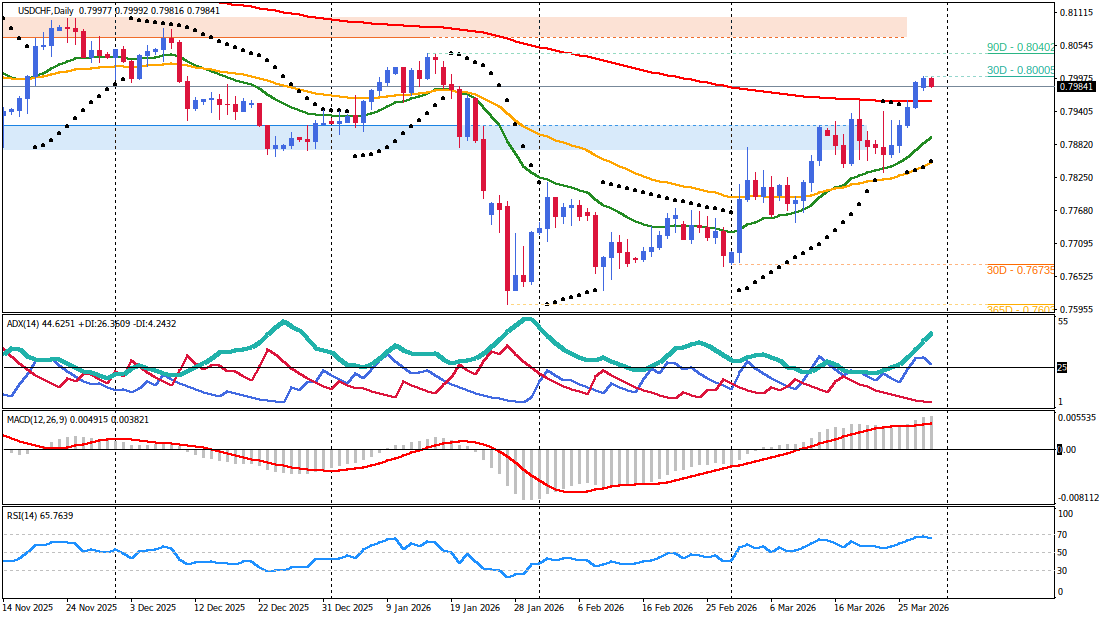
The USD/CHF pair is currently positioned at a critical technical and fundamental junction, trading just below the 0.8000 psychological barrier as markets digest a complex backdrop of geopolitical instability and shifting monetary policy expectations. Technical structure combined with the intensifying conflict in the Middle East supports a primary bullish bias, as the US Dollar continues to leverage its global reserve status. While the pair has touched fresh highs not seen since mid-January, price action remains tethered to the 0.8000 handle, awaiting a definitive catalyst from Federal Reserve Chair Powell's scheduled remarks. The prevailing market environment reflects a "risk-off" sentiment that traditionally benefits both the Greenback and the Swiss Franc, yet the USD is currently outperforming due to surging energy prices and the resulting hawkish shift in US interest rate projections. Traders are focused on whether the strong daily uptrend can overcome extreme overbought conditions to establish a new structural base above 0.8000, or if a mean-reversion move toward 0.7955 is required to neutralize momentum before the next leg higher.
Technical Analysis
Multi-Timeframe Market Structure
The primary trend assessment on the daily (D1) timeframe remains decisively bullish. Price action maintains a consistent position above the 20-day, 50-day, and 200-day Exponential Moving Averages (EMAs). The D1 EMA200 at 0.79575 serves as a significant long-term pivot, while the Average Directional Index (ADX) reading of 44.63 confirms the presence of a very strong trend. However, the technical structure is currently strained by extreme overextension, as evidenced by a Stochastic reading of 95.47. This suggests that while the directional bias is upward, the immediate upside may be limited without a period of consolidation.
On the medium-term H4 framework, momentum remains robust with an ADX of 62.45, reflecting the intensity of the recent rally from the 0.7603 lows. Despite this strength, price action has flattened significantly near 0.7986, and the Relative Strength Index (RSI) is beginning to slope downward from overbought territory. Price action aligns with fundamental uncertainty to favor a temporary pause in the rally. The short-term H1 and M30 charts show a shift toward a neutral-to-bullish consolidation. As long as the intraday support at 0.7980 (H1 EMA20) holds, the path of least resistance remains toward the 0.8000 barrier. A unified intraday bias suggests that buyers are defending minor dips in anticipation of a fundamental breakout trigger.
Critical Price Levels & Momentum Assessment
Technical levels are currently defined by the following parameters:
- Resistance 0.8000: This is the primary psychological level and recent session high. A decisive daily close above this level is required to confirm trend extension toward the 38.2% Fibonacci retracement of the 0.9200 to 0.7603 move, situated near 0.8213.
- Resistance 0.8015: Represents a short-term extension target and a known supply zone where selling pressure has historically intensified.
- Support 0.7980: The immediate intraday support zone, bolstered by the H1 EMA20 and recent M15 structural lows.
- Support 0.7955: A high-confluence zone featuring the D1 EMA200 and H4 EMA20. This level is critical for maintaining the current bullish momentum.
Momentum quality is currently categorized as moderate. While the ADX indicates extreme trend strength, the exhaustion signals from the Stochastic and RSI indicators suggest that momentum is reaching a point of diminishing returns. Volatility is expected to expand significantly during the New York session, particularly as the H1 Average True Range (ATR) typically doubles during major central bank communications.
Fundamental Market Drivers
Central Bank Policy & Economic Outlook
The fundamental narrative for USD/CHF is heavily influenced by the divergence in central bank outlooks and the impact of global inflation drivers. The Swiss National Bank (SNB) maintains a policy aimed at keeping annual inflation below 2%, meeting only four times a year. In contrast, the Federal Reserve's more frequent meeting schedule and the recent surge in US inflation fears have placed the USD in a position of relative strength. Rising crude oil prices, driven by the effective closure of the Strait of Hormuz and Houthi attacks in the Bab el-Mandeb Strait, are fueling global inflation concerns. This fundamental backdrop supports hawkish Fed expectations, as higher energy costs necessitate a more restrictive monetary stance to curb price growth.
Technical structure combined with these inflationary pressures supports the USD's outperformance. While the Swiss Franc is a traditional safe-haven, its high correlation with the Eurozone—where economic momentum remains fragile—often limits its gains against a resurgent US Dollar. The SNB's policy rate decisions are closely watched, but the current market focus is squarely on the Fed's response to labor market tightness and retail resilience. Upcoming US JOLTS and Non-Farm Payroll data will be essential in determining if the Fed has the latitude to maintain higher rates for longer, a scenario that would fundamentally validate a breakout above 0.8000.
Market Sentiment & Risk Environment
Market sentiment is dominated by escalating geopolitical risks in the Middle East. Reports of the Pentagon preparing for ground operations in Iran and continued missile launches by Houthi rebels have created a "flight to quality" environment. While both the USD and CHF serve as safe-haven assets, the USD currently benefits from its status as the global reserve currency and the primary denominator for energy markets. The US-Iran conflict entering a dangerous new phase provides a significant tailwind for USD/CHF, as traders seek the liquidity and yield advantage offered by the Greenback.
Price action aligns with this risk-off sentiment, though the lack of immediate follow-through buying above 0.8000 suggests a degree of caution. Investors are weighing the potential for a ceasefire or de-escalation against the reality of disrupted global trade routes. The perceived status of Switzerland as a stable, neutral economy provides a floor for the Franc, but until there is a clear shift in the US interest rate trajectory or a significant cooling of geopolitical tensions, the fundamental bias favors the USD.
Integrated Trading Execution
Primary Trading Scenario
- Bias: Bullish continuation supported by high-trend ADX readings and hawkish Fed expectations amid geopolitical risk.
- Trigger/Entry: Long entry on a definitive H1 candle close above 0.8005, signaling a breach of psychological resistance.
- Stop-Loss: 0.7989, placed below the recent H1 swing low to protect against false breakouts.
- Profit Targets:
- Target 1: 0.8030 - Aligning with short-term liquidity pools above the 0.8000 handle.
- Target 2: 0.8050 - Structural resistance level and psychological extension target.
- Session Context: Execution is optimized for the New York session following the initial market reaction to Fed Chair Powell's remarks at 14:30 UTC.
Alternative Market Scenario
- Invalidation: Failure to breach 0.8000 followed by an M30 close below the 0.7980 support level.
- Bias: Bearish mean-reversion/pullback justified by overbought technical indicators and potential "buy the rumor, sell the fact" behavior.
- Trigger/Entry: Short entry on an M30 close below 0.7980 with bearish confirmation.
- Stop-Loss: 0.7995, positioned just below the major psychological resistance.
- Profit Targets:
- Target 1: 0.7955 - Confluence of the H4 EMA20 and D1 EMA200.
- Target 2: 0.7940 - Structural support from the previous consolidation phase.
- Session Context: This scenario becomes relevant if Powell's commentary is perceived as dovish or if geopolitical tensions show unexpected signs of cooling before the London close.
Risk Management & Catalyst Analysis
Trade Risk Assessment
The technical breakout probability is currently rated as medium due to the proximity of high-impact event risk. The primary risk involves liquidity gaps and sharp volatility spikes during the 14:30 UTC window today. Given the extreme overbought readings on the D1 and H4 timeframes, there is a heightened risk of a "bull trap" if the 0.8000 level is breached only briefly before reversing. Traders should consider reducing position sizes by 50% until the market stabilizes post-Powell. A minimum 1.5x ATR buffer on H1 charts is recommended for stop-loss placement to account for increased intraday volatility.
Economic Calendar & Event Impact
The following high-impact events are scheduled for the current trading week and will dictate USD/CHF volatility:
- US Fed Chair Powell Speaks (Today, 14:30 UTC): Critical for determining the sustainability of the USD rally; hawkish tones will likely force a break of 0.8000.
- US JOLTS Job Openings (Tomorrow, 14:00 UTC): Forecast 6.90M, Previous 6.95M - A key indicator of labor market tightness affecting Fed policy.
- US ADP Non-Farm Employment Change (April 1, 12:15 UTC): Forecast 42K, Previous 63K - Leading indicator for Friday's payroll data.
- US ISM Manufacturing PMI (April 1, 14:00 UTC): Forecast 52.3, Previous 52.4 - Measures industrial health and inflationary pressures within the manufacturing sector.
- US Unemployment Claims (April 2, 12:30 UTC): Forecast 212K, Previous 210K - Weekly gauge of labor market resilience.
- US Non-Farm Employment Change (April 3, 12:30 UTC): Forecast 56K, Previous -92K - The primary market mover for USD direction and interest rate expectations.
- US Unemployment Rate (April 3, 12:30 UTC): Forecast 4.4%, Previous 4.4% - Critical for long-term economic outlook and SNB/Fed policy divergence.
Synthesized Market Outlook
The outlook for USD/CHF remains fundamentally and technically tilted toward the upside, provided the 0.8000 resistance can be converted into support. Technical structure combined with geopolitical instability in the Middle East supports the Greenback's dominance, yet the extreme overbought conditions on daily charts demand caution. The market is effectively in a "wait-and-see" mode ahead of Chair Powell's speech, which serves as the immediate hurdle for trend continuation. Monitoring the 0.7980 support level is essential; a sustained break below this point would signal that the market requires a deeper correction toward the 0.7955 confluence zone before attempting another rally. Conversely, a daily close above 0.8000 would open the path toward 0.8213, aligning with the broader corrective recovery of the long-term downtrend. Traders should prioritize risk management during the heavy US data cycle this week, as employment and retail figures will provide the final confirmation for the pair's next medium-term direction.


