
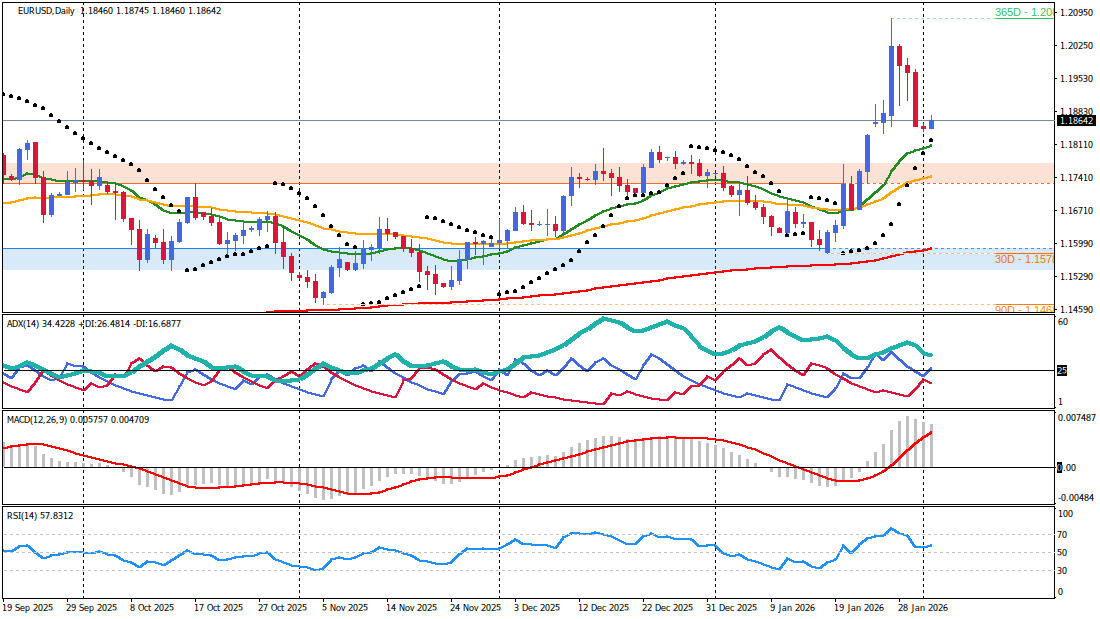
The EUR/USD pair enters the first week of February under significant selling pressure, currently navigating a sharp corrective phase within its dominant long-term uptrend. The technical structure combined with the fundamental shift in US dollar appeal following the nomination of Kevin Warsh as the next Federal Reserve Chairman supports a bearish intraday bias. While the pair remains structurally bullish on the daily timeframe, aggressive selling in the H1 and H4 periods has brought price action to a critical juncture at the 1.1840-1.1850 support zone. This technical vulnerability aligns with a fundamental backdrop where cooling Eurozone inflation expectations are beginning to outweigh recent resilient GDP data, potentially paving the way for the European Central Bank (ECB) to adopt a more accommodative stance. As investors weigh the prospect of a "strong dollar" advocate at the Fed against a softening price environment in Europe, the 1.1804 level emerges as the critical line in the sand for the broader bullish trend.
Technical Analysis
Multi-Timeframe Market Structure
The dominant structure on the daily (D1) timeframe remains bullish as the pair maintains its position above the EMA20, EMA50, and EMA200. However, the previous session's large bearish candle indicates a significant shift in market sentiment, with the RSI cooling from overbought levels to 56.86. The market is currently seeking a new higher low, and the 1.1804 level, representing the D1 EMA20, serves as the primary structural floor. A sustained close below this level would signal a deeper trend reversal rather than a simple correction.
On the H4 timeframe, the medium-term framework has transitioned into a neutral-to-bearish state. Price has breached the EMA20 and is currently testing the EMA50 at 1.1859. While the Stochastic indicator is deeply oversold at 6.71, suggesting the potential for a relief rally, the rising ADX at 35.89 confirms that the downward momentum possesses significant strength. This suggests that any short-term bounce may be met with further selling unless a definitive exhaustion spike occurs.
The immediate trading bias on the H1 timeframe is strongly bearish, characterized by a powerful ADX reading of 50.50. This indicates high-velocity selling. Price is trading well below the H1 EMA20 at 1.1890, which now serves as the primary intraday resistance. While oscillators show extreme oversold conditions, the lack of a bullish EMA cross suggests that the path of least resistance remains to the downside heading into the US session.
Critical Price Levels & Momentum Assessment
Technical levels are currently defined by the following zones:
- Resistance 1.1890 - 1.1910: This is the confluence of the H1 and H4 EMA20. It represents the primary pivot zone for intraday bearishness. A failure to reclaim this area keeps the immediate pressure on support.
- Resistance 1.1970: This marks the recent swing high and structural resistance that must be cleared to re-establish the bullish trend.
- Support 1.1840: The recent intraday low and the H4 EMA50 junction. This is the immediate battleground for bulls.
- Support 1.1804: The D1 EMA20. This is the most critical support for the long-term trend; a break here invalidates the current bullish cycle.
- Support 1.1740: The D1 EMA50 and H4 EMA200 confluence, acting as a secondary structural floor.
Fundamental Market Drivers
Central Bank Policy & Economic Outlook
The fundamental narrative is currently dominated by the nomination of Kevin Warsh as the successor to Jerome Powell at the Federal Reserve. Markets have reacted positively to this news, as Warsh is historically associated with a preference for a strong US dollar and central bank autonomy. This has provided a significant boost to the US Dollar Index (DXY), which is currently clinging to gains near its weekly high of 97.33. The anticipation of a potentially more hawkish or "strong-dollar" Fed policy is creating a headwind for EUR/USD that technical indicators are now reflecting.
In the Eurozone, the focus shifts to the preliminary Harmonized Index of Consumer Prices (HICP) data. Inflation is expected to cool to 1.7% on an annualized basis, down from the previous 1.9%. This cooling of price pressures aligns with technical bearishness, as it increases the probability of the ECB moving toward interest rate cuts. While recent Q4 GDP data showed a resilient Eurozone economy, the primary driver for the ECB remains price stability. If inflation continues to trend toward or below the 2% target, the fundamental support for the Euro will likely erode, making the technical support at 1.1804 even more vulnerable.
Market Sentiment & Risk Environment
Market sentiment has shifted toward USD-favoritism following the removal of some political uncertainty in the US. The avoidance of a government shutdown and the clarity on Fed leadership have stabilized the greenback. Conversely, the Euro is struggling to find buyers as the market anticipates a data-heavy week. Risk sentiment remains cautious, with technical momentum indicators like the H1 ADX above 50 suggesting that the current selling is not yet exhausted. This "risk-off" posture toward the Euro supports the primary bearish technical scenario, as traders prefer the liquidity and yield prospects of the dollar ahead of the high-impact NFP and ECB events later this week.
Integrated Trading Execution
Primary Trading Scenario
- Bias: Bearish continuation supported by USD strength and cooling EZ inflation expectations.
- Trigger/Entry: A sustained M30 candle close below 1.1840 or a failed retest and rejection at the 1.1890 resistance zone.
- Stop-Loss: 1.1920, placed above the H4 EMA20 to protect against intraday volatility.
- Profit Targets:
- Target 1: 1.1805 - Alignment with the critical D1 EMA20 structural support.
- Target 2: 1.1750 - Secondary structural floor near the D1 EMA50.
- Session Context: Best executed during the US session overlap, specifically around the ISM Manufacturing PMI release.
Alternative Market Scenario
- Invalidation: A failure of the US ISM data to meet expectations combined with a hold of the 1.1840 support level.
- Bias: Mean-reversion rally based on extreme technical oversold conditions.
- Trigger/Entry: A bullish engulfing pattern on the M30 timeframe at the 1.1840 level.
- Stop-Loss: 1.1810, just below the psychological support level.
- Profit Targets:
- Target 1: 1.1890 - Retest of the H1 EMA20 resistance.
- Target 2: 1.1940 - Extension toward the H4 pivot.
- Session Context: Requires a fundamental catalyst, such as a weak US PMI print, to overcome existing bearish momentum.
Risk Management & Catalyst Analysis
Trade Risk Assessment
The primary risk to the bearish outlook is the extreme oversold state of intraday oscillators. With the H1 Stochastic at 4.59, the pair is susceptible to sharp, news-driven short-covering rallies. Furthermore, the divergence between the bullish daily trend and the bearish intraday momentum creates a high-risk environment for trend-followers. Traders should consider reducing position sizes by half until the initial volatility from today's US ISM data subsides. Using a stop-loss protocol of 1.5x ATR (approximately 32 pips) is recommended to avoid being stopped out by noise during session transitions.
Economic Calendar & Event Impact
The following high-impact events are scheduled for the current trading week:
- US ISM Manufacturing PMI (Today, 15:00 UTC): Forecast 48.5, Previous 47.9 - A strong beat would likely trigger a break of 1.1840.
- US JOLTS Job Openings (Tomorrow, 15:00 UTC): Forecast 7.21M, Previous 7.15M - Critical for assessing labor market tightness and Fed policy.
- EZ CPI Flash Estimate y/y (February 4, 10:00 UTC): Forecast 1.8%, Previous 2.0% - Lower inflation will reinforce ECB cut expectations.
- US ISM Services PMI (February 4, 15:00 UTC): Forecast 53.6, Previous 54.4 - Key indicator for US economic resilience.
- EZ Main Refinancing Rate (February 5, 13:15 UTC): Forecast 2.15%, Previous 2.15% - Markets watch for forward guidance shifts.
- EZ ECB Press Conference (February 5, 13:45 UTC): High-impact event; Lagarde's tone on Euro strength will be vital.
- US Non-Farm Employment Change (February 6, 13:30 UTC): Forecast 67K, Previous 50K - The primary volatility driver for the week's close.
Synthesized Market Outlook
The EUR/USD is currently caught between a long-term bullish structural trend and a powerful intraday bearish correction. The fundamental catalyst of the Warsh nomination has rejuvenated the US dollar, while cooling inflation in the Eurozone provides the ECB with the justification to remain patient or even pivot toward easing. Technically, the pair is "stretched" to the downside on intraday charts, but the strength of the momentum (ADX > 50) suggests that the 1.1840 support is under severe threat. Traders should monitor the 1.1804 level closely; a daily close below this mark would signal that the multi-year bullish thesis is being fundamentally re-evaluated. Conversely, a successful defense of 1.1840 coupled with a miss in US manufacturing data could spark a sharp mean-reversion move back toward 1.1900.


