
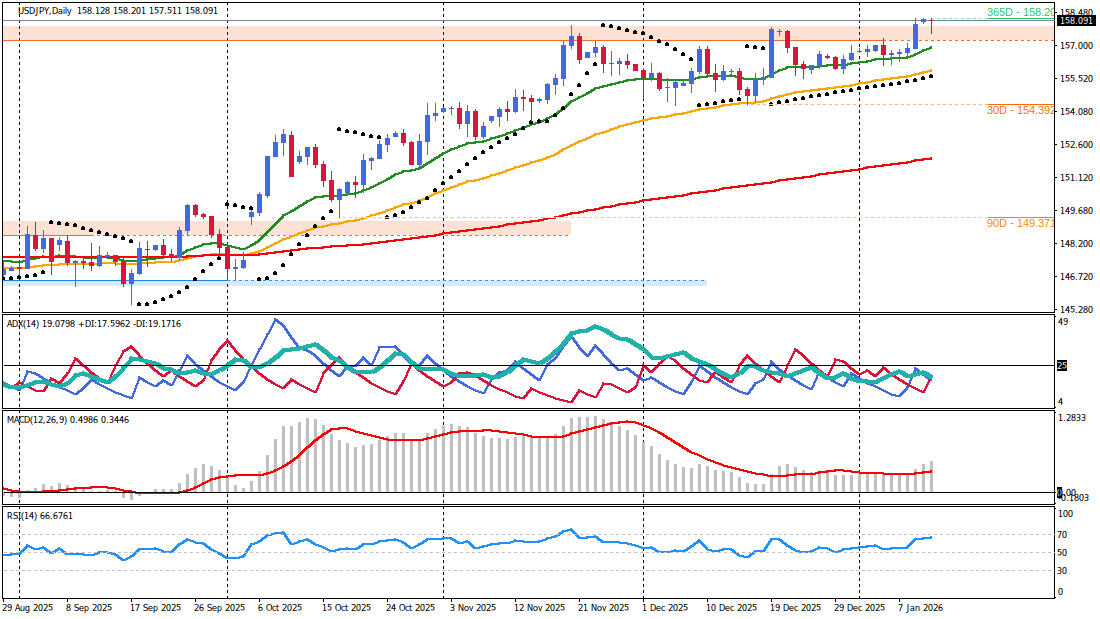
The USD/JPY maintains a high-confidence bullish bias as the pair enters a critical juncture, characterized by a structural uptrend confronting formidable resistance near the 158.20 level. Technical structure combined with the widening US-Japan yield spread supports the prevailing uptrend, although price action is currently in a consolidation phase ahead of high-impact US inflation data. The fundamental narrative is increasingly complex, as domestic political uncertainty in Japan—stemming from reports of a potential early general election in February—collides with renewed concerns regarding Federal Reserve independence in the United States. While the primary trend remains aggressively bullish on higher timeframes, the market is currently navigating a period of technical overextension and verbal intervention from Japanese officials, suggesting that the immediate directional move will be dictated by today’s Consumer Price Index (CPI) release. Critical technical levels are expected to be tested as market participants recalibrate expectations for both Bank of Japan (BoJ) and Federal Reserve policy trajectories.
Technical Analysis
Multi-Timeframe Market Structure
The primary trend on the daily (D1) chart remains aggressively bullish, with price action trading significantly above the 20-day Exponential Moving Average (EMA) at 156.87 and the 50-day EMA at 155.88. This alignment confirms a robust structural uptrend; however, a Stochastic reading of 93.17 signals extreme overbought conditions, raising the probability of mean reversion or a sharp corrective pullback if fundamental catalysts disappoint. The technical structure combined with recent price history suggests that the path of least resistance remains upward, yet the risk of exhaustion is palpable as the pair approaches the January 2025 high of 158.87.
On the four-hour (H4) timeframe, momentum is exceptionally strong, evidenced by an Average Directional Index (ADX) of 44.74. Price is currently holding above the H4 EMA20 at 157.58, which serves as the primary structural support for the intraday trend. The Relative Strength Index (RSI) at 65.97 remains in bullish territory without immediate divergence, suggesting that buyers are still in control of the secondary momentum. Technical levels on the H1 and M30 timeframes show a narrowing consolidation range between 157.90 and 158.18, reflecting the market's "wait-and-see" approach ahead of the New York session overlap.
Critical Price Levels & Momentum Assessment
The pair is currently testing a significant resistance cluster, with the following levels identified as pivotal for the next directional leg:
- Resistance 158.18: Recent intraday high and immediate ceiling for the current consolidation.
- Resistance 158.50: A psychological level that represents a short-term extension target for bulls.
- Resistance 159.00: Major structural resistance; a break above this level would signal a move toward the July 2024 highs near 161.95.
- Support 157.90: Intraday support defined by the M30 EMA50 and recent session lows.
- Support 157.60: Structural support at the H4 EMA20 and a previous breakout zone.
- Support 157.05: Deep corrective support aligned with the H1 EMA200.
Fundamental Market Drivers
Central Bank Policy & Economic Outlook
The fundamental backdrop for the Japanese Yen remains pressured by a combination of domestic economic data and political shifts. Recent Japanese data presents a mixed picture; while Bank Lending grew by 4.4% in December, exceeding expectations of 4.1% and suggesting some underlying economic momentum, the Current Account surplus came in at ¥3.674B, slightly below the ¥3.594B expectation. These figures complicate the Bank of Japan’s path toward further rate hikes. BoJ Governor Kazuo Ueda has maintained a flexible stance, indicating that while rate increases are possible if economic forecasts are met, the central bank is not on a pre-set path. This uncertainty, combined with a "bullish reversal" in US-Japan yield spreads, continues to act as a significant headwind for the Yen.
The technical bullish structure aligns with fundamental drivers in the US, where the focus has shifted toward Federal Reserve independence. Charges presented by the Department of Justice against Fed Chair Jerome Powell regarding building renovations have introduced a layer of risk sentiment that may paradoxically impact the Dollar. While "open warfare" between the US administration and the Fed is generally viewed as negative for the Greenback, the underlying yield advantage remains a dominant force. The upcoming CPI data is the ultimate arbiter; should inflation exceed the 0.3% monthly forecast, the technical breakout above 158.20 will likely find strong fundamental justification as markets price in a "higher-for-longer" Fed policy.
Market Sentiment & Risk Environment
Risk sentiment is currently being influenced by Japanese political developments and verbal interventions. Japan’s Finance Minister, Satsuki Katayama, recently raised concerns about "one-sided" and "unacceptable" FX moves during a bilateral meeting with US Treasury Secretary Scott Bessent. This verbal intervention has historically preceded more aggressive action, and the market is treating the 158.00–158.50 zone with caution. Furthermore, reports that Prime Minister Sanae Takaichi may call an early general election as soon as February have introduced political risk, which typically weakens the Yen as investors favor the stability of the USD.
The broader risk environment is also reacting to safe-haven flows. Interestingly, while Gold has rallied to record highs past $4,600 due to US political tensions, the Yen has failed to capture its traditional safe-haven status, lagging behind other G10 currencies. This relative underperformance of the JPY, even during periods of broad USD weakness, underscores the bearish sentiment surrounding the Japanese currency and supports the technical bullish case for USD/JPY.
Integrated Trading Execution
Primary Trading Scenario
- Bias: Bullish - Price action aligns with the fundamental backdrop of Japanese political uncertainty and widening yield spreads to favor further upside.
- Trigger/Entry: Long positions are preferred near the 157.90-158.00 support zone or on a confirmed H1 candle close above 158.18.
- Stop-Loss: 157.65 - Positioned below the critical H4 EMA20 support to protect against a false breakout.
- Profit Targets:
- Target 1: 158.50 - Psychological resistance and short-term liquidity zone.
- Target 2: 158.95 - Structural resistance near the January 2025 highs.
- Session Context: This setup is most effective during the London-New York overlap, specifically post-CPI release if the data meets or exceeds forecasts.
Alternative Market Scenario
- Invalidation: A sustained H1 candle close below 157.85, especially if accompanied by a significant miss in US CPI data.
- Bias: Bearish Correction - A failure at 158.18 followed by a breakdown of intraday support suggests a period of mean reversion.
- Trigger/Entry: Short entry on a breakdown of 157.85 following a failed test of 158.18.
- Stop-Loss: 158.25 - Placed above the recent intraday high.
- Profit Targets:
- Target 1: 157.30 - Interim support level.
- Target 2: 157.05 - Major support at the H1 EMA200.
- Session Context: This scenario is likely only if US inflation data is substantially lower than expected, prompting a rapid unwinding of long USD positions.
Risk Management & Catalyst Analysis
Trade Risk Assessment
The primary risk to the bullish technical setup is the high-impact CPI event. During the initial 30 minutes of the release, technical levels are often superseded by algorithmic reactions to the headline numbers. Intraday volatility, as measured by the H1 ATR (0.139), suggests a standard 15-20 pip range, but this is expected to expand significantly. Traders should account for potential slippage and widened spreads. The "open warfare" between the Fed and the US administration adds an unpredictable element to USD sentiment, which could lead to erratic price action regardless of the inflation print. Additionally, the risk of actual BoJ intervention increases as the pair approaches the 160.00 handle.
Economic Calendar & Event Impact
- US ADP Weekly Employment Change (Today, 13:20 UTC): Previous 11.5K - Provides a preliminary pulse of the labor market just minutes before the CPI print.
- US Core CPI m/m (Today, 13:30 UTC): Forecast 0.3%, Previous 0.2% - The most critical catalyst for USD/JPY direction today; a beat would likely trigger a breakout.
- US CPI m/m & y/y (Today, 13:30 UTC): Forecast 0.3% / 2.7% - Key indicators for Federal Reserve interest rate expectations.
- US New Home Sales (Today, 15:00 UTC): Forecast 716K - Secondary indicator for US economic health and consumer demand.
- US Core PPI & Retail Sales (Tomorrow, 13:30 UTC): Forecast 0.2% / 0.5% - These events will determine the sustainability of any post-CPI directional move.
- US Unemployment Claims (January 15, 13:30 UTC): Forecast 215K, Previous 208K - Critical for assessing late-week labor market stability.
Synthesized Market Outlook
The USD/JPY remains in a well-defined bullish structure, but it is currently navigating a high-volatility environment where technical levels and fundamental catalysts are tightly intertwined. The confluence of a strong H4 trend (ADX 44.74) and the fundamental pressure from Japanese political uncertainty favors the continuation of the uptrend toward 159.00. However, the extreme overbought conditions on the daily timeframe and the threat of verbal intervention from Tokyo necessitate a disciplined approach to risk. Market participants should closely monitor the 158.18 resistance and the 157.90 support levels; a decisive break in either direction, catalyzed by today's US CPI data, will likely set the tone for the remainder of the week. While the primary bias is bullish, the potential for a "buy the rumor, sell the fact" reaction post-CPI remains a risk if the data does not significantly exceed expectations.


